He Gave an Apache Mother His Last Horse — Three Days Later, Riders Stopped at His Ranch
Part 1
Silas Cord saw the woman standing in the trail and knew, before she said a word, that whatever she needed would cost him more than he could afford.
The morning was pale and hard over the high desert, the sun not yet hot but already promising cruelty. Dust lay silver on the scrub oak leaves. The creek below his east pasture had shrunk to a brown ribbon between stones, and the grass beyond it stood brittle as old broom straw. Silas had ridden out before breakfast to check the fence line, his mind fixed on posts, wire, debt, and the thin, mean arithmetic of survival.
Then he came around the bend and found her there.
She stood in the middle of the trail as if she had chosen that exact place to meet whatever came. She was Apache, maybe thirty, lean from travel, her dark hair tangled by wind and falling loose around a face that held exhaustion without surrendering to it. Her dress was dust-stained. Her boots were worn nearly through. In her arms, wrapped in a faded blanket despite the heat, lay a little boy.
The boy’s head sagged against her shoulder.
Silas stopped Calla ten yards away.
The roan mare tossed her head once, uneasy, then settled beneath him. Silas’s hand rested lightly on the reins. He did not reach for the rifle in the saddle boot. The woman saw that. Her eyes moved from his face to his hands, then back again.
She looked at him the way a person looked when there was no room left for error.
Not pleading.
Measuring.
The child stirred weakly and made a dry sound that was not quite a cry. Silas looked at his cracked lips, his flushed cheeks, the small hand hanging limp outside the blanket.
“How far?” Silas asked.
The woman did not answer immediately. Maybe she was deciding whether he deserved speech. Maybe she was deciding whether to run, though on foot, with a fevered child in this heat, there was nowhere to run that death could not follow.
At last she said, in careful English, “Three days north.”
“Your people?”
She held his gaze. “Yes.”
“On foot?”
Her chin lifted a fraction. Pride, even now. Especially now.
“I had a horse,” she said.
Had.
Silas heard everything in that one word.
A horse stolen. A horse dead. A horse lost to men, weather, or misfortune. It did not matter. What mattered was the boy’s hand, so small and still, and the cruel distance between where they stood and the help she needed.
Silas looked past her to the open country.
No wagon tracks. No dust of riders coming back. No sign that anyone had followed or would.
He thought of the drought. He thought of the six cattle he had sold too early and too cheap. He thought of the two dollars folded in his coat pocket, the empty spaces in his feed bin, the town run he had been putting off because he could not pay what he owed. He thought of Calla, deep-chested and steady, the last good horse on his place. Not just an animal. The hinge his whole life swung on.
Without her, he had no practical way to move cattle, haul supplies, ride fence, or reach town without losing half a day each way to walking.
Without her, his one-more-year plan became something thinner than hope.
Silas got down from the saddle.
The woman’s eyes narrowed.
He did not make a speech. Men who made speeches about mercy usually wanted witnesses to admire them. Silas had no witness but the desert, the woman, the child, and a roan mare who breathed softly into the morning.
He led Calla forward and held out the reins.
The woman looked at them.
Then at him.
“This is your horse,” she said.
“Yes.”
“Your only horse.”
The words were not a question. She had read his land, his tack, his face, the way Calla responded to him. She knew what he was giving up.
Silas glanced at the boy. “He needs her more.”
For the first time, something broke through the woman’s controlled expression. Not softness. Something sharper. Pain, maybe, at receiving help from a stranger she had every reason to fear. Or anger that the world had reduced her to needing it.
“What is your name?” she asked.
“Silas Cord.”
She repeated it under her breath, storing it somewhere serious.
“Mine is Chuscal,” she said. “My son is Nalin.”
Silas nodded.
Chuscal shifted the boy, then reached for the saddle horn. She did not ask Silas to help her mount. He offered anyway, not by touching her, but by shortening the stirrup and holding Calla steady. Chuscal put her boot in, swung up with the fierce grace of someone who had done harder things while weaker, and settled the child in front of her.
Nalin’s head lolled against her breast.
Silas took off his canteen and tied it to the saddle.
Chuscal’s gaze dropped to it. “You need water too.”
“I have a creek.”
“You have a thread in the rocks.”
Despite himself, Silas almost smiled. “Then I have a thread.”
She looked at him a long time.
No thank you came. He did not expect one. Gratitude, like grief, was sometimes too large for speech.
Instead, she touched two fingers to Nalin’s brow, then to the reins.
“If he lives,” she said, “he will know your name.”
Silas felt those words strike somewhere he had not armored well enough.
Then Chuscal turned Calla north.
He watched until the dust swallowed horse, woman, and child.
Only when the trail was empty did he begin the long walk back to his ranch.
It was strange how familiar land could become hostile in one decision. The scrub oak was the same. The fence posts were the same. The far ridge, the same dark blue line against the morning. But each step reminded Silas of what would not be waiting at the barn. No soft nicker from Calla. No warm neck under his palm. No horse to saddle before dawn when trouble moved along the boundary or supplies ran low.
He walked with his hat low and his coat slung over one shoulder.
By the time the house came into view, the sun was high. The place looked smaller than it had that morning. A one-room cabin with a lean-to kitchen, a barn patched more often than repaired, a corral, a garden, and land that had not decided whether to save him or finish him.
Silas stood at the gate and let the loss settle.
Then he went inside, drank from the dipper, checked his flour, salt, coffee, beans, ammunition, lamp oil, and feed. He counted everything twice, because numbers were less cruel when honest.
Three weeks.
If he was careful, brutally careful, he had three weeks before hunger, debt, or distance became the kind of problem a man did not solve alone.
He had always been alone.
For years, he had considered that a kind of peace.
There had been a wife once, back in Missouri, a woman named Elise who laughed at rain and planted marigolds in cracked teacups. Fever took her before their second winter ended. After that came a business partner who emptied their account and vanished south, leaving Silas with a ruined store, unpaid notes, and a shame so public he could still feel the heat of it years later.
So Silas went west and learned to need little.
He built fences instead of friendships. He listened more than he spoke. He paid cash when he had it and went without when he did not. He trusted land because land did not smile while lying. It withheld, yes. It punished. It demanded sweat and bone. But it did not pretend.
That afternoon, he carried fence posts by hand.
By sunset, his shoulders burned, his palms blistered, and he had managed thirty feet of line that Calla could have helped him mend in half the time. He ate beans standing at the stove and fell asleep in a chair before the lamp burned out.
The second day was worse.
The third brought wind.
Dust came out of the west in a gray wall and hissed against the cabin like thrown sand. Silas spent most of the afternoon indoors, mending harness he could not use and cleaning a rifle he hoped not to need. Near dusk, the storm broke. The sky cleared hard and cold, stars showing one by one above the ridge.
Silas stepped onto the porch.
Three days since the woman on the trail.
Three days since the boy’s limp hand.
He wondered if Nalin had lived.
He did not let himself wonder long.
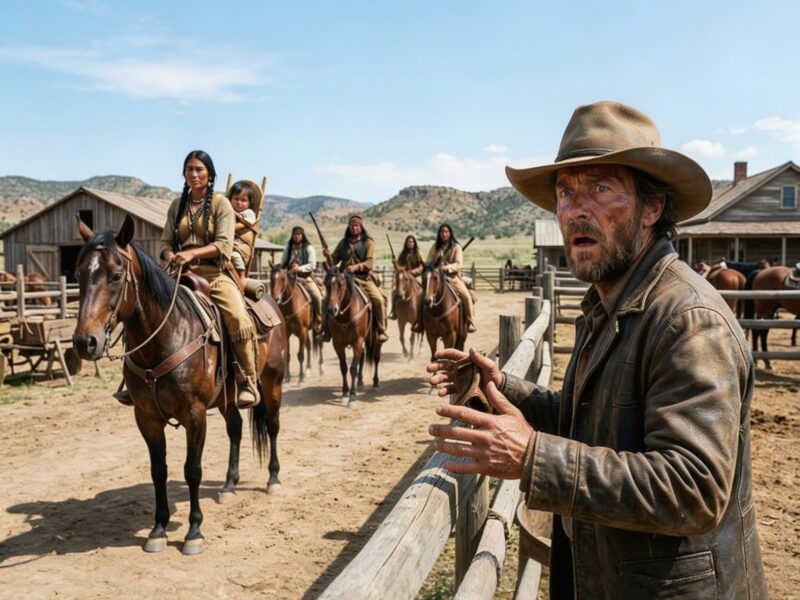
In the morning, riders came down from the eastern ridge.
Silas was setting a corral post when he heard them. Hooves, many of them, moving at a deliberate pace. Not fast. Not hidden. He straightened slowly, hammer in hand, and watched eleven riders descend into his valley.
Apache.
Men mostly, with two older women riding near the center. At their front rode an older man with long gray-streaked hair and a face carved by weather and command. Beside him rode Chuscal.
On Calla.
Silas set down the hammer.
The riders stopped outside his fence. Nobody reached for a weapon. Nobody smiled.
Chuscal looked different mounted among her own people. Still tired, but no longer alone. Her hair was braided now. A strip of red cloth bound one wrist. Her eyes found Silas, and something unreadable passed through them.
The older man spoke.
Chuscal translated. “He asks if you are Silas Cord.”
“I am.”
She spoke to the elder. He listened without taking his eyes off Silas.
“This is Hakon,” she said. “My mother’s brother. He leads us north.”
Silas nodded once. “Your boy?”
“Nalin lives.”
The breath Silas had not known he was holding left him.
Chuscal saw that too.
“He asks why you gave me your horse,” she said.
Silas looked at Hakon. “Because your boy needed her.”
Chuscal translated.
Hakon listened, expression still.
Then he spoke again, longer this time.
Chuscal’s mouth tightened slightly, as if the translation carried more weight than she wanted to give it. “He says a man who gives what keeps him alive is either a fool or a man whose heart has not rotted. He asks which you are.”
This time Silas did smile faintly. “Depends who you ask.”
Chuscal translated, and one of the younger riders made a sound like restrained amusement.
Hakon’s eyes changed by a degree. He gestured toward Calla.
Chuscal dismounted and led the mare to the gate.
“She is yours,” she said.
Silas opened the gate.
Calla stepped through and nudged his chest with her nose as if irritated by his absence. Silas laid a hand against her neck. On her head was a new halter, braided leather worked with beads in deep red, white, and blue. It was finer than anything he owned.
“You did not have to bring her back,” he said.
Chuscal’s expression sharpened. “Yes. We did.”
He looked at her then, really looked.
There was dignity in repayment. He understood that. To refuse its importance would insult what she had carried back across three days of distance.
So he said, “She looks better than when she left.”
Chuscal’s eyes lowered to the halter. “My aunt made it. She said your horse deserved something beautiful after carrying fear so far.”
“And you?”
Her gaze lifted.
The question had escaped him before caution could stop it.
Chuscal looked toward the riders, then back at Silas. “I am still carrying mine.”
Before he could answer, dust rose from the southern trail.
Two riders approached the gate. One was young Deputy Fitch, a nervous man with freckles and a badge too large for his confidence. The other was Reston Far.
Silas’s jaw tightened.
Reston owned the Far Spread to the south, a ranch fattened on water rights, intimidation, and the slow ruin of smaller neighbors. He was broad, clean-shaven, and pale-eyed, dressed better than any man needed to be on horseback. He had wanted Silas’s creek since the first summer drought. He had offered to buy the Cord place twice, insultingly low both times. Silas had refused without apology.
Reston reined in and surveyed the riders at Silas’s fence.
His mouth curved.
“Well,” he said. “That is a sight.”
Fitch swallowed. “Mr. Cord, we had word of Apache riders near your property.”
“You had word fast,” Silas said.
Reston’s smile did not change. “Men notice things when they concern safety.”
Hakon watched him with expressionless patience. Chuscal went very still.
Reston’s eyes lingered on her. “This the one you lent your horse to?”
Silas stepped slightly in front of her without thinking.
Chuscal noticed.
So did Reston.
“Careful,” Reston said softly. “A man ought to know who he’s standing with before he stands too close.”
Silas’s voice stayed quiet. “You’re on my land.”
“I am inquiring after a war party.”
“They came to return my horse.”
“Apache don’t ride eleven strong to return a horse.”
Chuscal spoke before Silas could. “Perhaps the men you know do not return what they take.”
Reston’s eyes flashed.
Fitch shifted uncomfortably.
Silas stepped closer to the gate. “They are leaving in peace. You can do the same.”
Reston stared at him for a long moment, then let his gaze move over the dry creek, the thin cattle, the weathered barn.
“You’re already hanging by a thread, Cord. Don’t tie that thread to the wrong people.”
Silas said nothing.
The silence hardened.
At last Reston turned his horse. “The county will hear about this.”
“I imagine you’ll tell it badly,” Silas said.
Reston’s smile vanished.
Then he and Fitch rode away.
Only when their dust faded did Hakon speak again. His eyes remained on the southern trail.
Chuscal translated quietly. “He says that man wants something of yours.”
“My water.”
“No.” Chuscal looked at him. “More than that now.”
Silas turned to her.
She stood beside Calla, one hand on the mare’s neck, the other pressed flat against her own ribs as if keeping something contained.
“I brought trouble back to your gate,” she said.
“Trouble knew the road already.”
“That does not make me blameless.”
“I didn’t ask for blame.”
Her eyes met his. “What do you ask for, Silas Cord?”
No one had asked him that in years.
He had forgotten how dangerous a simple question could be.
“Nothing,” he said.
Chuscal’s gaze held his a moment too long.
“That is not always strength,” she said.
Then she mounted with her people and rode north, leaving Silas at his gate with his horse returned, his life restored, and trouble moving toward him from the south like weather.
Part 2
By the end of the week, the story had changed shape three times.
In the first version, Silas Cord had received Apache riders on his land and traded with them in secret. In the second, he had guided them along settler trails. By the third, he had taken an Apache woman into his house and was hiding weapons in his barn for raids that existed only in the fearful minds of people who liked rumors better than truth.
Silas heard it all in town.
He had ridden Calla in for flour, nails, coffee, and salt, the beaded halter visible beneath her bridle because he had refused to take it off. It was beautiful, and it had been given honorably. He would not hide it to make cowards comfortable.
The mercantile went quiet when he entered.
Mrs. Voss, who usually complained about the heat while measuring coffee, would not meet his eyes. Two men near the stove stopped talking. Deputy Fitch stood near the counter, hat in hand, looking like a man who had slept badly.
Silas set his list down. “Morning.”
No one answered.
Mrs. Voss read the list, folded it, and pushed it back across the counter. “I’m sorry, Mr. Cord. Store credit’s closed.”
“I’ve never missed a payment.”
“That isn’t the issue.”
“What is?”
She looked toward the stove. One of the men looked away.
Silas understood.
He picked up the list and walked out without buying a thing.
Reston Far waited across the street with three of his hands.
Of course he did.
“Hard season to lose friends,” Reston called.
Silas tied the list into his coat pocket and mounted Calla.
Reston stepped into the street. “You could still sell. Before things get uglier.”
“Things are ugly now.”
“They don’t have to be for you.”
Silas looked down at him. “You burned my credit.”
“I told the truth as I understood it.”
“You wouldn’t recognize truth if it drank from your trough.”
Reston’s hands moved forward.
Silas stayed mounted.
The town watched.
Reston smiled because he had an audience and men like him grew braver when others could admire the performance.
“You’re choosing savages over your own kind.”
Silas leaned slightly in the saddle. “A sick child isn’t a kind. A mother trying to save him isn’t a threat. And a man who turns mercy into treason is lower than either of us has words for.”
Reston’s face flushed.
One of his hands reached for Silas’s bridle.
Calla pinned her ears and snapped at him. The man cursed and stumbled back. A few people laughed before fear swallowed the sound.
Silas rode out empty-handed.
That night, he ate the last of the beans with no salt and told himself hunger was simpler than surrender.
Two days later, he found three of his cattle dead near the south boundary.
Not taken by wolves. Shot.
He crouched beside the nearest carcass and pressed his fingers into the dry dirt near the hoof marks. Three riders. Shod horses. Far Spread shoes had a distinctive bar across the heel because Reston liked his men equipped in matching tack, as if cruelty looked better uniformed.
Silas buried what he could and burned what he had to.
At dusk, he sat on the porch with his rifle across his knees and listened to coyotes call beyond the ridge.
Near midnight, Calla lifted her head.
Silas stood.
A figure moved at the edge of the yard.
He raised the rifle. “That’s close enough.”
“It is me.”
Chuscal stepped into moonlight with Nalin asleep against her back, tied there with a woven cloth. A cut marked her cheek. Dust clung to her dress. One sleeve was torn at the shoulder. She held a knife low in her right hand, not threatening, not hidden.
Silas lowered the rifle slowly.
“What happened?”
“Men followed us from the south wash. Not soldiers. Ranch men.” Her voice was controlled, but he heard the strain beneath it. “They fired over our heads. Hakon took the others east to draw them away. Nalin was frightened. I circled back.”
“To me?”
The words came rougher than he intended.
Chuscal looked at his rifle, his empty yard, the dark cabin behind him. “You stood in front of Reston Far when he looked at me like I was already guilty. That made you either safe or foolish.”
“Which one?”
“I have not decided.”
Nalin stirred and whimpered.
Silas stepped aside. “Bring him in.”
Chuscal did not move. “If I enter your house, the stories become worse.”
“They’re already lying.”
“Lies can still kill.”
“So can fever. So can men in the dark.” His voice lowered. “Bring him in.”
She came.
Inside, the cabin seemed too small for the three of them. Silas lit the lamp while Chuscal untied Nalin and laid him on the narrow bed. The boy blinked awake, eyes huge and dark, then clutched at his mother’s sleeve.
Silas set water on the table and found the last heel of bread wrapped in cloth.
Chuscal saw it. “No.”
“Yes.”
“You have little.”
“I have enough for tonight.”
“You always answer only the part you choose.”
“That’s because the other parts argue back.”
For the first time since arriving, her mouth softened.
It was not quite a smile, but Silas felt it like sunlight through a boarded window.
Nalin drank, then ate in tiny bites. He watched Silas with solemn suspicion.
“My mother says you gave Calla,” he said.
His English was accented but clear.
“I lent her,” Silas said.
Nalin frowned. “She says gave.”
Silas glanced at Chuscal.
She did not look away.
“I suppose mothers know better,” he said.
Nalin considered this and nodded, satisfied.
Chuscal washed the cut on her cheek at the basin. Silas pretended not to watch the careful way she worked, the way she refused to wince though the cloth came away bloody.
“You need stitches,” he said.
“I need quiet.”
“That too.”
He stepped closer, holding a cleaner strip of linen.
She eyed him. “Have you stitched skin before?”
“Mine.”
“That does not comfort me.”
“It shouldn’t.”
This time she did smile, brief and unwilling.
He cleaned the cut with whiskey. Her fingers gripped the edge of the table, but she did not flinch. Silas stood close enough to feel the warmth of her shoulder, close enough to see the pulse beating at the base of her throat.
He had been lonely so long that he had mistaken loneliness for discipline.
Now, with Chuscal standing in his cabin and her son asleep in his bed, the room felt full in a way that hurt.
“Why are you looking at me like that?” she asked.
Silas stilled.
“Like what?”
“Like you remember something.”
He lowered the cloth. “I had a wife once.”
Chuscal’s face changed, not with surprise, but respect. “She died?”
“Fever.”
“I had a husband once,” she said. “He died with a bullet in him because men wanted his horse and blanket.”
Silas closed his eyes briefly.
When he opened them, she was watching him.
“There are many kinds of fever,” she said. “Some burn in the blood. Some in men’s minds.”
He tied the bandage carefully. “Reston has both.”
Her gaze dropped to his hands. “You are gentle for a man who looks made of fence wire.”
The words struck him harder than flirtation would have.
Silas stepped back.
“I’m not always gentle.”
“I know.”
The way she said it held no fear.
That frightened him more.
For three days, Chuscal and Nalin remained hidden at the Cord ranch.
Hidden was a poor word for it. Silas did not lock them away or treat them as shame. But he kept the lamps low at night and watched the ridges at dawn. Chuscal helped without asking permission. She mended his torn shirts, dug weeds from the garden, reset snares, and showed him how to find moisture beneath stones where he had seen only dry earth. Nalin followed Calla everywhere and solemnly informed Silas that his corral gate leaned because he had set the post wrong.
“He is five,” Silas told Chuscal.
“He has eyes.”
Together, they fixed the post.
At night, when Nalin slept, Silas and Chuscal sat on the porch. They spoke quietly, not because they were afraid of waking the boy, but because some things demanded lower voices.
She told him her people had traveled through that valley long before fences. Not claiming it as men in land offices claimed, with ink and seals, but knowing it by water, by stone, by season. He told her he had come there because the land had looked empty enough to hold his silence.
“It was not empty,” she said.
“No,” he admitted. “I know that now.”
She looked at him sharply, as if expecting defensiveness.
He gave her none.
The next morning, Deputy Fitch arrived alone.
Silas met him at the gate.
Fitch looked pale and miserable. “I have to ask if you’re harboring the woman.”
Silas rested one hand on the fence rail. “You have to?”
“Reston says—”
“Reston says many things.”
“He says if you’re aiding hostile Indians, the county can seize your stock and hold you pending military review.”
“I have no hostile Indians here.”
Fitch’s gaze flicked toward the cabin.
Silas stepped closer, voice low. “Listen carefully. There is a woman in that house with a child who was chased by men from Far Spread. If you came to protect them, come in. If you came to drag them out, turn around before you become a worse man than you woke up.”
Fitch swallowed.
Inside the cabin, a floorboard creaked.
Silas knew Chuscal stood behind the door with her knife in hand.
Fitch removed his hat. “Reston is calling a council meeting tomorrow. Says people deserve answers.”
“Then they’ll get them.”
“Cord, don’t bring her.”
Silas’s eyes narrowed. “Why?”
“Because angry people don’t always stay people.”
Fitch left without searching the house.
That night, Chuscal packed.
Silas found her rolling the blanket around Nalin’s few things.
“You’re leaving.”
“Yes.”
“No.”
Her hands stopped.
He had never spoken to her like that before.
She turned slowly. “No?”
“They want you frightened and running. That makes their story easy.”
“They want me visible and surrounded. That makes their violence easy.”
He could not argue with that.
So he said the thing under it. “I don’t want you out there alone.”
Chuscal’s expression shifted.
For a moment, all the guarded strength in her face became something more vulnerable and more dangerous.
“I have been alone many times,” she said.
“I know.”
“Do you?”
“Yes.” His voice roughened. “That’s why I hate it.”
The cabin went still.
Nalin slept near the hearth, one hand curled beneath his cheek.
Chuscal looked toward him, then back to Silas.
“If I stay, you lose more.”
“I’ve lost enough to know what matters.”
“That sounds brave.”
“It isn’t.”
“No?”
“No.” Silas stepped closer. “It scares the hell out of me.”
Her breath changed.
Outside, wind moved dust against the walls. Inside, the space between them filled with everything neither had allowed themselves to name: hunger, grief, danger, tenderness, the terrible relief of being seen after years of expecting no one to look closely.
Chuscal lifted her hand and touched the place where his shirt opened at the throat.
Not seduction.
A question.
Silas went still beneath her fingers.
“You carry your dead wife like a wound you must keep open,” she said.
His jaw tightened. “And you carry your dead husband like a blade.”
“Yes.”
Her fingers moved once against his skin.
“Maybe both things can be put down,” she whispered. “Not forgotten. Put down.”
Silas wanted to touch her so badly he closed one hand around the back of a chair to keep from doing it too fast.
“You should not trust me,” he said.
“I did not say I trusted you.”
A faint smile touched her mouth.
“I said I came back.”
He bent his head slowly, giving her time to step away.
She did not.
Their first kiss was not soft. It was careful for half a breath, then aching, then desperate in a way neither of them expected and both understood. Chuscal’s hand tightened in his shirt. Silas cupped the back of her head with a restraint that shook through his whole body. He kissed her like a man afraid that wanting might become theft if he did not keep his soul awake inside it.
She pulled back first, breathing unevenly.
His hand dropped immediately.
“I’m sorry,” he said.
Her eyes flashed. “Do not apologize for what I chose.”
That silenced him.
She looked shaken too, but not regretful.
“We go to the council tomorrow,” she said.
He stared at her.
“We?”
“Yes. If they want a story, they can hear mine from my mouth.”
The council room above the livery was packed before noon.
Silas entered first with Chuscal beside him and Nalin between them, holding his mother’s hand. The room changed when people saw her. Men leaned forward. Women stiffened. Reston stood near the front with his thumbs hooked in his vest, satisfied as a preacher before a hanging.
Silas felt every eye.
Chuscal walked like she felt none of them.
Abernathy, the oldest man in town and the only one Reston had never managed to buy, called the room to order.
Reston spoke first.
He painted fear with an artist’s care. Apache riders on white land. Secret visits. A rancher hiding a woman. Cattle shot near boundaries. Danger growing while good people slept.
When he finished, the room hummed with nervous agreement.
Abernathy looked at Silas. “Your answer?”
Silas stood. “I gave my last horse to a mother with a fevered child. Her people returned it. Reston Far saw a chance to take my land by making decency sound like treason.”
Reston laughed. “Pretty speech.”
“I’m not finished.”
Silas looked around the room.
“Three of my cattle were shot with Far Spread horses standing near them. Store credit was cut after Reston spoke to Mrs. Voss. Chuscal and her son were chased by ranch hands from the south wash. If this town wants danger, it is not hard to find. It’s standing here in a clean vest telling you to be afraid.”
Reston’s face darkened.
Then Chuscal stepped forward.
The room went silent in a different way.
“I am not a rumor,” she said.
Her English was clear, deliberate, and cold enough to cut.
“My son had fever. Silas Cord gave his horse. My people returned it because we are not thieves. Men followed me later. They fired at my child. I came to the only house where a man had already seen us as human.”
A woman near the back lowered her eyes.
Reston sneered. “And we’re to believe every word?”
Chuscal turned to him. “You do not believe truth. You believe usefulness.”
The room stirred.
Reston stepped forward. “This woman has no standing here.”
Silas moved before thought.
He placed himself between Reston and Chuscal, close enough that Reston had to stop or collide with him.
“She has standing beside me,” Silas said.
The room froze.
Reston’s smile returned, ugly and triumphant. “Beside you? Is that what this is?”
The implication rolled through the room.
Chuscal’s face did not change, but Silas felt the blow land.
Reston looked at the crowd. “There it is, then. Not charity. Not honor. A man giving away his horse to buy himself an Indian woman.”
Silas hit him.
The punch cracked loud enough to silence the room completely. Reston slammed into a chair and went down hard. Men shouted. Fitch grabbed Silas’s arm. Chuscal caught Nalin against her skirts.
Reston rose with blood at his mouth and murder in his eyes.
“You just ruined yourself,” he said.
Silas flexed his bleeding hand. “No. I did that when I let you talk too long.”
Abernathy slammed his cane against the floor. “Enough!”
But enough had passed.
By sundown, Reston’s men had blocked the road south. By midnight, Silas’s barn was burning.
Part 3
The flames were taller than the house when Silas dragged the last mule from the smoke.
Calla screamed inside the corral, fighting the gate. Chuscal ran through sparks with her shawl over her head and threw the latch before Silas could reach it. The mare burst free, eyes rolling, and Silas caught the lead rope as she reared.
“Nalin!” Chuscal shouted.
The boy stood near the porch, coughing, clutching the beaded halter he had pulled from its peg before fleeing the cabin. Embers spun around him like fireflies from hell.
Silas shoved Calla’s rope into Chuscal’s hand and ran for the barn.
“Silas!”
He did not stop.
The hayloft was gone. The roof beams cracked overhead. Smoke punched into his lungs. He found the strongbox under a collapsed workbench by feel more than sight—the deed to the ranch, his few papers, Elise’s old photograph, everything that proved his life had existed before this night.
A beam came down behind him.
Heat struck his back.
He staggered out through the side door just as the roof folded inward with a roar.
Chuscal reached him first.
She caught his face in her hands. “You fool.”
His eyebrows were singed. His coat smoked. He coughed hard enough to bend in half.
“You saved the halter,” he rasped.
“Nalin saved the halter. I am trying to save the man.”
He looked past her at the barn collapsing into itself.
The fire painted her face gold and savage with fear.
Then shots cracked from the dark.
Silas shoved her down.
A bullet tore through the porch post.
Nalin screamed.
Three riders moved beyond the burning barn, silhouettes against flame. Far Spread men. One carried a torch. Another lifted a rifle.
Chuscal rolled to her knees and threw Silas’s spare pistol into his hand.
He did not ask how she had found it.
He fired twice.
One rider fell from the saddle. The others scattered.
From the ridge came an answering cry—not from Reston’s men.
Apache riders poured down like shadows released from stone.
Hakon had come.
So had half a dozen others, moving fast and silent except for the thunder of hooves. Reston’s men turned south, suddenly less brave without darkness to hide inside. Hakon’s riders drove them toward the dry wash and vanished after them.
The ranch yard settled into smoke, coughing, and the groan of dying timber.
Silas sat in the dirt because standing had become too complicated.
Chuscal knelt before him, hands moving over his chest, shoulders, arms.
“I’m not shot,” he said.
“I will decide that.”
Despite the smoke and fear, he almost laughed.
Nalin crawled into his lap without asking permission and buried his face against Silas’s shirt. Silas froze, then wrapped one arm around him.
Chuscal saw it.
Something in her face broke open.
Not weakness.
Love, perhaps, before either of them was ready for the word.
Hakon returned near dawn with two captured Far Spread men and one of Reston’s horses bearing a saddlebag full of oil rags and matches. Reston himself had escaped. Of course he had. Men like him rarely stayed close enough to their own violence to be burned by it.
Deputy Fitch arrived after sunrise with six townsmen who looked ashamed of their delay.
Abernathy came in a wagon, jaw tight.
He surveyed the blackened barn, the wounded rider tied near the trough, the burned ground, Chuscal standing beside Silas with a rifle in her hands, and Hakon’s riders waiting beyond the fence.
Then Abernathy removed his hat.
“This has gone far enough,” he said.
Silas’s voice was rough from smoke. “It went far enough when a child was shot at.”
Fitch looked at the dirt.
One of the captured men broke before noon.
Reston had paid them to burn the barn and leave signs that would be blamed on Apache riders. The plan had been simple. Fire. Panic. Retaliation. Soldiers called in. Hakon’s people blamed. Silas arrested or ruined. The Cord place left vulnerable enough that debt would finish what fire started.
By afternoon, Fitch had a warrant.
By evening, Reston Far had Chuscal.
He took her on the south road while Silas was in town giving his statement. She had ridden out alone to gather the few things hidden near the wash where she and Nalin had sheltered before coming to the ranch. She did not tell Silas because she knew he would insist on going, and because part of her still believed needing protection too openly invited the world to take more.
Reston’s men found her at the cottonwoods.
They left Nalin’s red wrist cloth tied to a branch and sent a message nailed to Silas’s gate.
Sell me the water rights and she walks back.
Silas read it once.
The world went very quiet.
Nalin stood beside him, face gray with terror. Hakon took the boy gently by the shoulders, but Nalin’s eyes stayed on Silas.
“You will bring my mother?” he asked.
Silas folded the paper slowly.
“Yes.”
Hakon spoke in Apache. His face held fury like banked coal.
Chuscal’s aunt translated. “He says Reston wants you to come angry. Angry men ride into traps.”
Silas looked toward the southern ridge.
“I know.”
“You are angry,” she said.
“Yes.”
“Then what will you do?”
Silas turned back, and everyone in the yard saw the change in him.
The rage was there. Any fool could see that. But it had gone cold, clear, and disciplined. The rage of a man who had learned at last that love did not make him weaker. It gave him something precise to defend.
“I’ll go careful,” he said.
Reston held Chuscal in an abandoned line shack at the edge of Far Spread land, where the creek forked through cottonwoods before entering Silas’s valley. He had tied her hands, but not well enough. That was his first mistake. His second was assuming fear would make her smaller.
Chuscal sat on the dirt floor with blood at the corner of her mouth and watched Reston pace.
“You could have had his land without this,” she said.
Reston turned. “I could have had his land two years ago if he’d known his place.”
“His place?”
“Men like Cord cling to failure and call it honor.”
“And men like you steal and call it order.”
Reston crouched before her.
“You think he loves you?”
The word struck, but she did not let him see where.
Reston smiled. “He may want you. Men want strange things when they’ve been alone too long. But love? Love is what respectable people get to name their appetites when nobody laughs.”
Chuscal’s bound hands tightened.
“My husband loved me,” she said. “My son loves me. My people love me. Silas Cord gave me his last horse when he knew nothing of me but my need. Do not speak of love as if you have stood near it.”
Reston’s smile vanished.
He struck her.
She tasted blood and smiled anyway.
That unsettled him more than tears would have.
Outside, one of his men called, “Rider coming!”
Reston stood. “Only one?”
“One.”
Reston laughed softly. “There’s your honorable fool.”
Silas rode into the clearing alone on Calla, hands visible, rifle left behind across the saddle in plain view. He stopped twenty yards from the shack.
Reston came out with a pistol in one hand and Chuscal dragged in front of him with the other.
Silas’s face changed when he saw the blood on her mouth.
Only Chuscal, who knew his stillness now, understood how much violence he was holding back.
“You brought the deed?” Reston called.
Silas reached into his coat and held up folded papers.
“Water rights too?”
“Yes.”
Chuscal’s eyes flashed.
No, they said.
Silas looked at her.
For one brief moment, the whole world narrowed to the distance between them. Smoke still lived in his lungs. Grief still lived in his bones. Elise’s ghost, his ruined store, his empty years, every loss that had taught him to need little—they all stood behind him.
And Chuscal stood before him, living, furious, afraid, beloved.
Land mattered.
Water mattered.
But not more than her breathing.
Reston saw something in Silas’s face and smiled. “Throw them down.”
Silas did.
The papers landed in the dust.
Reston shoved Chuscal toward one of his men and stepped forward to pick them up.
That was when Hakon’s riders rose from the creek bed behind the cottonwoods.
Fitch and Abernathy’s men came from the southern wash.
Silas had come alone only in the part Reston could see.
Reston froze.
Chuscal drove her heel into the foot of the man holding her, twisted hard, and brought her bound hands up under his chin. He went down choking. She ran toward Silas as shots erupted around the clearing.
Reston fired.
Silas felt the bullet pass his arm like hot wind. He drew and shot Reston’s pistol hand before the man could fire again. Reston screamed, dropped the gun, and lunged for the papers.
Chuscal reached Silas.
He caught her with one arm and turned his body between her and the fight.
“I told you not to sell,” she said, breathless.
“I didn’t.”
“What did you throw?”
He looked down at her, eyes fierce. “Old feed receipts.”
Despite the blood and gunfire, she laughed.
Reston tried to crawl toward the trees. Hakon stopped him with a rifle pointed at his chest.
Fitch arrested him with shaking hands.
No one argued.
The trial in town took place three days later, though trial was a generous word for a room full of evidence and a town full of people trying to pretend they had not nearly let fear make murder respectable.
Reston’s men testified. Fitch produced the oil rags. Abernathy read the threats aloud. Silas stood with a bandage around his burned arm. Chuscal stood beside him, bruised but unbowed, Nalin pressed against her skirt.
Reston Far was removed in irons before sunset.
No one cheered.
The town had lost the right to easy satisfaction.
Mrs. Voss reopened Silas’s credit with trembling apologies. He paid cash for flour and salt anyway, using money Abernathy insisted was not charity but payment for testimony and damages until a proper judgment came through.
Restitution would come later. Repairs would take longer. Trust, if it came at all, would come slowest.
Hakon’s people prepared to move north the next morning.
That night, Silas found Chuscal by the creek.
Water moved thinly over stone, catching moonlight in broken pieces. She stood with her arms wrapped around herself, looking toward the ridge.
“Nalin is asleep,” he said.
“He trusts your house now.”
“It barely has a roof on one side.”
“He trusts you.”
Silas came to stand beside her.
For a long while, neither spoke.
Then Chuscal said, “We leave at sunrise.”
The words struck like a fist he had expected and still could not brace against.
“I know.”
“My people need to move before soldiers hear a twisted version of what happened. Even truth travels slower than fear.”
Silas nodded.
The creek whispered between stones.
Chuscal turned to him. “Ask me to stay.”
His head lifted.
Her eyes shone in the dark, but her voice stayed steady.
“I will not promise I can,” she said. “I will not promise my life can become this cabin, this fence, this valley only because your heart has opened. I belong to people who carried me when I broke. My son belongs to them too. But I need to hear whether you are brave enough to ask for what you want.”
Silas closed his eyes.
All his life, he had survived by not asking.
Want had been unsafe. Need had been a debt men could exploit. Love had been a house fever could empty overnight.
But Chuscal was standing in front of him, asking him not for land, not for shelter, not for rescue.
For truth.
He opened his eyes.
“Stay,” he said.
The word was rough and bare.
Her breath caught.
“Stay if you can. Come back if you can’t. Let me ride north with you for a while if that’s what’s needed. Let me build a place where you and Nalin can come without asking. Let me learn the shape of a life that has room for more than my own silence.”
Chuscal covered her mouth with one hand.
Silas stepped closer but did not touch her.
“I love you,” he said. “I don’t say it to bind you. I say it because it is true, and I am tired of living as if truth should be hidden when it costs me.”
Her tears came silently.
She looked angry about them.
He loved that too.
“You are a difficult man,” she whispered.
“Yes.”
“Stubborn.”
“Yes.”
“Too willing to walk into fire.”
“I’m working on that.”
She laughed through the tears, then gripped his shirt and pulled him down to her.
This kiss was different from the first. The first had been a door opening in a storm. This was the storm itself breaking over them. She kissed him with grief, hunger, fury, and relief. He held her as if holding was prayer, his hands firm at her back, not trapping, only there.
When she rested her forehead against his chest, he bent his face into her hair.
“I cannot stay tomorrow,” she said.
His arms tightened once, then eased.
“I know.”
“But when we come back through this valley, I will stop at your gate.”
Silas closed his eyes.
“And if winter turns harsh,” she continued, “I may bring Nalin before then.”
“I’ll have the roof fixed.”
“And food?”
“I’ll manage.”
She drew back and looked at him.
“No,” she said. “You will not manage alone. Not anymore.”
Spring came late.
The barn rose again with help from men who had once looked away and now arrived awkwardly with lumber, nails, and shame. Silas accepted the lumber. He accepted the labor. Like Chuscal, he accepted no false innocence.
He rebuilt the barn stronger, with a place on the wall for the beaded halter. Nalin’s red wrist cloth hung beside it.
The creek returned with the first real rains.
By summer, grass softened the valley. Silas bought two calves, then four more. Reston’s trial ended with prison and the forced sale of part of Far Spread land. Abernathy made certain Silas’s water rights were recorded in three separate offices, “because paper,” the old man said, “is only useful when honest men make copies.”
Silas kept watch on the northern ridge more often than he admitted.
In late August, riders appeared.
Hakon came first.
Then the older women.
Then Chuscal, with Nalin riding before her on a gray pony too patient for any child’s dignity.
Silas walked to the gate and opened it.
Nalin slid down and ran to him without asking whether he was allowed. Silas caught the boy, surprised by the force of his small body, and lifted him clean off the ground.
“You fixed the roof,” Nalin said.
“I was told to.”
“My mother says you listen only when you are bleeding or in love.”
Behind him, Chuscal made a sharp sound.
Silas looked over Nalin’s head at her.
She sat her horse in the morning light, braid over one shoulder, eyes bright with amusement and something deeper. She looked road-worn, proud, alive. The sight of her entered him like water entering dry earth.
“She’s right,” he said.
Nalin nodded solemnly, as if this confirmed a theory.
Hakon’s people stayed three days.
No one in town interfered.
On the second evening, Chuscal walked with Silas to the east pasture where Calla grazed beneath the juniper. The mare lifted her head, then went back to cropping grass, unimpressed by human longing.
Chuscal touched the beaded halter in Silas’s hand.
“You kept it safe.”
“It kept me safe.”
“How?”
He looked at the valley, green now where it had been nearly dead.
“It reminded me who I wanted to be when fear gave me easier choices.”
Chuscal was quiet.
Then she said, “Hakon says Nalin and I may stay through winter if we choose. Some of the others will camp north of the ridge and move when the season turns.”
Silas’s heart began to beat harder.
“And what do you choose?” he asked.
Chuscal looked toward the cabin, the barn, the creek, the fence that did not erase the water, the land that had become a meeting place instead of a wall.
Then she looked at him.
“I choose not to be alone where I do not have to be.”
Silas reached for her hand.
She gave it.
Their fingers locked with the solemnity of vows neither needed a preacher to bless.
“I have little,” he said.
“You have a horse you once gave away.”
“And got back.”
“You have land that nearly burned.”
“And came back.”
“You have a heart that tried very hard to die before I found it.”
Silas swallowed.
Chuscal stepped closer.
“I have a son who knows your name,” she said. “A people who will not vanish because others wish not to see us. A grief I still carry. A temper you should respect. And love for you, Silas Cord, which frightens me because it asks me to believe the world can give without taking everything back.”
He touched her face with work-rough fingers.
“We’ll be frightened together, then.”
She smiled.
It was full this time.
Not brief. Not guarded.
Full.
Behind them, the sun lowered over the high desert, turning the creek gold. Nalin’s laughter carried from the yard, where he was ordering Calla away from his gray pony’s feed bucket. Hakon sat near the porch with Abernathy, both old men pretending not to approve of each other. Smoke rose from the cabin chimney. The rebuilt barn stood square against the ridge.
Silas bent and kissed Chuscal in the open, where anyone could have seen.
There was no shame in it now.
There had been fire, lies, blood, hunger, and fear. There had been a last horse given away on a desperate morning. There had been three days of silence, riders at the gate, and a reckoning that burned nearly everything false out of the valley.
What remained was not simple.
Love never was.
It was a woman who had crossed desert with a fevered child and still stood straight before men who wanted her erased. It was a man who had lost enough to believe needing nothing was wisdom until she showed him that the heart could be defended like land, like water, like a gate opened freely.
That winter, snow came thin but real.
Nalin slept in the cabin loft under blankets Chuscal’s aunt had woven. Chuscal kept herbs hanging from the rafters and laughed whenever Silas burned bread, which was often enough to become a household joke. Some nights she woke from dreams and reached for the knife beneath her pillow. Some nights he woke reaching for ghosts.
They learned each other slowly.
Not gently always.
But honestly.
In spring, when Hakon’s people returned, Chuscal and Nalin rode north with them for a month. Silas did not ask her not to go. She came back before the cottonwoods leafed fully green, and he met her at the ridge because waiting at the gate had become impossible.
Years later, people would still tell the story of Silas Cord giving his last horse to an Apache mother on a desert trail.
Most told it badly.
They made it cleaner than it was. Easier. They liked the part where generosity returned with a beaded halter. They forgot the hunger, the rumors, the burned barn, the gunfire, the woman with blood on her mouth telling a rich man he had never stood near love.
But Silas never forgot.
Neither did Chuscal.
The halter hung in the barn until the leather cracked with age. Calla lived long enough to carry Nalin as a lanky boy and later a serious young man. When the mare died, they buried her under the juniper near the east pasture, where the creek could be heard after rain.
On the day they covered the grave, Chuscal stood beside Silas and took his hand.
“She brought me to you,” she said.
Silas looked at the red earth, the tree, the woman beside him, the son watching quietly at the fence, the valley that had held every cost and every return.
“No,” he said. “You came. She only carried you.”
Chuscal leaned against his shoulder.
The wind moved softly through the juniper branches.
And Silas Cord, who had once believed a man survived by needing almost nothing, held the woman he loved and understood at last that some choices did not leave a man poorer.
Some choices opened the gate.
Some choices brought the whole world riding back.