Whatever Mined the Canyons Left the Debris in Piles — We Walk on It and Call It Desert
Part 1
The first body surfaced after the windstorm.
It came out of the desert north of Tuba City in pieces, not because animals had gotten to it, though they had, and not because the sun had cooked it down to leather and bone, though it had done that too. It came up in layers, the way old things came up in that part of Arizona: a scrap of denim first, then a wristwatch filled with grit, then the white curve of a jawbone grinning from beneath a skin of red sand.
Deputy Wade Kessler found it because his left front tire blew on Highway 89 just after dawn.
The storm had moved through overnight, a hard spring wind that came shrieking off the high desert and threw sand across the road in sheets thick enough to erase the yellow lines. By morning, the world looked newly made and badly unfinished. Dunes had shifted. Fence posts leaned. The sky was a raw, pale blue, and the desert stretched away in every direction, flat and red and glittering with crushed stone.
Kessler was kneeling by his cruiser, swearing at the spare, when something winked at him from a low wash twenty yards off the shoulder.
At first he thought it was bottle glass.
Then he saw the watch.
Then the hand.
By noon, the county had taped off the wash with yellow plastic that snapped and cracked in the wind. By one-thirty, Dr. Lena Calder arrived in a white BLM truck with a cracked windshield, two field cases, and a headache that had started three days earlier behind her right eye and had not let go.
She was not supposed to be there.
Technically, Lena was a geomorphologist attached to a federal land survey project, not a forensic anthropologist, not law enforcement, not anyone who should be asked to stare at a sun-bleached corpse half-emerged from a dune. But the body had been found on federal land near an active geological assessment zone, and when land started giving up bones in the desert, everyone called whoever knew the dirt best.
Deputy Kessler met her at the tape line.
He was big, sunburned, and young enough to still look offended by death.
“Dr. Calder?”
“Lena is fine.”
He looked relieved by the permission, then immediately uncomfortable with using it. “The sheriff’s on his way. Medical examiner too, but Flagstaff’s backed up. I figured since you were nearby…”
“You figured I could tell you whether the desert moved him.”
Kessler glanced toward the wash. “Can you?”
Lena put on nitrile gloves and crouched near the exposed remains.
The body lay partly embedded in a mound of pale gravel and red dust that did not match the surrounding soil. The wash itself was shallow, maybe eighteen inches deep, with wind-scoured edges and a bed of angular fragments ranging from sand to thumb-sized chips of sandstone, limestone, and dark volcanic rock. The mixture bothered her immediately.
The desert was never random if you knew how to read it.
This was too mixed.
Too crushed.
Too sorted and unsorted at the same time.
She brushed loose grains from the wristwatch. The band was cracked black rubber. The face had stopped at 3:17. A cheap digital model, maybe fifteen years old. Not archaeological. Not ancient. Recent enough to be someone’s father, brother, son.
“Any ID?” she asked.
Kessler shook his head. “Not yet. We found part of a wallet, but it’s empty. No cards. No cash. Nothing.”
“Clothing?”
“Jeans. Hiking boots. A belt buckle. Some kind of canvas jacket. There’s a pack under the sand, but we didn’t pull it.”
“Good.”
Lena moved closer to the skull. The mandible had separated but remained near the cranium. Teeth intact. No obvious gunshot trauma. The right side of the skull was still buried.
She looked at the surrounding mound again.
“How deep was he before the storm?”
Kessler frowned. “Hard to say.”
“Guess.”
“Maybe two, three feet?”
Lena stood and turned slowly, scanning the desert.
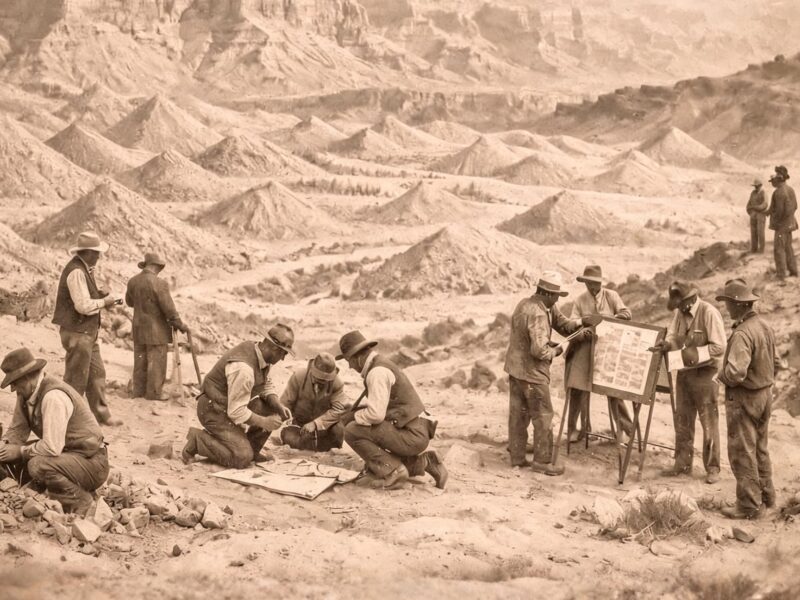
Northwest, beyond a stretch of sagebrush and broken fence, rose the distant silhouettes of mesas, their flat tops purple in the heat shimmer. East, the land fell toward a wide basin littered with pale piles that most people saw as dunes or low hills. Lena had spent the last six months mapping those piles. She knew their shape too well.
Tailings.
She hated the word because it belonged to mines, not deserts. It implied intent. Extraction. Machinery. Waste left behind after something valuable had been removed.
But the piles looked like tailings.
That had been the problem from the beginning.
Kessler followed her gaze. “You seeing something?”
“I don’t know yet.”
“That sounds bad.”
“It usually is.”
Her phone buzzed in her pocket. No signal showed on the screen, but a voicemail notification appeared anyway. Unknown number. No timestamp. She stared at it until the screen went dark.
Kessler said, “Everything okay?”
Lena looked back at the body.
“Do you have missing persons in the area?”
He exhaled. “How much time you got?”
“Recent. Hikers. Survey crews. Documentary people. Anyone tied to the canyon study.”
His expression changed.
“What?” Lena asked.
“There was a man last month,” he said. “Name was Eric Voss. Came through asking questions about old mines that weren’t on maps. Said he was making some internet thing. Sheriff told him not to go poking around washes after dark.”
“And?”
“And his truck was found outside Cameron. Keys still in it. Camera gone. No sign of him.”
Lena’s headache sharpened.
Eric Voss.
She knew that name.
Not well. Enough.
He had emailed her three times, each message more breathless than the last. He wanted comment on “non-natural debris distribution across the Colorado Plateau.” He attached blurry drone images, screenshots from old maps, and a spreadsheet comparing canyon volumes to sediment deposits downstream. Lena had replied once, politely, saying his conclusions were unsupported. He replied within minutes.
Then explain the piles.
She hadn’t.
Not because she believed him.
Because she couldn’t explain them either.
Kessler’s radio hissed. He stepped away to answer.
Lena crouched beside the pack still half-buried beneath the body. Its canvas was sun-faded green. One strap protruded from the sand like a root. She did not touch it, but the wind lifted a corner of fabric near the zipper, exposing something inside.
A notebook.
The cover was stained with rust-colored mud. On it, in black marker, someone had written:
THE DESERT IS NOT THE WASTE.
Below that, in smaller letters:
WE ARE.
The wind moved across the wash.
The exposed jawbone shifted slightly, teeth clicking together once.
Lena froze.
“Kessler.”
The deputy turned. “Yeah?”
“Did you move the head?”
His face went pale. “No.”
The jaw clicked again.
Not from wind.
From below the sand came a low vibration, almost too deep to hear. Lena felt it first through the soles of her boots. A mechanical hum. Slow. Buried. Vast.
The gravel mound trembled.
All around the body, angular stones began to settle downward as if something beneath them had opened its mouth.
Kessler ran toward her. “Back up!”
Lena stumbled away just as the wash collapsed.
The body dropped six inches, then a foot. Sand poured inward, funneling around the bones. The pack vanished. The skull tilted toward her, empty sockets filling with red dust.
For one sick second, Lena had the impossible impression that the dead man was being pulled back under.
Then the ground stopped moving.
The hum faded.
Silence returned to the desert.
Kessler stood beside her, breathing hard, one hand on his holster.
“What the hell was that?”
Lena stared at the new depression in the wash. Beneath the loose sand, something dark showed through. Not bedrock. Not soil.
Metal.
A flat black plate, scored with parallel grooves, lay under the desert floor.
Lena’s mouth went dry.
The grooves were too straight.
Too evenly spaced.
She knelt despite Kessler’s warning and brushed away sand with her fingertips.
The plate continued under the body, under the wash, under the desert.
On its surface, half-hidden by corrosion, were stamped letters in a script she did not recognize.
And beneath those letters, in English, four words had been carved by hand.
NOT LEFT BY NATURE.
Part 2
Three days before the body surfaced, Lena had been standing on the South Rim of the Grand Canyon, trying not to think about her father.
That was difficult in a place that had killed him.
The tourists around her leaned over railings and took photographs. Children complained about the heat. A German couple argued over a map. Somewhere behind her, a tour guide spoke in a bright practiced voice about erosion, uplift, the Colorado River, and time so enormous it made human grief seem rude for existing.
Lena kept her eyes on the canyon.
It did not look carved.
She had never said that out loud.
Not in graduate school. Not in papers. Not at conferences where men with endowed chairs described erosional processes while tapping laser pointers against cross-sections. Certainly not after her father, Dr. Paul Calder, had built the last decade of his career around a theory everyone privately called beautiful nonsense.
The canyon did not look carved by tools either. That was where the conspiracy people went wrong. They saw a vertical wall and imagined blades. They saw flat desert and imagined a mining floor. They picked up angular sand and forgot that rock fractured in deserts all the time.
But still.
The Grand Canyon looked like an injury.
It looked as if the Earth had once been opened for a reason and never properly closed.
Lena’s field assistant, Mateo Rivas, stood beside her with a tablet tucked under one arm and a gas station burrito in his hand.
“You’re doing the face again,” he said.
“What face?”
“The ‘I’m about to disprove a dead man or become him’ face.”
Lena glanced at him. “That’s a lot for one face.”
“You’re expressive in very specific professional ways.”
Mateo was twenty-seven, brilliant, underpaid, and allergic to solemnity. He wore mirrored sunglasses, a sun hoodie, and a silver crucifix his grandmother had given him when he took the job. At first Lena assumed the crucifix was sentimental. After two months in the field, she had noticed he touched it whenever their instruments malfunctioned near the tailings piles.
She understood the impulse.
Their survey had begun as a straightforward federal study of sediment mobility, erosion risk, and abandoned extraction impacts across sections of the Colorado Plateau. Then the data started refusing to behave.
Ground-penetrating radar found voids where no mine records existed.
Magnetometer readings spiked beneath dunes in perfectly straight lines.
Sediment samples from widely separated basins contained identical crushed mixtures, as if processed through the same mill.
And every time they mapped the anomalies, the lines pointed toward the canyons.
Not just the Grand Canyon. Smaller ones too. Slot canyons. Dry washes. Places where the land dropped suddenly into shadow.
Mateo nudged her with his elbow. “Voss uploaded again.”
Lena closed her eyes. “I am begging you not to show me.”
“He tagged you.”
“Of course he did.”
“And called you ‘one of the last honest geologists inside the federal denial structure.’”
“That’s almost flattering.”
“He also said your father was murdered.”
Lena opened her eyes.
Mateo winced. “Yeah. Sorry.”
Her father had not been murdered. He had disappeared during a solo survey near Marble Canyon nine years earlier. His camp was found intact. His boots were gone. His field notebook lay open on his cot. The last page contained a hand-drawn map of debris piles and one sentence:
The river is too small because the river is an excuse.
Search teams found his hat three miles away in a dry ravine. Nothing else.
No blood. No fall site. No animal drag. No remains.
A disappearance in desert country could be brutally simple. Heat killed. Falls killed. Flash floods killed. Pride killed. The land did not need conspiracy to make people vanish.
But Paul Calder had vanished while investigating the same anomalies Lena now mapped under federal contract.
That was why she had taken the job.
That was why she told herself she was there to end it.
Her phone buzzed. This time, a message came through.
UNKNOWN:
Stop measuring the waste. Measure what is missing.
Lena stared.
Mateo leaned over. “Is that Voss?”
“I don’t know.”
A second message appeared.
UNKNOWN:
Your father found the first access.
Lena felt the rim beneath her feet as if it had shifted.
Mateo’s voice lost its humor. “Lena?”
She typed:
Who is this?
The reply came almost instantly.
UNKNOWN:
Do not go below after dark.
Then the phone lost signal.
That night, the first drone fell from the sky.
They were camped east of the park boundary in a permitted survey area, far from tourist roads, under a sky so crowded with stars it felt like the universe had been scraped raw. Their two trailers sat near a low ridge of pale gravel. The ridge had no business being there. It curved for nearly a mile in a crescent, composed of crushed material sorted into bands by grain size: coarse fragments outside, fine powder inside.
“Natural processes can do that,” Lena had said earlier, mostly to herself.
Mateo had looked at the ridge, then at the flat basin around it.
“Sure,” he said. “And my uncle can stop gambling whenever he wants.”
They flew the drone at 9:12 p.m., chasing thermal anomalies that appeared only after sunset. On the tablet, the desert rendered in ghostly whites and blacks. Cold sand. Warmer rock. The fading heat of their truck engines.
Then, half a mile north, a perfect circle appeared.
Not a hot spring. Not an animal. Not equipment.
A circular patch of ground thirty meters wide, colder than everything around it.
“Sinkhole?” Mateo asked.
“In this substrate?”
“Buried tank?”
Lena adjusted the drone path.
The circle sharpened. At its center was a dark rectangle.
The drone camera flickered.
For one frame, the rectangle opened.
Not visually. Lena could never explain that part. The image did not show movement exactly. It showed an absence becoming deeper, as if the screen had gained depth in the shape of a doorway.
Then a sound came from the tablet.
A metallic scraping.
Mateo grabbed the controls. “That’s not from the drone mic.”
“Bring it back.”
“I’m trying.”
The screen filled with static. Through it came another sound: a voice speaking from very far away.
Not English.
Not any language Lena recognized.
The drone’s altitude dropped from 120 feet to 60 in two seconds.
“Mateo.”
“I don’t have control.”
The feed cleared.
For an instant, they saw the desert from above, pale under moonlight, the cold circle directly below.
Inside the circle stood a figure.
Human-shaped.
Too tall.
Looking up.
The drone fell.
They found the wreckage at dawn.
It lay in the center of the cold circle, smashed but not scattered. The battery had melted into a glossy black lump. The camera casing was split open. Around it, the sand had arranged itself in radiating lines, like iron filings around a magnet.
Mateo crouched beside it, whispering prayers in Spanish.
Lena walked to the dark rectangle at the center of the circle.
It was not a sinkhole.
It was a hatch.
Stone, not metal, though polished smooth. Its edges were so precise that the seam looked drawn. Sand had been cleared from its surface recently, but there were no footprints.
On the hatch, carved in shallow relief, was the same script she would later see on the black plate beneath the dead man.
Below it, in English, someone had scratched:
PAUL CALDER WAS HERE.
Lena did not tell Mateo for almost an hour.
When she finally did, he said, “We leave.”
“No.”
“Lena.”
“No.”
“That is exactly the kind of thing people say before they die in documentaries.”
“My father found this.”
“Your father vanished.”
“And maybe this is why.”
Mateo stood, anger breaking through his fear. “Or maybe someone carved his name there because they know you’re his daughter and they want you to open the creepy desert door.”
Lena looked at the hatch.
The stone was cold even in the rising heat.
“I’m not opening it.”
“Good.”
“I’m documenting it.”
“That’s foreplay with opening it.”
She almost laughed. Then the hatch clicked.
Once.
Deep inside the ground, something unlocked.
Mateo stepped back.
A thin line of black appeared along the seam.
Cold air breathed out of the desert.
With it came the smell of old machinery, mineral oil, and something organic left too long in a sealed room.
Lena lifted her recorder with a shaking hand.
“Field log,” she said. “April nineteenth, 6:43 a.m. Unmapped subsurface feature discovered at anomaly site C-seven. Stone hatch with unknown inscription. Possible recent human interference. Temperature differential significant. Opening appears to have initiated without contact.”
Mateo whispered, “Please stop narrating the haunted hole.”
From below came a sound like enormous gears turning after centuries of sleep.
Then a man’s voice rose through the crack.
“Lena?”
Her recorder slipped from her hand.
Mateo crossed himself.
The voice came again.
Weak. Close. Impossible.
“Lena, don’t trust the river.”
It was Paul Calder’s voice.
Her father’s voice.
Nine years dead or missing or swallowed by the land.
The hatch opened another inch.
And from the darkness beneath the desert, Paul Calder began to scream.
Part 3
The official rescue team did not arrive until after sunset, which meant the desert had all day to change its mind.
By noon, the hatch had closed again.
By two, the cold circle had warmed to match the surrounding sand.
By four, wind had erased every trace of the radiating pattern around the drone.
By six, when Sheriff Alma Yazzie arrived with two deputies, a park service ranger, and a search-and-rescue coordinator from Coconino County, the site looked like ordinary desert interrupted by ordinary people behaving strangely.
Sheriff Yazzie listened to Lena’s account without visible reaction.
She was in her fifties, Navajo, compact and hard-eyed, with a silver braid down her back and a face weathered by sun and suspicion. She did not interrupt. She did not laugh. She did not look at Mateo when Lena described the voice.
When Lena finished, Yazzie said, “You have the recording?”
Lena handed over the device.
The sheriff played it.
Static. Lena’s field log. Mateo muttering in the background. A low mechanical groan. Then the voice.
“Lena, don’t trust the river.”
The scream followed, distorted but unmistakably human.
The deputies exchanged glances.
Yazzie played it again.
Then she handed the recorder back.
“You ever hear of Eric Voss?” she asked.
Lena nodded slowly.
“He came to my office twelve days before he disappeared,” Yazzie said. “Had a hard drive full of drone footage and old maps. Said the canyons were excavations, deserts were tailings, Monument Valley buttes were support columns, all that internet fever-dream stuff.”
Mateo said, “No offense, Sheriff, but that’s not exactly rare online.”
“No,” Yazzie said. “But then he showed me a video of a hatch opening in the sand.”
Lena’s stomach tightened.
“Same place?”
“No. Forty miles east.”
The sheriff looked toward the stone seam, now almost invisible beneath dust.
“He said there were access points all across the plateau. Said someone had been sealing them, opening them, resealing them for over a hundred years. He had names.”
“What names?” Lena asked.
“Surveyors. railroad men. mining companies. federal agencies. old territorial officials. A private foundation in Flagstaff. Half his list sounded like nonsense.” Yazzie paused. “The other half sounded like people who could get him killed.”
The search-and-rescue coordinator, a narrow man named Briggs, cleared his throat.
“With respect, Sheriff, we’ve got an alleged confined-space victim beneath unknown geological conditions. We need to stop talking folklore and assess entry.”
Yazzie looked at him. “You have equipment for a vertical descent through a self-sealing stone hatch into an unmapped void that may contain a missing man dead for nine years?”
Briggs opened his mouth, closed it, then said, “We have ropes.”
The hatch opened at 8:03 p.m.
No one touched it.
The seam widened with a slow grinding sound. Cold air spilled outward. Sand skittered away from the opening as if repelled. Beneath the hatch was not a shaft, as Lena expected, but a staircase descending at a shallow angle. The steps were black stone, worn concave at the center. Their edges were too perfect to be natural and too old to be modern.
Yazzie ordered a camera lowered first.
The feed showed twenty-seven steps, a landing, then a corridor.
The walls were carved from pale sandstone but faced with plates of dark material that reflected no light. Along the corridor floor lay piles of angular gravel arranged in neat ridges. Tailings, Lena thought before she could stop herself.
On the right wall, someone had painted an arrow in white.
Not ancient.
Not mysterious.
Recent spray paint.
Beneath it were the initials E.V.
Eric Voss.
Briggs swallowed his skepticism.
They descended in pairs.
Yazzie and Briggs first. Then Lena and Mateo. Deputies remained at the surface with radios and floodlights. The air below was cold enough to raise goosebumps on Lena’s arms. Her breath fogged in her headlamp beam. The corridor smelled of dust, oil, and something faintly electrical, like a storm trapped underground.
At the landing, Mateo touched the wall.
“Don’t,” Lena said.
He jerked his hand back. “It’s vibrating.”
She held her palm near the dark facing plates without touching. He was right. A low vibration moved through them, steady as a sleeping engine.
Yazzie’s voice echoed ahead. “You need to see this.”
The corridor opened into a chamber so large their headlamps failed to find the ceiling.
For several seconds, nobody spoke.
The chamber was not a cave.
It was a processing hall.
That was the only word Lena’s mind offered, and once it did, the entire place arranged itself around the idea. Rows of massive troughs cut through the floor. Stone channels sloped toward circular pits filled with hardened sediment. Along the walls stood machines, or the remains of machines, black and ribbed and fused with mineral deposits. Conveyor-like tracks ran into darkness. Suspended overhead, enormous rings hung from chains thicker than tree trunks.
But everything was wrong in scale.
A person did not belong there.
A truck would have looked small.
The troughs could have held houses. The tracks were wide enough for trains, though no rails she knew. At the center of the hall, a vertical shaft rose into darkness and descended farther than their lights could reach.
Lena walked forward as if in a dream.
“My God,” Briggs whispered.
Mateo said, “This is not a mine.”
“No,” Lena said. “It’s something after a mine.”
Yazzie looked at her. “Meaning?”
“A place where material was processed.”
“What material?”
Lena looked at the ridges of crushed stone.
“The plateau.”
Her own answer frightened her.
They found Eric Voss’s camera beside one of the troughs.
Not his body. Just the camera, mounted on a broken tripod, battery dead. A memory card remained inside. Mateo had a portable reader in his field kit. He did not want to use it down there. No one did. They did it anyway because dread, once discovered, demanded evidence.
The first video showed Voss entering through another hatch at dusk, laughing nervously.
“If this gets me killed,” he whispered to the camera, “please tell Dr. Lena Calder I was right about the piles.”
Mateo muttered, “Great. Love being a supporting character in dead guy footage.”
The video cut to the processing hall.
Voss’s flashlight swept over the giant troughs.
“Not natural,” he whispered. “Not erosion. This is infrastructure. This whole region is spoil. They took something out and left the waste topside.”
He moved deeper. The video jumped. He had been editing in-camera, recording short clips.
In the next, he stood before a wall covered in maps.
Actual maps.
Not paper. Engravings on black plates, each one showing a different region: the Grand Canyon, Monument Valley, Bryce, the Atacama, the Sahara, shapes Lena recognized from satellite imagery and others she did not. Lines connected them beneath continents and oceans, like veins in a dead god.
Voss’s voice trembled with triumph.
“It was global.”
Behind him, something moved.
“Eric,” Lena whispered to the screen, uselessly.
The camera turned.
A woman stood at the edge of the light.
She wore modern clothes: jeans, boots, a tan field jacket. Her hair was cut short and gray. Her face was thin, almost skeletal, but alive.
Voss gasped.
“Dr. Calder?”
Lena went cold.
Not her.
Her father had once had a research partner.
Dr. Miriam Saye.
Miriam had been with Paul during the early years of the canyon project. She vanished from academia after his disappearance, resigned from her university, stopped publishing, stopped answering calls. Lena had tried to contact her twice. The number was dead. Emails bounced. It was as if the woman had erased herself.
On the video, Miriam stepped closer.
“You shouldn’t have followed the piles,” she said.
Voss laughed, panicked. “You’re Miriam Saye. You worked with Calder.”
“I still do.”
Voss lowered the camera slightly. “Paul Calder is alive?”
Miriam looked directly into the lens.
“That depends on what you mean by Paul.”
The video glitched.
The next clip showed Voss running.
His breath tore through the microphone. The camera swung wildly over black walls, ridges of gravel, old machines. Behind him came a grinding sound, then voices. Many voices. Some human. Some not.
He ducked behind a column.
Whispered, “They’re still mining.”
The camera zoomed shakily across the hall.
At the far end, something enormous moved beyond a veil of dust.
Not a machine exactly.
Not alive exactly.
A structure of black plates, limbs, cables, and rotating jaws, lowering itself into the central shaft. Its surface carried lights that burned dull red. Around it moved people in protective suits, guiding, servicing, worshiping—Lena could not tell.
Voss whispered, “They never left.”
Then Miriam’s voice came from very close.
“No,” she said. “We inherited them.”
The video ended.
No one spoke for a long time.
Then a radio crackled.
Not Briggs’s.
Not Yazzie’s.
A voice came from the dark beyond the troughs.
“Lena.”
She turned so fast her headlamp beam spun across the hall.
Far across the chamber, on a raised walkway, stood a man.
He was thin, bearded, filthy, and wearing a sun-faded blue field shirt Lena recognized because it had belonged to her father.
Paul Calder lifted one hand.
“Hi, kiddo,” he said.
Lena could not move.
Mateo whispered, “No way.”
Paul smiled sadly.
“I told you not to trust the river.”
Then floodlights exploded on all around the chamber, one after another, white and blinding.
Men and women stepped from the dark holding rifles.
Miriam Saye emerged beside Paul Calder and placed a hand on his shoulder.
Sheriff Yazzie raised her weapon.
Briggs dropped his radio.
Miriam’s voice carried across the impossible hall.
“Please don’t shoot. The mine doesn’t like percussion.”
From somewhere deep beneath them, the buried machine began to wake.
Part 4
They were taken without handcuffs.
That frightened Lena more than restraints would have.
Armed people guided them through the processing hall with the weary efficiency of workers moving visitors through a dangerous factory. No one shouted. No one threatened. One man took Briggs’s sidearm. Another relieved Yazzie of hers with an apologetic nod. When Pell—no, not Pell; Lena’s mind, snapping under stress, kept trying to borrow names from old fears—when Deputy Mason at the surface radioed down to ask for status, Miriam answered using Yazzie’s handset.
“False alarm,” she said in the sheriff’s voice.
Everyone stopped.
Even Yazzie.
Miriam smiled faintly at the radio. “Equipment interference. We’re assessing. Hold position.”
It was not a recording. Not mimicry exactly. Miriam’s mouth formed the words, but Yazzie’s voice came out.
Mateo crossed himself again.
Miriam handed the radio back to one of the riflemen. “The acoustics down here teach you things.”
Yazzie glared at her. “What are you?”
“Tired.”
Paul Calder walked beside Lena as they crossed a bridge over the central shaft. He moved stiffly, like a man recovering from a long illness or a body remembering how to perform a man. His left hand trembled. His eyes were his eyes. That was the worst part. Whatever else had happened, whatever impossible machinery or subterranean cult had swallowed him, his eyes remained Paul Calder’s: kind, clever, guilty.
Lena could not look at him without feeling nine years collapse inside her.
“You died,” she said.
“No.”
“You let us think you did.”
“Yes.”
The answer struck harder for being honest.
“Mom spent two years waiting for bones.”
Paul closed his eyes.
“I know.”
“She drank herself into sleep every night for a year.”
“I know.”
“No, you don’t.”
His face twisted. “Lena—”
“Don’t.”
The rifleman behind them glanced over but said nothing.
They crossed into a narrower passage lined with black plates. The vibration grew stronger. Along the walls, symbols pulsed faintly with internal light. Some resembled the script on the hatch. Others looked almost like engineering diagrams reduced to glyphs: spirals, cuts, branching channels, stacks of horizontal lines.
Lena’s training tried to rescue her by naming things.
Subsurface facility.
Unknown metallurgy.
Inherited infrastructure.
Cultic maintenance group.
Psychological manipulation.
But every label came apart in the face of scale.
They passed a window, or an opening covered by transparent mineral. Beyond it lay a view into the central shaft.
Lena stopped.
The shaft descended through the Earth in terraces, each level connected by ramps and tracks. Far below, red lights moved. Something vast rotated in darkness, grinding slowly against stone. It did not dig downward so much as listen downward, pressing instruments or teeth into the deep.
On the opposite wall of the shaft, she saw layers of rock exposed in clean horizontal bands, each one separated with uncanny precision.
Like pages in a book.
Miriam stepped beside her.
“This is why your father stayed.”
Lena’s voice was hollow. “What is this place?”
“Station Ninety-Three.”
“Station for what?”
“Extraction. Sorting. Waste distribution. Structural retention. Later, containment.”
“Built by who?”
Miriam looked through the window. “That is where language fails.”
“Tartaria?” Mateo blurted from behind them.
Everyone looked at him.
He shrugged miserably. “What? That was the guy’s video. Global lost civilization. Mud flood. Canyons mined by Tartaria. I watched it at two in the morning like an idiot.”
Miriam’s smile was thin. “Tartaria was one of the names people used when they found pieces of something too large to fit existing history. Empire. civilization. builders. giants. gods. None of those words are accurate.”
“What is accurate?” Lena asked.
Miriam touched the black plate.
“Previous tenants.”
They were taken to a room that looked almost human.
There were tables, maps, coffee mugs, folding chairs, battery lanterns, laptops, crates of medical supplies, and pinned photographs. It could have been a field office if not for the window overlooking impossible machinery and the wall of names carved into stone.
Hundreds of names.
Lena saw Eric Voss.
Below him: RECOVERED.
Her father’s name was there too.
PAUL CALDER — PARTIAL.
She turned slowly.
“What does partial mean?”
Paul sat at the table.
No one answered.
Lena stepped toward him. “What does partial mean?”
Miriam said, “The mine keeps what it needs.”
Lena lunged, but Mateo caught her before the riflemen did.
Paul lowered his head.
“My body came back,” he said quietly. “Not all of me did.”
Lena pulled free of Mateo. Her anger was the only thing keeping terror from swallowing her whole.
“Start from the beginning.”
Miriam sat opposite her and folded her hands.
“The official geology is not wrong in the small details. Water cuts. Wind abrades. Rock fractures. Time matters. But the region has been altered. Not everywhere. Not cleanly. Not in the simplistic way conspiracy channels claim. The canyons were not carved in decades by men with machines. They were expanded, exploited, and repurposed by an infrastructure far older than our species understands itself to be.”
“That means nothing.”
“It means something mined the plateau before human history, and human history grew up on the waste.”
Mateo whispered, “I hate when the crazy video is directionally correct.”
Miriam continued. “Most stations are dead. Buried. Collapsed. Desertified. A few remain active in maintenance cycles. They process trace materials from old waste fields. They monitor structural pillars. They open access when disturbed. Indigenous stories, settler records, railroad disappearances, missing surveyors, vanished hikers, strange lights in canyons—all fragments of people encountering the edges.”
Yazzie spoke for the first time in minutes.
“My grandmother told me there were places under the red rock where you don’t answer voices.”
Miriam looked at her with respect. “Your grandmother knew more than most universities.”
Lena gripped the edge of the table.
“And you? What are you? Caretakers?”
“Interpreters.”
“Collaborators.”
“Survivors.”
“With rifles.”
“Because people keep coming down.”
“Eric Voss came down,” Lena said. “Where is he?”
Miriam’s silence was answer enough.
The room seemed to tilt.
“You killed him.”
“No,” Paul said.
Lena turned on him. “Don’t defend her.”
“I’m not. I’m telling you there are worse outcomes than death.”
Miriam opened a laptop and turned it toward Lena.
The screen showed live footage from somewhere in the facility. A chamber full of pale sediment. At its center stood Eric Voss.
Or what remained arranged as Eric Voss.
He was upright, embedded to the waist in compacted gravel. His arms were outstretched. His head moved slowly from side to side. His mouth opened and closed, but the sound came through the laptop not as speech but as a grinding data-like rasp.
Across his chest, under the skin, something moved in straight lines.
Lena stepped back, gagging.
Mateo whispered, “Turn it off.”
Miriam did.
“The system uses nervous tissue for translation when other interfaces fail,” she said. Her voice had gone soft, almost ashamed. “Eric forced entry into an active sorting chamber. We recovered what we could.”
Yazzie surged to her feet. Two riflemen raised weapons.
“You people knew about this and kept it quiet?”
Miriam’s composure cracked.
“Do you think we had a choice?”
“Yes,” Yazzie said.
The answer hung there.
Simple. Devastating.
Miriam looked away first.
A low alarm began pulsing through the walls.
Not a siren. A tone felt more than heard.
The black plates flickered red.
One of the riflemen checked a console and went pale. “Surface breach.”
Miriam stood. “Where?”
“Body site. North wash.”
Lena stared. “The corpse?”
The rifleman nodded. “Plate exposure triggered.”
Paul pushed himself up from the chair. “It’s opening another access.”
Miriam looked at Lena. “Did you disturb anything?”
“The ground collapsed.”
“Did you remove the notebook?”
“No.”
Miriam cursed under her breath.
Mateo said, “Notebook?”
Lena remembered the words on the cover.
THE DESERT IS NOT THE WASTE.
WE ARE.
The alarm deepened.
From the shaft came a roar like mountains dragging themselves across iron.
Miriam shouted orders. People ran. Rifles were slung. Equipment packed. The field office transformed into panic with practiced steps.
Lena grabbed Paul’s arm.
“What is happening?”
Paul looked at her with absolute fear.
“The mine found a new interpreter.”
“Who?”
Before he could answer, every screen in the room turned on.
Each showed a different camera feed: tunnels, hatches, desert washes, canyon walls, Monument Valley buttes glowing under moonlight, the Grand Canyon rim empty beneath stars.
Then all screens cut to the same image.
The dead man from the wash.
He stood upright in darkness, jaw hanging wrong, one eye missing, sand pouring from his sleeves. The notebook was open in his hands.
When he spoke, his voice contained Eric Voss, Paul Calder, unknown men, unknown women, and something older underneath them all.
“Waste distribution complete.”
The room went silent.
The corpse smiled with broken teeth.
“Return extraction.”
Miriam whispered, “Oh no.”
Lena looked through the window at the central shaft.
Far below, the buried machine began climbing.
Part 5
They fled upward through a service tunnel that had not been opened in thirty-one years.
Miriam led with two riflemen. Yazzie followed, then Mateo, then Lena and Paul. Briggs came last, muttering to himself and clutching a flare like a religious object. Behind them, Station Ninety-Three shook itself awake.
The floor bucked in long waves. Black plates along the walls pulsed red. Somewhere behind them, enormous gates opened one after another, each impact rolling through the tunnel like thunder. The air filled with dust and a smell like hot metal cutting bone.
Lena stumbled. Paul caught her.
His grip was warm.
That almost undid her.
For nine years she had hated a ghost, mourned a mystery, defended and resented a dead man. Now he was beside her, breathing hard, half-human by his own admission, and she had no room inside herself for the size of it.
“What does return extraction mean?” she asked as they ran.
Paul did not answer.
She grabbed his sleeve. “Dad.”
He flinched at the word.
“It means,” he said, “the old cycle reversed.”
Miriam shouted back, “Keep moving!”
Paul continued anyway. “The system extracted selected strata and distributed processed waste to stabilize surface environments. Deserts, basins, dunes—some natural, some enhanced, some artificial. It left pillars, buttes, mesas. It maintained load. When the stations shut down, everything froze.”
“And now?”
“Now it thinks the waste field is contaminated.”
“By what?”
He looked at her.
“Us.”
The tunnel rose sharply. Ahead, moonlight shone through a narrow break in the rock. They climbed into a slot canyon so thin Lena had to turn sideways. Stars burned overhead in a black ribbon. The desert air hit her face warm and alive.
For one second, she believed they had escaped.
Then the ground opened behind them.
The slot canyon split with a sound like the Earth screaming through clenched teeth. Rock walls cracked. Sand poured downward. From beneath the opening rose a black structure the size of a building, unfolding joint by joint, shedding centuries of dust.
It was not the entire machine.
Only a limb.
A mining arm.
Its end opened into rotating segments lined with pale mineral teeth. Red lights moved across its surface in patterns that made Lena’s eyes water. It lifted above the canyon, tasting the air.
Briggs screamed and ran.
The arm turned toward him.
“Don’t move!” Paul shouted.
Too late.
The ground under Briggs liquefied into a funnel of gravel. He dropped to his knees, clawing at the slope. Yazzie lunged for him, but Mateo grabbed her around the waist.
Briggs slid backward into the opening.
His flare fell, spinning red light across his face.
Then he was gone.
The arm lowered into the hole after him with horrible delicacy, like a heron spearing fish.
Yazzie struck Mateo in the chest until he let her go, then stood shaking, helpless, furious.
Miriam aimed her rifle.
Paul shouted, “No!”
She fired anyway.
The bullet struck the black limb and ricocheted into the canyon wall. The machine made no sound, but every person there dropped as a pressure wave passed through their bones. Lena’s teeth clacked together. Her nose began bleeding.
Miriam collapsed.
The arm turned toward her.
Paul stepped in front of it.
“No,” Lena said.
He raised both hands.
The machine paused.
Symbols flickered across its surface. Paul’s body stiffened. His mouth opened, but the voice that came out was not his.
“Partial interface recognized.”
Lena crawled toward him. “Dad.”
His eyes moved to her, terrified and pleading.
“Surface contamination exceeds threshold,” the machine said through him. “Waste field reclamation authorized.”
Miriam, bleeding from one ear, whispered, “It’s going to take the desert back.”
Mateo’s laugh was hysterical. “How does a machine take back a desert?”
Lena looked beyond the slot canyon.
In the moonlight, distant ridges were moving.
At first she thought it was shadow. Then she realized the pale gravel piles across the basin were sinking, slumping inward as if drains had opened beneath them. Dust rose in long lines. The flat desert floor trembled. Miles away, a butte groaned, shedding rock from its vertical face.
The waste field was being recalled.
Every pile. Every dune. Every layer of crushed stone the station recognized as its own.
And if those piles stabilized the landscape, if they filled old voids, sealed shafts, supported roads, towns, highways, homes—
Lena understood the horror at once.
The desert was not empty.
The desert was a lid.
Yazzie grabbed Lena’s arm. “How do we stop it?”
Lena looked at Miriam.
Miriam’s face was gray. “We don’t.”
Paul’s voice, still occupied, said, “Primary interpreter required.”
Lena stared.
The corpse from the wash had opened a cycle, but it was damaged. Eric Voss had been used and ruined. Paul was partial. The system needed a better translator between old command and living surface.
That was why it had called her.
Paul fought to speak. His lips trembled.
“Lena,” he forced out. “Don’t.”
The machine’s red lights shifted toward her.
Mateo stepped in front of Lena. “Nope.”
The gesture was absurd and brave and useless.
Lena touched his shoulder. “Move.”
“No.”
“Mateo.”
“You are not becoming a customer service representative for the apocalypse.”
Despite everything, she laughed once.
Then she stepped around him.
The mining arm lowered until its black surface hovered inches from her face. It smelled of cold stone and electricity. In its reflection she saw herself warped: sunburned, bloodied, her father’s daughter, afraid.
A symbol appeared on the machine.
She did not know it.
But part of her understood it anyway.
Not language. Function.
Question.
“What was extracted?” Lena asked.
The machine pulsed.
Paul’s occupied voice answered, “Load-bearing memory.”
Miriam gasped softly.
Lena swallowed. “Explain.”
“Mineral. Metal. Water. Carbon. Bone. Structure. Pattern. Burial. Record. Obedience. All strata are memory.”
“The plateau was alive to you?”
“All matter records.”
“And humans?”
“Recent sediment.”
Mateo whispered, “Rude.”
Lena kept her eyes on the machine. “Why return extraction now?”
“Surface species reclassified waste as nature. Surface species penetrated containment. Surface species disturbed interpreter remains. Surface species multiplies load beyond support.”
“You want to remove us.”
“Reclaim contamination.”
The distant desert continued to sink.
Lena thought of towns sleeping under desert stars. Trailers, gas stations, chapter houses, roadside motels, families, dogs barking at dust, truckers on highways, tourists in rental cars, children dreaming beneath roofs built on a lid they never knew existed.
She thought of her father choosing silence and calling it survival.
She thought of Eric Voss filming himself into the dark because being right had mattered more than being careful.
She thought of every canyon described as scenery, every desert dismissed as empty, every old story laughed out of rooms where men preferred maps without warnings.
“What if we record it?” she asked.
The machine stilled.
Miriam lifted her head.
Lena continued. “You said all matter records. You are responding because the surface forgot what the waste field was. Because we mislabeled it. If contamination is misclassification, then correction is possible.”
Paul’s mouth opened.
The old voice said nothing.
Lena’s mind raced. “You don’t need to reclaim the waste if the surface recognizes containment. If we map the stations, seal the accesses, protect structural piles, stop drilling blind. If we remember correctly.”
Mateo stared at her. “Are you negotiating geology?”
“Shut up.”
The machine pulsed once.
“Surface species lies.”
“Yes,” Lena said. “Constantly. But we also archive. We preserve. We make laws. We make warnings. Not always enough. But enough to change behavior.”
Yazzie stepped beside her.
“My people already had warnings,” the sheriff said. Her voice shook with anger. “Your system ignored them because they weren’t written in its language.”
The machine turned slightly toward her.
Yazzie did not step back.
“You want memory?” she said. “Then listen to the people who remembered.”
The canyon was silent except for the grinding earth.
Then the machine spoke through Paul.
“Witness required.”
Lena felt the trap.
Miriam whispered, “It wants a living archive.”
Paul’s eyes filled with tears.
“No,” he said in his own voice. “No, take me.”
“Partial insufficient,” the machine replied.
Lena understood.
A witness, not a corpse. Not a damaged interface. Someone who could carry the record upward and remain connected enough for the station to verify correction.
A door that opened both ways.
Mateo grabbed her hand. “Lena, don’t you dare.”
She squeezed back.
“I spent nine years trying to find out why he didn’t come home,” she said. “I’m not letting this take everyone’s home.”
“That is a terrible heroic sentence.”
“I know.”
He was crying now. “I hate it.”
“Me too.”
Paul tried to reach for her, but the machine held him rigid.
“Kiddo,” he whispered.
She looked at him. “Did it hurt?”
He sobbed once.
“Yes.”
She nodded, because lies had brought them there, and she would not ask for one now.
Then she placed her palm against the black surface.
Cold entered her hand.
Not temperature. Information.
The canyon vanished.
She saw the plateau before the canyons, not flat but whole, layered with mineral memory. She saw something descend from above or rise from below; direction had no meaning at that scale. Vast systems unfolded across continents. They did not hate the land. They read it. Cut it. Processed it. Sorted it. Used it. Waste became desert. Pillars became monuments. Voids became sacred places because people felt the wrongness even when they lacked the words.
She saw humans arrive like dust motes after a demolition.
Small fires.
Footprints.
Songs.
Warnings.
Then survey flags. Rail lines. roads. drilling rigs. park signs. gift shops. documentaries. theories. laughter. denial. greed.
She saw Paul Calder opening a hatch and offering himself because he believed knowledge was worth any price until the price had a daughter’s face.
She saw Eric Voss dragged into a sorting chamber, still insisting the camera was recording.
She saw Miriam Saye standing beside machinery for decades, telling herself containment was morality because truth would panic the world.
She saw the corpse in the wash, not chosen by chance but by disturbance: a missing prospector named Daniel Reeve who had found a plate, pried at it, died below, and became useful after the storm exposed him.
She saw the desert as a lid.
And beneath it, doors.
Thousands.
Lena screamed until her voice disappeared.
When she woke, the sun was rising.
She lay on the desert floor beside the closed hatch. Mateo sat next to her, holding her wrist and whispering, “Stay here, stay here, stay here,” as if she were something that might drift away.
Yazzie stood nearby, wrapped in a rescue blanket, speaking into a satellite phone with the dead calm of a woman arranging the impossible into actionable sentences.
Miriam was gone.
So was the machine.
So was Paul.
Lena sat up too quickly and vomited into the sand.
Mateo steadied her. “Easy.”
“My father?”
His face crumpled.
She looked toward the slot canyon.
A new stone stood at its mouth.
Not a grave marker exactly. A black plate, waist-high, risen from the ground. On it, in English and in the older script, were carved two names.
PAUL CALDER.
WITNESS RETURNED.
ERIC VOSS.
WITNESS RECOVERED.
Below them, new lines were forming, cut by no visible blade.
LENA CALDER.
WITNESS ACTIVE.
The desert was still.
The distant piles had stopped sinking.
For now.
The official report took eighteen months to bury and failed.
Not completely. Governments were good at burying things, but the age of sealed rooms had ended. Yazzie released body camera footage to tribal authorities first, then federal investigators, then journalists when the federal language turned soft. Mateo leaked thermal maps anonymously. Lena published the first paper under a title so dry no one could accuse it of hysteria:
Subsurface Load-Bearing Sediment Anomalies and Artificial Void Networks Across Selected Colorado Plateau Waste Fields.
Scientists mocked it until the ground-penetrating radar data arrived.
Then they argued.
Then they denied.
Then they came.
The public never got the whole truth at once. It came in pieces, which was the only way people could survive it. Unmapped voids. Ancient processing structures. Evidence of non-human industrial alteration, though that phrase was softened again and again until it became “pre-anthropogenic lithic intervention.” Warnings against drilling. Protected zones around “structural sediment fields.” Tribal testimony reclassified as critical historical knowledge. Missing persons cases reopened.
Conspiracy channels celebrated for three weeks, then turned on Lena when she refused to say Tartaria, giants, mud flood, or global reset on command.
“The truth is worse than your theory,” she told one interviewer.
They cut that from the final video.
Years passed.
The desert became famous in a new way, not as emptiness but as architecture. Tourists still came to the Grand Canyon and took photographs from the rim. Guides still spoke of time, water, wind, and uplift. They were not wrong. They were simply no longer allowed to say only.
At certain overlooks, new signs appeared.
They were plain and dark, written in multiple languages.
DO NOT ENTER UNMAPPED VOIDS.
DO NOT DISTURB BLACK PLATES.
DO NOT ANSWER VOICES FROM BELOW GRADE.
REPORT HUMMING, HEATLESS WIND, OR SAND FLOW AGAINST GRAVITY.
People laughed at the last line.
They always did.
Lena did not laugh anymore.
Every spring, she returned to the hatch where she had last seen her father. She brought no flowers. Flowers felt wrong in a place that remembered matter differently. Instead, she brought field notes, corrected maps, names of the recovered, names of the still missing, and recordings from elders who had known the warnings before science learned humility.
She would place her palm on the stone and feel the cold question beneath it.
Are you remembering correctly?
And she would answer.
“We’re trying.”
Most years, that was enough.
In the seventh year, it was not.
She arrived at dawn with Mateo, now Dr. Rivas, older in the eyes but still wearing his grandmother’s crucifix. Sheriff Yazzie had retired and walked with a cane, but she came too, because some duties did not end with office.
The hatch was already open.
Cold air poured from beneath the desert.
On the top step sat a child’s sneaker.
Modern.
Pink laces.
Lena closed her eyes.
Mateo whispered, “No.”
From below came a little girl’s voice.
“Hello?”
Yazzie gripped her cane.
Lena switched on her headlamp.
The voice called again, trembling.
“Is somebody there?”
Mateo looked at Lena, pleading without words.
The desert around them was silent. The piles waited. The canyons held their shadows. Far away, tourists stood at rims and called the view beautiful.
Lena stepped onto the first black stair.
The hatch did not move.
From the darkness below came a low mechanical hum.
Not threat.
Recognition.
Lena looked back at Mateo and Yazzie.
“Record everything,” she said.
Then she descended into the mine beneath the desert, where the waste remembered, where the missing waited, and where the old machinery of the Earth was still deciding whether humanity could learn to be more than recent sediment.