Widow and Her Mother Dug a Wood-Drying Tunnel — The Blizzard Made It Their Only Hope
Part 1
The night Sheriff Caleb Brody saw smoke rising from the widow’s chimney while the rest of Providence was freezing, he understood that the whole town had mistaken grief for madness.
The blizzard had been raging for seven days.
It had come down from the Bitterroot peaks like a white animal with its teeth bared, swallowing roads, fences, woodpiles, porches, and the low roofs of cabins until the town looked less built than buried. The wind made a hollow, punishing sound as it moved between the buildings, rattling shutters and driving snow through cracks no one had noticed in kinder weather. Chimneys that should have been breathing thick plumes into the night gave only thin gray threads, weak as dying pulse beats.
Caleb walked Main Street with his collar up and his badge hidden under three layers of wool. His eyelashes were rimed white. His beard had frozen stiff at the edges. He had just come from the Gable house, where the mayor himself had been chopping up a dining chair while his wife held two feverish children beneath every quilt they owned. The general store had burned through its packing crates. The church had burned hymnals and one broken pew. Families who had stacked wood proudly in October now found their piles locked under ten feet of ice and snow, frozen so hard the axes bounced off them.
Green wood smoked.
Damp wood hissed.
Furniture flared hot and died fast.
Providence was running out of heat.
Then Caleb saw the chimney at the edge of town.
Anelise Ward’s cabin stood beyond the last bend of the road, half tucked against the pines, small and dark except for the windows glowing amber behind frosted glass. From her chimney rose smoke thick and black and steady, not a desperate flicker, not a dying breath, but a confident column that climbed straight through the storm before the wind tore it apart.
Caleb stopped in the road.
For months the town had laughed at her.
The widow and her mother, digging into the earth like grave robbers. The widow with dirt on her face and blisters on her hands. The widow who should have been sewing mourning quilts or accepting invitations from respectable men but instead spent the summer dragging logs into a tunnel everyone said would rot them black.
He had not laughed.
But he had doubted.
That felt nearly as shameful now.
The smoke from Anelise’s chimney did not falter.
And Caleb knew, with a weight settling cold and deep beneath his ribs, that she might be the only reason Providence survived the night.
But the story had begun months earlier, before the snow, before the hunger in men’s eyes, before the storm stripped pride from the town and left only need.
It had begun in late May, behind Anelise Ward’s cabin, with her mother pointing a cane at the ground as if ordering the earth to open.
“That is where it should begin,” Marin said.
Anelise stood beside her in a faded work dress, sleeves rolled past her elbows, dark hair pinned carelessly at the nape of her neck. She was twenty-five and widowed six months, though widowhood had aged her in ways no calendar could. Her husband, Thomas Ward, had died beneath a pine trunk at Thorne’s mill the previous winter, leaving behind a debt, a half-finished cabin, and a silence so complete that Anelise sometimes woke before dawn convinced she had already been buried.
The woodpile beside the cabin was pathetic. Damp logs. Half-rotted pieces left from the previous winter. Kindling too green to trust. Not enough for two women if winter came mild, and according to Marin, winter would not come mild.
“The almanac says hard cold,” Marin said. “The squirrels agree. The woolly worms agree. My knees agree.”
Anelise looked at her mother’s thin frame, bent but unbroken after seventy-one years of work, childbirth, hunger, fever, loss, and stubborn survival. “Your knees always predict disaster.”
“And have they often been wrong?”
Anelise almost smiled.
Almost.
Marin’s hand tightened around the cane. “Your grandfather never feared winter.”
“Grandfather had four sons to help him.”
“He had a breathing cellar.”
Anelise closed her eyes. “Mother.”
“You remember the stories.”
“I remember stories told to children beside a fire. That does not make them plans.”
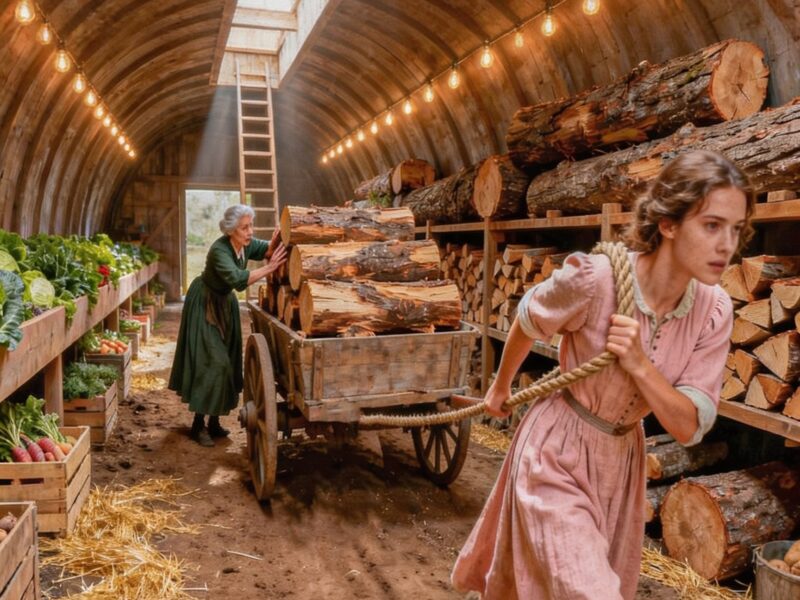
“It was a plan before it became a story.” Marin pointed again to the slope behind the cabin. “A tunnel dug into the hill. Timber-lined. Shelves on both sides. Vents at the far end so damp air could rise and escape. The earth draws moisture out if you let the air move properly. Wood dries faster, stays safe, never gets buried.”
Anelise stared at the dense earth, the roots twisting through it, the stones half visible under grass. It was absurd. It would be brutal work for a team of men, let alone a widow and an old woman whose joints swelled before rain.
“People will laugh.”
Marin looked at her sharply. “People laughed when your father married me because I came with no dowry and too much opinion. I still outlived them.”
“That is not the same.”
“No,” Marin said. “This matters more.”
The words landed hard.
Anelise looked toward Providence below. Smoke rose from neat chimneys. Men moved wagons near the mill. Women hung washing. Life went on with the easy cruelty of a world that did not pause because Thomas Ward had stopped breathing beneath a tree.
Her husband had not been cruel. That was the kindest truth she could tell about him. He had been handsome, restless, unlucky, and weak when strong men leaned on him. He had borrowed from Ezra Thorne, owner of the mill, without telling her. He had gambled once, then twice, then more. By the time he died, Anelise learned that grief did not arrive alone. It came with papers, debts, men at the door, and neighbors lowering their voices when she passed.
Ezra Thorne had stood in her yard three weeks after the funeral with his hat in his hand and hunger in his eyes.
“You can’t manage this place alone,” he had said. “A woman in your situation needs protection.”
Anelise had understood exactly what kind of protection he meant.
She had shut the door in his face.
Since then, Providence had watched her with pity sharpened by speculation.
Now Marin wanted her to dig a tunnel into the earth.
Madness, perhaps.
But madness had one advantage over despair.
It moved.
Anelise reached for the shovel leaning against the cabin wall.
“Show me where to start.”
Marin’s face softened, just for a breath.
Then she lifted her cane and marked the earth.
By noon, Anelise’s palms were blistered.
By sundown, she had a pit three feet deep and anger enough to dig another three.
The work became her language.
Pickaxe. Shovel. Bucket. Rope. Dump.
Pickaxe. Shovel. Bucket. Rope. Dump.
At first, people came with curiosity disguised as concern.
Mrs. Gable arrived with bread and a mouth full of velvet-covered judgment. “Dear Anelise, grief can make a woman fix her mind on strange things. There are better uses of your youth than digging in dirt. Mr. Thorne has spoken kindly of you, you know.”
Anelise wiped sweat from her brow. “Has he?”
“He is a practical man. A widowed woman might do worse.”
“I was not aware I was taking bids.”
Mrs. Gable’s face went pink. “I only meant—”
“I know what you meant.”
After that came Ezra Thorne himself.
He drove up in a wagon loaded with clean-cut lumber, his shirt white, his boots polished, his beard trimmed close to a square jaw. He was forty-five, broad and prosperous, with the confidence of a man who had purchased enough obedience to mistake it for respect.
“What in creation are you doing?” he called down into the trench.
Anelise kept digging. “Drying wood.”
He laughed. “Underground?”
“Yes.”
“You’ll rot it. Wood needs sunlight and wind. Everybody knows that.”
“Not everybody.”
His smile thinned. “I run the only mill within forty miles.”
“I noticed.”
“And I am telling you this is a fool’s errand.”
Anelise looked up at him then, dirt streaked across one cheek, hair escaping its pins, arms shaking from labor. “Then you have nothing to fear from it.”
Something ugly moved behind his eyes.
He leaned down slightly. “Your husband owed me.”
The shovel stopped.
“Thomas owed many people,” she said.
“He owed me most.”
“Then file your papers.”
“I’d rather offer mercy.”
The word made her skin crawl.
He looked toward the cabin, where Marin sat in the shade sharpening an axe with slow, steady strokes. “A house like this. A woman alone. An old mother. Winter coming. Pride won’t keep you warm.”
“No,” Anelise said. “That is what the wood is for.”
Thorne’s jaw tightened.
He drove away without another word.
That evening, Sheriff Caleb Brody came by.
Anelise heard his horse before she saw him. She knew the sound because Caleb rode a big black gelding named Saint, and there was nothing saintly about the way the horse struck earth. Caleb dismounted near the fence and removed his hat.
He did not smile.
Caleb Brody rarely did.
At thirty-two, he had already buried a wife, taken two bullets, hanged one murderer, and broken the jaw of a man who beat a saloon girl nearly blind. He was built tall and rangy, with broad shoulders, dark hair, and a face made severe by weather and restraint. Providence trusted him in the way towns trusted a locked door—less out of affection than belief that he would hold when pushed.
Anelise had always found him difficult to look at for too long.
There was too much silence in him.
Too much seeing.
“Mrs. Ward,” he said.
“Sheriff.”
His gaze moved over the pit, the rope, the buckets, the timber stakes Marin had begun marking.
“That hole’s getting deep.”
“That is generally what happens when one digs.”
Marin made a sound that might have been a laugh.
Caleb’s eyes flicked toward the old woman, then back to Anelise. “Bank could cave.”
“We’ll brace it.”
“You have bracing timber?”
“Not yet.”
“You have men helping?”
Her grip tightened around the shovel. “You see any?”
His mouth pressed flat.
She waited for the lecture. Concern. Authority. Another man telling her what was too heavy for her hands and too dangerous for her judgment.
Instead, Caleb stepped closer to the edge and studied the soil.
“Clay pocket on the west wall,” he said. “If you keep cutting beneath it, it’ll drop.”
Anelise blinked.
He crouched, picking up a handful of earth. “Dig shallower until you have posts in. Set crossbeams every four feet, not six. This soil holds until it doesn’t.”
“You came to stop me.”
“I came because folks are talking.”
“And?”
“And they talk more than they help.” He stood. “I don’t like deep holes without bracing.”
“Is that your official position?”
“My official position is I don’t want to dig you out dead.”
The bluntness struck through her irritation.
For one moment, the air changed.
He seemed to realize it too. His gaze dropped to her blistered hands. Something tightened in his face, quickly hidden.
“Thorne bothering you?” he asked.
“No more than usual.”
“That’s not an answer.”
“It is the only one I have patience for.”
Caleb looked toward the road Thorne had taken. “If he presses you, send for me.”
“I do not need rescuing, Sheriff.”
His eyes returned to hers. “I did not say you did.”
The words should not have warmed her.
They did.
He left after telling Marin good evening. As he mounted Saint, Anelise called after him, though she did not know why.
“You think I’m mad too?”
Caleb turned in the saddle.
Snow was months away, but the evening light had already gone cold. He looked at the pit, the marked earth, the old woman with the whetstone, and the young widow standing muddy and defiant beside a thing no one else believed in.
“No,” he said. “I think you’re scared enough to be smart.”
Then he rode away.
Part 2
The earth caved in during the hottest week of July.
Anelise was working the far end of the trench, carving the first horizontal stretch of tunnel, when the wall gave a low groan. She had just enough time to look up before several hundred pounds of clay, stone, and roots broke loose and crashed down around her.
The sound swallowed the world.
One moment there was sun above the trench. The next, dirt filled her mouth, her eyes, her lungs. Something struck her shoulder. Her left leg vanished beneath crushing weight. Her shovel disappeared. Pain went up her thigh in a white-hot line.
For a few seconds, she could not breathe.
Then she heard Marin.
“Anelise!”
The voice came from above, thin with fear but not broken.
“I’m trapped,” Anelise gasped. “My leg.”
“Do not struggle.”
The calm in Marin’s voice became a rope thrown into darkness.
Anelise closed her eyes and fought the panic clawing up her throat. She was under the earth. Alone. Stupid. Buried by the very thing everyone had warned her against.
“They were right,” she thought wildly.
Then, from farther off, another voice.
“Mrs. Ward!”
Caleb.
Hooves. Boots hitting ground. A man sliding down into the trench with more speed than caution.
“Don’t come close!” Marin shouted. “The wall is loose.”
Caleb ignored her only enough to get where he could see.
Anelise turned her head and found him crouched five feet away, face hard, eyes fixed on the trapped leg and the clay above it.
“Look at me,” he said.
“I can get out.”
“I know.” His voice was steady. “But you’ll do it carefully.”
“I don’t need—”
“Anelise.”
Her name in his mouth stopped her.
Not Mrs. Ward.
Anelise.
She looked at him.
His expression did not soften, but something fierce moved beneath it. Fear, controlled so completely it appeared as command.
“I’m going to dig from this side,” he said. “You move only when I tell you.”
“You’ll bring more down.”
“Not if you stop arguing.”
Above them, Marin muttered, “Listen to the man before pride kills you.”
Caleb’s mouth twitched despite the danger.
It took nearly an hour.
He dug with his hands when the shovel risked disturbing too much. He worked slowly, shoulders bent, sweat running down his temples, dirt darkening his shirt. Twice the bank shifted and he froze, one arm braced over Anelise as if his body could stop the earth if it decided to fall again.
The second time, his hand landed beside hers.
Their fingers touched.
Anelise felt it everywhere.
He pulled away first.
At last, the pressure eased enough for her to wrench her leg free. Pain tore a cry from her before she could bury it. Caleb caught her around the waist and lifted her clear, carrying her up the ladder and out into the brutal sun.
She hated being carried.
She hated more that she clung to his shirt.
He set her on the porch while Marin fetched water and bandages. Her ankle was swollen, her shin bruised purple, and a cut along her calf bled through her stocking.
Caleb knelt before her and took off her boot.
The intimacy of it struck her harder than the pain.
“I can do that,” she said.
“I know.”
He did it anyway, careful as prayer.
Marin watched from the doorway with eyes too knowing for Anelise’s comfort.
Caleb cleaned the cut, wrapped the leg, and did not look at her face until he was finished.
“You go back in without bracing, I’ll fill the damn hole myself.”
Anger flared. “You have no right.”
“No.” He stood. “I don’t.”
The agreement disarmed her again.
He picked up his hat, then looked toward the trench. “I’ll bring cedar posts tomorrow.”
She stared at him.
“I didn’t ask.”
“You don’t ask for anything.”
“That should tell you something.”
“It does.”
His gaze held hers.
For a moment, the air between them seemed thinner than July heat allowed.
Then Thorne’s wagon rattled up the road.
Ezra Thorne stepped down slowly, eyes moving from Anelise on the porch to Caleb standing near her, dirt-covered, sleeves rolled, hands scraped from digging.
“Well,” Thorne said. “Providence grows neighborly.”
Anelise’s face went cold. “You are not needed here.”
“I heard there was an accident.” His gaze lingered on Caleb. “Looks like the sheriff arrived quickly.”
Caleb turned. “Is that a question?”
“No. Merely an observation.”
“Make fewer.”
Thorne’s eyes narrowed.
He looked back at Anelise. “This is what comes of stubbornness. You could have been killed. I have dry lumber. Proper lumber. Take my offer before your mother is burying you beside Thomas.”
Marin stepped onto the porch. “You speak my son-in-law’s name like you did not work him half dead at that mill.”
Thorne’s face hardened. “Thomas owed me because Thomas lacked discipline.”
Anelise rose too fast, pain shooting through her leg.
Caleb moved to steady her.
She pulled free before he touched her.
“My husband is dead,” she said. “You don’t get to insult him in my yard.”
Thorne’s voice lowered. “Your husband left you with debt. I can call it in tomorrow.”
“Then do it.”
A flicker of surprise crossed his face.
Anelise leaned on the porch rail, pale but unbending. “File whatever papers you have. Stand in front of the whole town and explain why you waited until his widow refused your bed before remembering the money.”
Silence dropped.
Caleb went very still.
Thorne’s eyes flashed with rage.
“You should be careful, Anelise.”
Caleb stepped forward then.
He did not draw his gun. Did not raise his voice.
But the yard changed around him.
“No,” Caleb said. “You should.”
Thorne looked between them and smiled thinly.
“People will talk.”
“People already do,” Anelise said.
“And the sheriff cannot protect a reputation once it’s ruined.”
Caleb’s jaw flexed.
Anelise saw that the words had struck him. Not for himself. For her.
Thorne climbed back into his wagon. “Winter decides all things. Remember that.”
After he left, the silence felt dirty.
Caleb looked at Anelise. “What debt?”
“Thomas borrowed from him.”
“How much?”
“Enough.”
“Enough for him to threaten your home?”
Her throat tightened. “Yes.”
“Why didn’t you tell me?”
“Because every man who knows what a woman owes starts calculating what else she might pay.”
The words landed between them with brutal force.
Caleb looked away first.
Not because he was offended.
Because he understood.
The next morning, cedar posts appeared.
So did Caleb.
He brought them before sunrise, unloaded them without knocking, and started setting braces in the trench as if he had been hired by the earth itself. Anelise came outside on a crutch Marin had carved from an ash branch.
“You cannot just take over my work,” she said.
“I’m not taking over. I’m making sure it doesn’t bury you.”
“That sounds like taking over.”
He drove a post into place. “Then call it interfering.”
“I don’t have money to pay you.”
“I didn’t ask.”
“Everybody asks eventually.”
He stopped and looked up at her.
“No,” he said. “Not everybody.”
For three weeks, Caleb came when he could.
Never at night. Never in secret. Always in daylight, always with tools, always leaving before the town could make more from his presence than work. That caution hurt Anelise before she admitted why.
He helped brace the tunnel. He showed her how to notch beams. He taught her to set supports so pressure traveled down into the floor instead of bowing the walls. He listened when Marin explained the vents and did not laugh. When the first shaft opened and cool air moved through the tunnel like a slow breath, Caleb stood in silence, palm against the timbered wall.
“Well?” Marin demanded.
Caleb looked at the old woman with grave respect. “Ma’am, I believe your father knew a few things.”
Marin smiled like a queen receiving tribute.
By August, Providence had chosen its story.
Anelise Ward had bewitched the sheriff.
There were other versions. She had trapped him with tears. She had promised what widows promised when desperate. She had gone strange with grief and Caleb Brody, lonely since his wife’s death, had lost his judgment. Mrs. Gable repeated none of it aloud but heard all of it. Thorne fed the stories without ever appearing to be their source.
Caleb heard enough to stop coming for four days.
Anelise told herself she was relieved.
On the fifth evening, he found her in the woods trying to load a felled aspen onto the cart alone. The cart tilted, the log rolled, and she nearly went down beneath it before Caleb caught the weight and shoved it aside with a curse.
“You trying to get crushed again?”
She spun on him. “You vanished.”
His face shut. “I had work.”
“Providence run out of crime for four days?”
“Anelise.”
“No. Do not say my name like I am the reckless one when you let gossip drive you off.”
His eyes darkened. “You think I stayed away for myself?”
“Didn’t you?”
He stepped closer. “They’re saying ugly things.”
“They always have.”
“Not like this.”
Her laugh broke sharp. “You think I don’t know what they say? That I’m lonely. That I’m desperate. That I’m using you. That I should marry Thorne because a woman without a man is a loose shutter in a storm.”
His expression tightened.
She moved closer, fury carrying her past caution. “Do you want to know what I say? Let them freeze on their opinions.”
“Don’t.”
“Why? Because anger is unbecoming?”
“Because I don’t want you hurt for my sake.”
That silenced her.
Caleb looked like he regretted saying it, but he did not take it back.
The forest around them smelled of sap and dry needles. Evening light slanted gold between the trees. The half-loaded log lay at their feet like a felled animal.
Anelise’s voice lowered. “And what is your sake, Sheriff?”
His gaze moved over her face, stopping briefly at her mouth.
Something in her chest tightened painfully.
“I don’t know anymore,” he said.
It was the first honest, helpless thing she had ever heard him say.
She took one step closer.
“Caleb.”
His control cracked at the sound.
Only slightly, but she saw it.
He turned away, hands on his belt, head bowed. “I buried a wife. I know what people do with a woman’s name after a man is gone. They make it public property. They pity it, judge it, trade it, dirty it. I won’t be the reason they do that to you.”
“They were doing it before you.”
“I make it worse.”
“You make it bearable.”
He turned back.
The admission had cost her. She felt exposed, almost angry at herself.
Then Caleb crossed the distance between them.
Slowly.
Giving her every chance to retreat.
She did not.
His hand rose to her face, rough from work, warm against her cheek. He looked at her as if one wrong movement might shatter something neither could afford to lose.
“I should not want you,” he said.
Anelise’s eyes burned. “I am tired of what people think we should not do.”
She kissed him first.
For one heartbeat he was stone.
Then he made a low sound in his throat and kissed her back with months of restraint breaking all at once. It was not gentle, not at first. It was grief meeting grief, hunger meeting hunger, two lonely people discovering that survival had not killed every tender thing in them after all. His hand cupped the back of her head. Her fingers gripped his shirt. The forest seemed to hold its breath around them.
When he pulled away, he looked shaken.
“This changes things,” he said.
“They were already changed.”
“Thorne will use it.”
“Thorne uses air.”
His mouth almost smiled.
Then the crack of a branch snapped through the trees.
Both turned.
A boy from the mill stood twenty yards away, pale and frozen with what he had seen.
He ran.
Caleb cursed softly.
By morning, the whole town knew.
By afternoon, Ezra Thorne posted a notice at the church door claiming legal interest in Anelise Ward’s property for unpaid debt and accusing Sheriff Brody of abusing his office to influence a vulnerable widow.
By evening, three councilmen asked Caleb to surrender his badge pending inquiry.
He did.
Not because he was guilty.
Because Providence had already decided to enjoy the trial.
Anelise walked into the council hall before sunset with Marin beside her and half the town gathered to witness her humiliation. Caleb stood near the front, badge on the table, face carved from granite. Thorne sat with folded hands and an expression of solemn regret.
It made Anelise want to break something valuable.
The mayor cleared his throat. “Mrs. Ward, these are delicate matters.”
“No,” she said. “They are not.”
The room quieted.
She took Thomas’s debt paper from her pocket and laid it on the table. “My husband owed Ezra Thorne money. That is true. What is also true is that Mr. Thorne has repeatedly offered to forgive that debt in exchange for marriage.”
Women gasped. Men shifted. Thorne’s face darkened.
“You have no proof,” he said.
Marin stepped forward.
The old woman looked frail until she spoke.
“I was in the next room when you told my daughter a widow’s bed was better collateral than land.”
A stunned silence followed.
Caleb’s eyes went black with rage.
Thorne rose. “That is a lie from a bitter old woman.”
Anelise turned on him. “My mother’s bitterness has more honor than your kindness.”
The room stirred.
Thorne pointed toward Caleb. “And him? You deny what was seen in the woods?”
Heat climbed Anelise’s throat.
She felt Caleb’s pain from across the room, his need to protect her even from the truth of him.
She lifted her chin.
“I kissed Caleb Brody because I wanted to,” she said. “Not because I owed him. Not because he asked. Not because he held power over me. I kissed him because he was the only man in this town who could stand beside my work without making himself its owner.”
No one spoke.
Caleb stared at her as if she had just walked through fire.
Thorne’s mouth twisted. “A moving speech. Still doesn’t pay debt.”
A voice came from the back.
“No. But this might.”
Mrs. Gable stepped forward, face pale but determined. “Thomas Ward paid Thorne’s mill account with labor the month before he died. My husband witnessed the agreement.”
Thorne snapped, “Your husband is dead.”
“He kept records.” She held up a small ledger. “I found them after hearing the notice read.”
The mayor took the ledger.
Minutes stretched.
The room shifted as the truth came into focus.
Thomas had owed less than half what Thorne claimed. The “interest” was invented. The property lien invalid. The debt real, yes, but small enough that Anelise’s cordwood sales from autumn would have covered it twice over.
Thorne lunged for the ledger.
Caleb moved faster.
He caught Thorne by the wrist and twisted him face-first onto the table. The old badge rattled beside his cheek.
“I am not sheriff tonight,” Caleb said quietly. “So understand the restraint is personal.”
The next morning, the council reinstated him.
Thorne left town for three days.
And winter came early.
Part 3
The first snow looked harmless.
It drifted down in soft white flakes while Anelise and Marin stacked the last armloads of split wood on the tunnel shelves. The tunnel was fifty feet long now, timber-lined, vented through two stone-capped shafts hidden among rocks, and filled from floor to ceiling with carefully spaced logs. The air inside was cool and dry and smelled of pine, cedar, and earth. When Anelise carried the lantern to the far end, the light showed row upon row of fuel, each piece a promise made solid.
Caleb stood near the entrance, one hand resting on a support beam.
He had helped set that beam.
Anelise remembered the sweat darkening his shirt, the careful way he listened to Marin, the kiss in the woods, the public shame, the hearing, the danger of wanting him, the greater danger of pretending she did not.
He had not kissed her since the council hall.
Not because he had changed his mind.
Because he was waiting.
That made her love him and resent him in equal measure.
Marin, who missed little, announced she was tired and left them alone in the tunnel with the lantern and the smell of seasoned wood.
Anelise slid one log into place. “You can stop standing there like a church door.”
Caleb’s mouth twitched. “Never been compared to a church door.”
“Tall, grim, and always deciding who may enter.”
“Sounds like a sheriff.”
She turned to him.
The smile faded from both their faces.
Outside, snow whispered over the sealed entrance. Inside, the tunnel breathed through its hidden vents, a soft draft moving past them like something alive.
Caleb stepped closer. “When winter passes, people will find something else to talk about.”
“They can.”
“I don’t want to make your life harder.”
Anelise gave a tired laugh. “My life is hard. You are not the cause.”
“No. But loving me might be.”
The word entered the space between them and stayed there.
Anelise’s hand tightened around the lantern handle.
Caleb looked as if he had not meant to say it yet, but he did not retreat.
“I do love you,” he said. “I’ve been trying to find a clean time to say it, but nothing about us has been clean. Grief. Debt. Gossip. Danger. Dirt under your nails and blood on your hands. Me standing there wanting to protect you and knowing you’d hate me if I tried too hard.”
Her throat ached.
“I did not want this,” he continued. “I did not want to feel something that could be used against you. I did not want to wake up thinking about whether your chimney was smoking, whether Thorne had come by, whether you had eaten, whether you were down in this earth alone. I did not want to love a woman who had every reason to mistrust a man standing too close.”
Anelise set the lantern on the shelf.
“And now?”
His eyes held hers. “Now I want it anyway.”
She crossed the distance between them.
This time, when he kissed her, he did it slowly. With reverence and hunger braided together. She felt the restraint in him, the force of a man who could break another with his hands choosing instead to hold her like something entrusted, not possessed. Her fingers slid into his coat. His arms came around her. For a moment the whole world narrowed to earth, wood, breath, and the impossible warmth of him.
Then Marin’s voice called from the cellar entrance. “If you two are finished pretending you are only discussing firewood, supper is ready.”
Anelise buried her face against Caleb’s chest.
For the first time in months, she laughed.
The blizzard arrived two weeks later.
It did not come as weather.
It came as siege.
By the second day, Providence was buried. By the third, the roads were gone. By the fourth, men had dug tunnels between houses only to watch them fill again. By the fifth, Thorne’s lumber yard was unreachable under drifts taller than horses. By the sixth, green wood smoked uselessly in half the town’s stoves.
On the seventh night, Caleb reached Anelise’s door half frozen.
She opened it before he knocked a second time.
He staggered inside carrying a little Gable boy in his arms.
The child’s lips were blue.
Anelise’s heart lurched.
“By the fire,” she said.
Marin was already moving, blankets in hand, her old body quick with purpose. Caleb laid the boy down near the hearth. Anelise wrapped heated stones in cloth and tucked them near his feet while Marin brewed willow bark and pine needle tea.
Caleb stood in the middle of the cabin, snow melting off his coat, staring at the fire.
It burned hot and clean.
His face changed.
Not surprise. He had known.
But seeing it now, with Providence dying beyond the door, was different.
“How much?” he asked.
“Enough.”
“For the town?”
Anelise looked toward the cellar door.
Months of work. Blood. Humiliation. Her mother’s memory. Their survival.
Then she looked at the child shivering by her hearth.
“Yes,” she said. “If they help carry it.”
Caleb’s eyes met hers.
Something passed between them that had nothing to do with romance and everything to do with devotion. He loved her for saying yes. She saw it. She also saw he would have loved her if she had said no.
That mattered more.
He went back into the storm.
Within an hour, he returned with six men roped together against the wind.
Among them was Ezra Thorne.
His beard was crusted white. His eyes were bloodshot from cold. He did not look proud now. Pride required warmth.
Anelise met him at the cellar steps.
For a moment, neither spoke.
The town’s most powerful lumberman had come to the widow’s buried tunnel because his own timber could not save him.
Thorne’s gaze dropped.
Not apology.
Not yet.
But the beginning of understanding that humiliation could be medicinal.
Anelise lifted the lantern and opened the small wooden door in the cellar wall.
Cool, dry pine-scented air breathed out.
The men followed her inside and stopped.
The tunnel stretched into darkness, shelves stacked high with perfectly seasoned wood. The lantern light moved over timber supports, neat ventilation channels, kindling bundles, logs spaced carefully for air, all of it hidden beneath earth while Providence laughed above it.
One of the men whispered, “Lord Almighty.”
Caleb stood behind Anelise, silent.
Thorne reached out and touched a log.
It was dry.
Bone dry.
His face worked with something close to pain.
“You were right,” he said.
Anelise looked at him.
The tunnel was so quiet she could hear the soft movement of air through Marin’s vents.
Thorne swallowed. “And I was a fool.”
“No,” Marin said from behind him. “A fool can learn. You were cruel.”
The men went still.
Thorne did not defend himself.
That was something.
Not enough.
But something.
Anelise began giving orders.
The Gable house first. Then the church, where five families had gathered. Then old Hemlock’s cabin. Then the houses with children. Every armload was counted, every route planned, every man roped to another before stepping into the storm. Caleb took the most dangerous trips himself, of course. He carried wood until his gloves froze solid. He broke trail between homes. He dragged one man out of a drift by the collar and cursed him alive all the way to the church.
Anelise worked at the cellar door until her arms shook. Marin sorted kindling and cursed anyone who loaded inefficiently. By dawn, thicker smoke rose across Providence. By the next night, nearly every chimney was breathing again.
On the ninth day, disaster came from the tunnel vents.
Thorne had gone with two men to clear snow from the stone-capped shafts after Marin warned that blocked vents could trap moisture and smoke. He returned alone, bleeding from the scalp, claiming the others had slipped into a drift.
Caleb knew he was lying before the words finished.
So did Anelise.
“What happened?” she demanded.
Thorne would not meet her eyes.
A boy from the mill burst through the door minutes later, wild with fear. “Mr. Thorne’s men tried to open the outside seal. Said the tunnel should belong to the town now. Said Mrs. Ward had no right deciding who got wood first.”
Anelise went cold.
Caleb grabbed his coat.
She grabbed hers too.
“No,” he said.
“Yes.”
“Storm’s blind.”
“So was I, apparently, thinking gratitude could warm selfish men.”
He tried to stop her only once. She looked at him, and he let his hand fall.
They reached the slope behind the cabin in punishing wind. Two men were there with pry bars, trying to tear open the sealed outer entrance beneath the snow shelf. One had already cracked a support plank.
If they opened it wrong, half the tunnel could collapse.
Months of work.
The town’s heat.
Their lives.
Anelise stepped forward. “Get away from it.”
The men froze.
One, drunk on cold and fear, shouted, “You don’t own survival!”
“No,” she shouted back over the wind. “But I built the thing keeping it alive!”
He lifted the pry bar again.
Caleb drew his gun.
The sound of the hammer cocking cut through the storm.
“Drop it.”
The man obeyed.
But the snow shelf above them groaned.
Anelise looked up.
“Move!”
The drift broke.
Caleb reached her as the snow came down, slamming into both of them and sweeping them sideways into the half-dug approach trench. The world vanished in white. Weight crushed the breath from her lungs. She heard Caleb grunt in pain as his body struck timber.
Then darkness.
Not complete. Snow-filtered. Suffocating.
She was pinned against him, one arm trapped, face pressed against his coat. His body had taken the worst of the fall, curved around hers.
“Caleb?”
“I’m here.”
His voice was tight with pain.
“Are you hurt?”
“Not enough.”
“That is not an answer.”
“It’s the one I have.”
Above them, men shouted. Snow shifted. The cracked outer plank creaked ominously.
If it gave, the tunnel could open to the storm.
Anelise struggled.
Caleb’s arm tightened. “Don’t. You’ll bring more down.”
Her breathing quickened.
Buried.
Again.
The summer cave-in came back with brutal force: clay in her mouth, her leg trapped, the whole town’s judgment pressing down like earth.
Caleb’s voice lowered. “Listen to me.”
“I can’t—”
“Yes, you can.” His breath hitched. Pain. Real pain. “You taught a tunnel to breathe, Anelise. Breathe with it.”
The words reached her through panic.
She forced air in.
Once.
Again.
Voices came closer. Marin’s voice among them, sharp as an axe. “Dig from the side! Not above, fools!”
It took twenty minutes to free them.
Caleb’s shoulder was dislocated. Two ribs likely cracked. His face was gray with pain by the time they got him into the cabin.
Anelise shook so badly she could barely help Marin strip his coat.
“Stop looking at me like that,” Caleb said through clenched teeth.
“Like what?”
“Like I’m dead.”
Her control broke.
She gripped his uninjured hand and pressed it to her forehead. “Do not joke.”
His expression softened through pain.
“I’m not dead.”
“You nearly were.”
“So were you.”
“That does not comfort me.”
“No,” he said. “I’m learning I’m poor at comfort.”
She laughed, but it came out like a sob.
He shifted, wincing. “Anelise.”
She looked at him.
The storm battered the walls. Men moved wood below. Marin muttered over bandages. Providence lived because of the thing no one had believed in.
Caleb’s thumb moved weakly against her hand.
“When this breaks,” he said, “marry me.”
The room stilled.
Even Marin stopped moving.
Anelise stared at him.
“That is a terrible proposal.”
“I know.”
“You are half buried, half frozen, and your shoulder is not where God placed it.”
“Then answer before I get worse.”
Tears blurred her vision.
She leaned close, careful of his injuries. “Ask me when you can stand.”
His mouth curved faintly. “Is that yes?”
“That is me refusing to be proposed to by a man who may faint before hearing the answer.”
“I won’t faint.”
He fainted three minutes later when Marin set his shoulder.
The blizzard broke on the eleventh day.
Providence emerged slowly, chimney by chimney, door by door, like a town dug back from the grave. No one died after the seventh night. Old Hemlock lost two toes but not his life. The Gable children recovered. The church stove glowed for a week on Anelise’s wood. Men took turns maintaining the vents. Women came to Marin for instructions, and Marin, who had waited a lifetime for people to admit old wisdom still had teeth, became insufferable in the most satisfying way.
Ezra Thorne publicly cleared Thomas Ward’s debt.
Then, under Caleb’s cold stare and Marin’s sharper one, he signed over a portion of his mill timber to replenish the widow’s stores and agreed to help expand the tunnel into a communal winter reserve under Anelise’s direction.
Not the town council’s.
Not Thorne’s.
Anelise’s.
Mrs. Gable came to the cabin after the thaw with bread in her hands and shame in her face.
“I was wrong,” she said.
Anelise took the bread. “Yes.”
Mrs. Gable blinked, then nodded. “I was cruel too.”
“Yes.”
“I am sorry.”
Anelise looked toward the yard, where Caleb stood with one arm in a sling arguing with Marin about whether he was well enough to lift a shovel. He was losing. Badly.
“I accept,” Anelise said. “But I will remember.”
Mrs. Gable’s eyes filled. “That seems fair.”
Spring came late but green.
The tunnel became known as the Providence Vein, though Marin insisted that was too grand a name for a hole that breathed properly. Anelise drew plans. Caleb enforced labor schedules when men tried to argue. Thorne provided timber and wisely kept his opinions technical. The town learned to stack, vent, dry, rotate, and prepare as if winter were not an accident but an enemy that respected planning.
One evening in May, almost a year after the first shovel entered earth, Caleb came to Anelise’s cabin without his sling.
She was behind the house near the tunnel entrance, planting small stones along the path so mud would not swallow it in rain. Marin sat nearby shelling peas and pretending not to supervise.
Caleb removed his hat.
Anelise looked up and smiled despite herself. “You can stand.”
“Yes.”
“Shoulder in place?”
“Last I checked.”
“Ribs healed?”
“Enough.”
Marin gathered her peas with sudden innocence. “I hear something boiling inside.”
“Nothing is boiling,” Anelise said.
“It will if neglected.”
The old woman disappeared into the cabin.
Caleb waited until the door closed.
Then he stepped closer.
The pines moved softly above them. The ground that had once mocked her with roots and stone now held the entrance to the thing that had saved a town. Evening light turned the cabin windows gold.
Caleb looked nervous.
That frightened and delighted her.
“I told myself,” he said, “that I would ask properly when I could stand. Then I spent three weeks deciding what properly meant and realized I am no good at it.”
“That has been established.”
His mouth twitched.
Then he took her hands.
“Anelise Ward, I love you. I love your stubbornness even when it makes me want to shout. I love your mind, which built what stronger men dismissed. I love your hands, because they made survival instead of waiting for mercy. I love your grief, not because I want you hurt, but because it is part of the road that brought you here still standing. I love your mother, though she terrifies me.”
“She should.”
“And I love you enough to ask, not demand, not rescue, not shelter you like a fragile thing, but stand beside you if you’ll have me.”
Anelise’s heart moved painfully.
For months she had feared love because it looked too much like another thing the world could take. But Caleb had never asked her to be less alone by becoming less herself. He had stood beside the pit. Beside the scandal. Beside the fire. Beneath the snow. He had protected without owning, waited without withdrawing, loved without turning her survival into his pride.
“Yes,” she said.
He went still.
Then his face changed in a way she had never seen. The hard sheriff, the feared man, the town’s locked door, undone by one word.
Anelise stepped into him, and he caught her with careful strength, laughing once against her hair like relief had broken something open in him.
When he kissed her, Marin shouted from inside, “Not too long. Supper actually is boiling now.”
They married in June.
Not in the church, because Anelise said she had no interest in standing beneath a roof where half the congregation had once discussed her ruin as entertainment. They married behind the cabin, beside the tunnel entrance, with Marin holding flowers, Sheriff Brody’s deputy crying harder than anyone expected, Mrs. Gable handing out bread, and Thorne standing at the back with a face full of humility he would need years to finish earning.
Anelise wore blue.
Caleb wore his badge.
Marin said her father would have approved of both the groom and the ventilation.
That winter, every chimney in Providence smoked steady.
And in the Ward-Brody cabin at the edge of town, a fire burned hot and clean, fed by wood dried in darkness, by wisdom remembered, by hands that refused to stop, and by a love that had grown not gently, but like a tunnel through hard earth—dug inch by inch through grief, shame, danger, and doubt until it reached air.