The Giants in 19th Century Photographs — And Why They Suddenly Disappeared
Part 1
The first photograph arrived folded inside a death certificate.
It should not have been there. Death certificates did not arrive folded anymore, not in the physical sense, not to county archival contractors like Nora Vale, whose job was to sit under buzzing fluorescent lights in the basement of the Pennsylvania Historical Records Annex and turn the dead into searchable data.
Name. Date. Cause. County. Volume. Page.
The work was repetitive enough to become soothing if you let it. Nora did not let it. She had learned early that records behaved badly when you trusted them too much. Ink faded. Clerks lied. Families changed names. Institutions lost what embarrassed them and preserved what protected them. Every archive had ghosts, though most of them wore file labels and smelled like mildew.
The certificate on her desk belonged to a man named Elias Rusk.
County: Allegheny.
Date of death: April 17, 1851.
Cause: “industrial accident.”
Age: thirty-eight.
Height: left blank.
That was odd, but not impossible. Many old certificates were incomplete. Nora typed what was there and reached for the next page.
The photograph slid out and landed face-down on her keyboard.
She froze.
The Annex basement was quiet except for the old scanner dragging light across glass in the next cubicle. Somewhere overhead, footsteps moved through the public reading room. Pipes clicked behind the walls. Rain tapped the narrow windows at sidewalk level, where passing shoes sometimes appeared like disembodied proof that the world above continued without her.
Nora turned the photograph over.
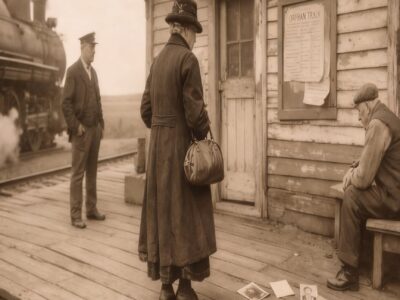
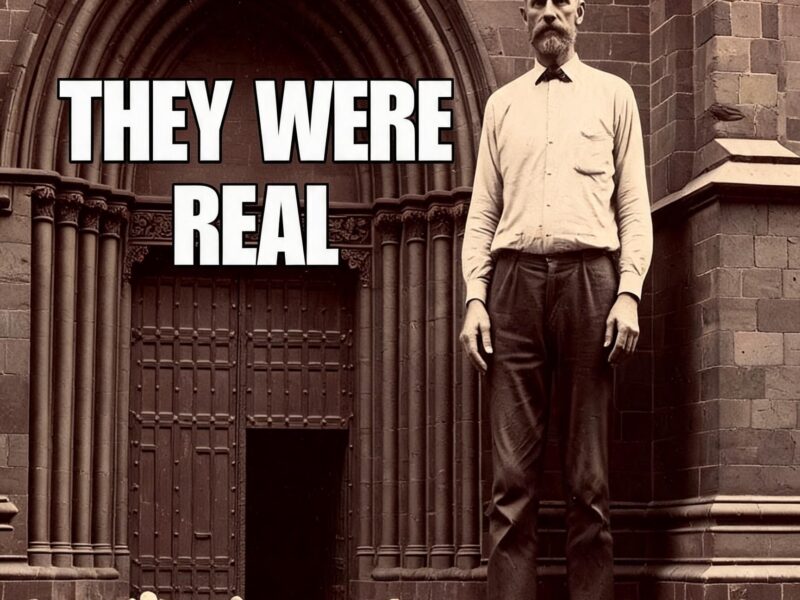
Six men stood outside a rail depot.
The image was sepia, cracked at the corners, mounted on stiff card. A handwritten note at the bottom read:
RUSK CREW, WESTERN DEPOT, 1847.
Three of the men were ordinary laborers by 19th-century standards: broad hats, canvas coats, dirty boots, hands around shovels and iron tools. They stood with the stiff patience of people enduring early photography.
The other three were wrong.
Not circus wrong. Not staged. Not placed on crates or caught by lens distortion.
Wrong because they were simply there, relaxed among the others, their heads rising near the roofline of the depot behind them. One man’s shoulder nearly met the bottom of a second-story window. Another held a sledgehammer that looked child-sized in his hand. The tallest stood beside a standard freight door, his head brushing the lintel though the door appeared taller than any modern doorway Nora had seen.
Nora leaned closer.
Her breath fogged the old surface.
Elias Rusk was marked with a small pencil X.
The X sat above the tallest man.
Nora measured instinctively with her eyes. Door. Window. Boot length. Hammer shaft. Rail ties stacked behind them.
Seven feet, at least.
Maybe eight.
She flipped the card over.
On the back, written in a different hand, were four words.
DO NOT INDEX HEIGHT.
Her phone buzzed.
Nora nearly screamed.
It was only a text from Marcus Bell.
Still alive down there?
She stared at the photograph, then typed back.
Come to Annex. Now.
Marcus called instead.
“I’m in Harrisburg, Nora.”
“Then drive.”
“That sounds like a horror movie sentence.”
“I found something.”
“Define something.”
“A photograph in a death certificate.”
“So?”
“He’s tall.”
“How tall?”
“Not tall like basketball. Tall like the building was made for him.”
There was a pause.
“Who is this?”
“Elias Rusk.”
The line went silent.
Nora sat straighter.
“Marcus?”
“Don’t scan it,” he said.
The scanner in the next cubicle finished with a soft mechanical sigh.
Nora looked at the photograph on her keyboard.
“Why?”
“Because my grandfather used to tell a story about men named Rusk.”
“I thought you said your grandfather only told stories about bad whiskey and union strikes.”
“He told one other kind.” Marcus’s voice had changed. The humor was gone. “Tall men who worked under cities.”
Nora looked toward the narrow basement window.
Rainwater streamed down the glass from the street above.
“What does that mean?”
“It means put the photograph in an envelope, leave the building, and don’t tell anyone else.”
Too late.
The old scanner beside her woke by itself.
Its lid opened.
The bright bar of light slid across empty glass.
On Nora’s desk, the photograph curled.
The three ordinary men in the picture remained still.
But Elias Rusk turned his head.
Not much.
Just enough to look directly at her.
From somewhere deep beneath the Annex floor came the sound of a shovel striking stone.
Nora did not remember standing.
One moment she was seated at the cubicle, phone pressed to her ear, staring at a dead man who had moved inside a 175-year-old photograph. The next she was in the corridor with the photograph clutched against her chest and Marcus shouting through the phone.
“Nora? Nora, answer me.”
She forced herself to speak.
“It moved.”
“What moved?”
“The picture.”
“You need to get out.”
The corridor lights flickered.
The Pennsylvania Historical Records Annex occupied an old municipal building that had once been a tax office, before that a courthouse annex, before that something no one fully agreed on. The public entrance faced the street at ground level. But in the basement, where Nora worked, the windows sat high on the walls, their lower halves buried behind soil and stone from some long-ago street raising project no one in the county had bothered to document properly.
She had always thought that was charming.
Now it felt like the building was standing neck-deep in a grave.
At the end of the corridor, the elevator dinged.
Its doors opened.
No one stood inside.
The panel lights blinked one by one.
B.
Then a button Nora had never seen before lit up beneath Basement.
The elevator waited.
Nora backed away.
Behind her, the scanner began again.
Whirr.
Light moving across glass.
Whirr.
Again.
And then all the scanners in the basement woke at once.
Every machine in every cubicle began copying pages no one had placed inside them. White light pulsed under lids. Paper trays rattled. The air filled with the smell of hot toner and wet earth.
From the machines came photographs.
They slid out one after another, black-and-white, sepia, albumen, silver nitrate. Work crews. Military units. Families in stiff Sunday clothes. Streets before their lower windows were buried. Men and women standing near doorways so tall they seemed to belong to a different human arrangement.
And among them, again and again, the tall ones.
Not giants from fairy tales.
Workers. Mothers. Soldiers. Carpenters. Blacksmiths. Girls with braided hair standing beside shorter siblings. A preacher whose hand rested on a pulpit too low for him. A woman in a dark dress holding a baby on one hip, her head nearly level with the top of a farmhouse door.
All of them marked in pencil.
Small Xs over faces.
Red circles around hands.
Notes on the backs.
CROP LEFT EDGE.
REPHOTOGRAPH FROM LOWER ANGLE.
DESTROY ORIGINAL AFTER COPY.
NO HEIGHT ENTRY.
Nora’s mouth went dry.
The elevator bell dinged again.
The 0 button glowed red.
A voice came from inside the empty elevator.
Not loud.
Not electronic.
A man’s voice, deep and patient.
“Records below ground require correction.”
Nora ran.
She hit the stairwell door with her shoulder and climbed toward the public reading room, the photographs slipping from her arms behind her like dead birds. The stairwell seemed longer than usual. Too many turns. Too many landings. The walls sweated brown water. By the third flight, her lungs burned. By the fourth, she saw daylight under the door.
She burst into the reading room.
Three researchers looked up from microfilm machines. An old woman copying land deeds frowned. The receptionist blinked.
Everything was normal.
Too normal.
Nora stumbled past the desk.
“Nora?” the receptionist called.
She did not stop.
Outside, rain came hard over downtown Pittsburgh, drumming on cars, pooling at curbs, shining on brick facades. Nora ran beneath awnings until she reached the parking garage across the street. Only then did she realize she still held the first photograph.
Elias Rusk stood in the rain-stiff card, marked by an X.
His head had turned back to its original position.
But now one of his enormous hands was raised.
In the photograph, he held a sign.
It had not been there before.
Nora looked closer.
The sign read:
THEY BURIED US STANDING.
Part 2
Marcus arrived before dark with mud on his boots and a pistol in his glove compartment.
Nora noticed both.
He pulled into the parking garage beside her old Subaru and cut the engine. For a moment, they just sat facing the concrete wall while rain hissed beyond the open sides of the structure. Marcus Bell had been Nora’s closest friend since graduate school and the only person she knew who could turn archival despair into jokes sharp enough to draw blood. He was a historian of industrial labor, which meant he knew more than anyone should about dead workers, vanished unions, company towns, and how often the phrase “accident” meant “something cheaper than justice.”
He looked at the photograph on Nora’s lap.
His face changed.
“Jesus.”
“You’ve seen one before.”
“No.”
“But you knew the name.”
Marcus rubbed his jaw. “My grandfather worked demolition in the seventies. When they were tearing down old buildings downtown, sometimes they found lower floors nobody had plans for. Bricked doors below the street. Windows under sidewalks. Whole rooms with ceilings fifteen feet high.”
“Old basements.”
“That’s what everyone called them.”
“But?”
“But he said some rooms had hooks too high for normal men. Tools too heavy. Stair risers wrong. Workbenches at chest height for him, and he was six foot one.”
Nora turned the photograph over.
DO NOT INDEX HEIGHT.
Marcus read the words and swore softly.
“What else printed?”
“Hundreds of images.”
“You left them?”
“They were coming out of every scanner.”
“You need to tell me exactly what happened.”
She did.
He listened without interruption until she mentioned the elevator button.
Zero.
Marcus closed his eyes.
“My grandfather called it Undergrade.”
“That’s a place?”
“He said every old city had one. Not sewers. Not exactly basements. The first ground. The buried ground.”
Nora looked out at the rain.
“The transcript we heard last month,” she said.
Marcus stiffened.
They had both listened to it because Marcus was considering writing an article about modern alternative-history movements and why people were drawn to claims of erased giants, buried cities, lost technology, and institutional cover-ups. He had asked Nora to review the archival claims. She had laughed at half of them, argued with the other half, and told him the danger was not that the claims were persuasive.
The danger was that archives really did have gaps.
That was enough for fear to grow teeth.
“Don’t start,” Marcus said.
“I’m not saying the transcript was true.”
“Good.”
“I’m saying someone sent me a photograph that matches its mythology.”
“Or something did.”
Nora looked at him.
He did not smile.
Before she could answer, her phone rang.
UNKNOWN CALLER.
Marcus said, “Don’t.”
She answered anyway.
Static.
Then a woman spoke.
“Nora Vale?”
“Who is this?”
“My name is Dr. Evelyn Hart. I run the Whitcomb Collection in Boston. You accessed a restricted height record at 3:41 p.m.”
Nora looked at Marcus.
“I accessed a county death certificate.”
“You accessed a restricted height record,” the woman repeated. Her voice was calm, precise, deeply tired. “You have approximately nine hours before the correction process reaches you.”
“What correction process?”
“You saw the elevator.”
Nora stopped breathing.
Dr. Hart continued. “Bring the Rusk photograph to Boston. Do not scan it. Do not photograph it. Do not describe the face over an unsecured line.”
“Why?”
“Because descriptions are records, Ms. Vale. And records are how it finds what still remembers.”
The call ended.
Marcus stared at her.
“We’re going to Boston,” Nora said.
“I hate when obvious bad ideas become our only plan.”
They drove through the night.
The rain followed them across Pennsylvania and into New York, heavy and constant, smearing headlights into long white wounds. Nora kept the photograph sealed between two acid-free boards on her lap. Every time she began to drift toward sleep, she heard shovels striking stone under the tires.
Marcus drove with both hands tight on the wheel.
“Tell me about your grandfather,” Nora said somewhere near Scranton.
“Now?”
“I need something human.”
Marcus watched the road.
“His name was Thomas Bell. Black man from Homestead. Ironworker, demolition, occasional drunk philosopher. He used to say buildings lie less than people. If a wall has a seam, believe the seam. If a window is underground, don’t let some rich man tell you it was designed that way.”
“He saw giants?”
Marcus shook his head.
“He saw spaces made for them.”
“You never told me.”
“You would’ve asked for sources.”
“I am very lovable that way.”
He almost smiled.
“He told me they found bones once.”
Nora turned toward him.
“Where?”
“Old municipal hall near the river. This was 1976. They broke into a sealed lower chamber during demolition. Inside were three skeletons.”
“How tall?”
“He said long enough that the men stopped joking.”
“What happened?”
“County took them. Then state. Then no one knew anything.”
Nora looked at the black road ahead.
“Did he believe they were human?”
Marcus was quiet so long she thought he would not answer.
“He said one still had boots.”
At 2:17 a.m., Nora woke to the car stopped in the middle of the highway.
Fog surrounded them.
Not normal fog. It pressed against the windshield in thick gray layers, dense enough to reflect the dashboard lights. Marcus sat rigid behind the wheel, staring forward.
“What happened?”
“Road changed.”
“What?”
He pointed.
Through the fog, two enormous stone columns rose on either side of the highway. They had not been there a moment earlier. Beyond them, the asphalt descended at a steep angle into darkness.
A sign hung between the columns.
UNDERGRADE ACCESS
AUTHORIZED RECORDS ONLY
Nora’s heartbeat slowed with terror.
In the fog beside the car stood a man.
He was so tall that at first Nora thought he was a utility pole.
He wore a long canvas coat, too old-fashioned for any living road worker, and a broad hat shadowed his face. Rain dripped from his sleeves. One hand held a lantern. The other rested against the passenger window.
His fingers were the length of Nora’s forearm.
Marcus whispered, “Don’t look up.”
But Nora already had.
The man bent.
His face filled the window.
Not monstrous.
That was worse.
Human. Bearded. Gaunt. Eyes pale with cataracts or dust. His skin had the gray-brown color of something buried in clay. Across his forehead, someone had carved a number.
His mouth moved.
The window did not open, but his voice entered the car.
“Index me.”
Nora could not speak.
He pressed something against the glass.
A wet cabinet card.
In the photograph, the same tall man stood beside three others in front of a building with metal spires and vast doors. The men wore work clothes. Behind them, ordinary people stood at waist height, looking upward with expressions of fear and reverence.
On the back, visible through the wet paper, was a name.
ABRAHAM BELL.
Marcus made a sound like something breaking.
The tall man turned his pale eyes toward him.
“Blood remembers where paper fails.”
Then the fog lifted.
The man vanished.
They were on the shoulder of I-80, hazard lights blinking, dawn paling behind the clouds.
Marcus opened his door and vomited onto the pavement.
Nora sat frozen with the Rusk photograph on her lap.
A second photograph lay against the passenger window, stuck there by rain.
Abraham Bell stared out from the past.
Part 3
Dr. Evelyn Hart was waiting in the basement of the Whitcomb Collection with three cups of coffee, two legal waivers, and a bolt cutter.
She was in her seventies, tall by modern standards but not unusually so, with white hair pinned severely behind her head and the unsettling stillness of someone who had spent decades listening to paper decay. The Whitcomb Collection occupied a former banking house near Boston Harbor, though the public never saw the parts that mattered. Scholars visited the reading room upstairs. Donors attended lectures under chandeliers. Trustees praised preservation and transparency while entire floors remained locked beneath their polished shoes.
Hart took one look at the Abraham Bell photograph and said, “I’m sorry.”
Marcus folded his arms. “For what?”
“For being right to call you.”
Nora set the Rusk photograph beside it.
Hart did not touch either.
“Who are they?” Nora asked.
Hart looked toward the stacks.
“The people who kept the first machines running.”
“What machines?”
The old woman smiled without humor.
“Every generation thinks it invented power. Steam, coal, oil, electricity, data. But before those categories hardened, there were structures built to draw charge from the air, from pressure, from weather, from what one engineer called ‘the breathing voltage of the earth.’”
Marcus said, “You’re talking about atmospheric electricity.”
“I’m talking about architecture people later called decorative because the manuals disappeared.”
Nora thought of the transcript. Oversized doors. Metal spires. Grounded basements. Resonant cavities. Buildings repurposed as courthouses, museums, exhibition halls.
“Were the tall people operators?” she asked.
Hart’s eyes sharpened.
“You are quick.”
“I’m terrified. It helps.”
Hart led them deeper into the collection.
The first locked door opened with a key.
The second required a code.
The third had no modern lock at all, only a rusted iron mechanism Hart cut through with the bolt cutter. Beyond it, stone stairs descended into cold darkness.
“Before we go down,” Hart said, “understand this. What you saw in the archive is not a conspiracy in the ordinary sense. Conspiracies need meetings. Orders. Ideology. This is older and more mechanical. It is a correction process built into records themselves.”
Nora gripped the railing.
“Records don’t do things.”
Hart looked at her.
“Of course they do. They certify. They erase. They transfer property. They declare people dead. They declare people free or enslaved. They turn a person into a line item. Archives are not passive. They are slow machines.”
Marcus whispered, “And this machine corrects height.”
“It corrects scale,” Hart said.
The stairway opened into a vast underground room.
Nora stopped.
The ceiling rose at least twenty feet. Metal ribs curved overhead like the inside of a whale. Ceramic tiles lined the walls, many cracked, some humming faintly though no electricity should have passed through them. In the center stood a circular platform surrounded by iron columns that rose into darkness and disappeared through the ceiling.
On the far wall hung photographs.
Hundreds.
Thousands.
Tall men and women in work crews, city streets, factory floors, churches, rail yards, military camps, family porches. Some images had been slashed. Some cropped. Some marked with instructions. Others were intact.
At the bottom of the wall, arranged in neat black frames, were photographs of buried windows.
Boston. Seattle. Galveston. Edinburgh. Rome. Pittsburgh. Paris.
Ground levels swallowed. Doors bricked. First floors turned into basements.
Nora walked toward the images as if in a dream.
“What happened?” she asked.
Hart stood beside her.
“In the middle of the nineteenth century, something failed.”
“What?”
“The grid beneath the cities.”
Marcus frowned. “Electrical?”
“Not exactly. Atmospheric, seismic, hydraulic, social. The words we have are too specialized. The old system used buildings as organs. Towers drew charge. Basements grounded and distributed it. Water tables mattered. Street grades mattered. Bodies mattered.”
“Tall bodies,” Nora said.
Hart nodded.
“They were not another species. Not giants in the mythic sense. Families with unusual height, yes, but also trained from childhood for work in those spaces. Their size made them useful in systems built at a larger scale. They maintained the towers, chambers, conductors. They were visible because no one yet thought to hide them.”
“Then the failure?”
Hart’s face hardened.
“Cities sank. Streets were raised. Lower floors were buried. Some events were documented and explained: fires, floods, hurricanes, sanitation projects. Others were quietly absorbed into urban improvement. But beneath the explanations was panic. Chambers collapsed. Towers overloaded. Operators died in places too dangerous to recover.”
Marcus touched the Abraham Bell photograph.
“My grandfather said they found bones.”
“They did. Often.”
“Why erase them?”
Hart looked at the wall of altered photographs.
“Because the world after the failure needed continuity. Imagine telling people that the grand buildings in their cities were not merely civic monuments but dead organs of a system no one understood. Imagine admitting that entire classes of workers had been buried, that institutions had kept using the buildings without knowing what slept beneath them. Imagine the lawsuits, the fear, the religious hysteria, the political collapse.”
“So they cropped the pictures.”
“At first. Then reclassified records. Then stopped recording height. Then dismissed every surviving image as anomaly, circus trick, medical curiosity, hoax. One small correction at a time. Until memory became manageable.”
Nora felt sick.
“And now?”
Hart turned toward the circular platform.
“Now someone indexed Elias Rusk.”
“I did.”
“No. You found him. Something else marked him active.”
The iron columns began to hum.
Far above, thunder rolled though the sky had been clear when they entered.
Hart went pale.
“It followed you faster than I expected.”
A bell rang.
Not from above.
From below.
Deep under the platform, something answered.
The photographs on the wall stirred. Faces turned. The tall men and women looked toward Nora with expressions too old for anger.
The room’s lights dimmed.
On the circular platform, a figure appeared.
It unfolded out of shadow, tall enough to bow beneath the high ceiling. Its body wore a black archivist’s coat stretched grotesquely long. Its fingers were stained with silver nitrate. Where its face should have been was a blank photographic plate, reflective and dark.
Hart whispered, “The Curator.”
The figure lifted one long hand.
The air filled with the sound of pages turning.
Nora’s skin prickled.
The Curator spoke without a mouth.
“Unstable record detected. Scale variance exposed. Correction required.”
Hart stepped forward.
“This collection is sealed.”
“Seal expired.”
“It has not expired.”
“Witness entered. Blood entered. Height entered.”
Marcus backed away.
Nora realized the Curator’s blank face reflected them differently.
Hart appeared elderly and small.
Nora appeared as herself.
Marcus appeared enormous.
Not as he stood now, but stretched upward into another inheritance: shoulders broad, head near the iron ribs, hands like Abraham Bell’s hands. Behind his reflection stood generations of tall silhouettes, all marked with Xs.
Marcus saw it too.
“No,” he whispered.
The Curator turned toward him.
“Lineage variance identified.”
Hart shouted, “Run!”
The photographs burst from the wall.
They flew through the room like paper knives, slicing air, faces flashing past: Elias Rusk, Abraham Bell, unnamed women, soldiers, laborers, children. Nora grabbed Marcus and pulled him toward the stairs, but the room tilted.
The floor became mud.
The iron columns became street lamps rising from buried ground.
They were no longer in the Whitcomb basement.
They stood on a city street in 1853.
At least, it looked like a street. Buildings towered on both sides, their doors vast, their metal spires crackling with blue-white light. Rain fell upward. Men and women ran through knee-deep mud while bells clanged from every tower. Ordinary-height people screamed from windows. Tall workers moved among them, trying to open drains, carry children, brace collapsing doors.
Nora saw Elias Rusk.
Alive.
He stood in the street, holding a metal rod taller than a tree, shouting orders to a crew of tall men as electricity crawled over their wet coats.
Then the ground liquefied.
Mud surged upward, not like floodwater but like the earth had become a mouth.
It swallowed the street level in seconds.
People vanished mid-scream.
Hands struck windows from below.
A tall woman lifted two children toward a second-story balcony before mud took her to the chest. Another worker braced a doorframe while shorter families climbed over his shoulders to escape.
Elias Rusk turned.
He saw Nora.
Across time, across record, across whatever broken machine had pulled her here, he saw her.
“Write us whole!” he roared.
Then the mud reached his mouth.
The world snapped back.
Nora hit the Whitcomb floor hard.
Marcus fell beside her.
Hart was at the base of the stairs, blood running from her nose.
The Curator stood over the photographs now scattered across the room.
Its blank plate face had developed a crack.
“Unauthorized witness event,” it said.
Nora pushed herself up.
“You erased them.”
“Stabilized continuity.”
“You buried them twice.”
“History requires usable proportions.”
Marcus rose unsteadily.
The room seemed to bend around him.
For a moment Nora saw the tall reflection again—not physical, not fully, but ancestral, a scale the present had refused him.
Marcus looked at Abraham Bell’s photograph on the floor.
His voice shook.
“What do you want from me?”
The Curator extended one stained hand.
“Consent to correction.”
Hart shouted, “Marcus, don’t answer.”
But he was staring at the photograph.
At Abraham Bell.
At the impossible face of a man who looked like his grandfather, his father, himself, stretched through time and buried under every record that said nothing happened.
The Curator spoke again.
“Consent restores peace.”
Nora grabbed Marcus’s arm.
“Peace for who?”
The Curator’s blank face turned toward her.
“Those who fit the frame.”
Part 4
They escaped the Whitcomb Collection through a coal chute that should have been sealed in 1912.
Hart led them up a rusted ladder into an alley behind the banking house, where morning had come pale and cold over Boston Harbor. None of them spoke until they were inside Hart’s car, parked illegally under a sycamore dropping wet leaves onto the windshield.
Marcus sat in the back with Abraham Bell’s photograph in both hands.
Nora twisted around to face Hart.
“What is the Curator?”
Hart started the car.
“A failsafe.”
“Made by who?”
“By everyone who preferred the corrected world.”
“That is not an answer.”
“It is the only honest one.” Hart pulled into traffic. “No single committee built it. No dark society met under gaslight and voted to erase tall workers from history. The Curator emerged from repetition. Every cropped photograph. Every missing height entry. Every reclassified chamber. Every report softened for public comfort. Every archive that chose stability over truth. Enough corrections became an intelligence.”
Nora looked back at the old building.
A face appeared in one upper window.
Blank. Reflective. Watching.
Hart drove faster.
“Where are we going?” Marcus asked.
“Pittsburgh,” Hart said.
Nora stared at her. “Why?”
“Because Elias Rusk was not just an operator. He was among the last foremen of Undergrade West. If his photograph surfaced, the buried chamber beneath the Western Depot may still be intact.”
“The depot in the picture?”
“Yes.”
Nora thought of the dead man’s sign.
THEY BURIED US STANDING.
“What’s there?”
Hart’s hands tightened on the wheel.
“The uncorrected record.”
The Western Depot no longer existed.
Officially.
The site had become a courthouse, then an office block, then a parking authority building, then a vacant property caught in litigation between developers, preservationists, and the city. By the time Nora, Marcus, and Hart returned to Pittsburgh, a chain-link fence surrounded the lot. Weeds grew through broken asphalt. Across the street, new apartments rose with black balconies and cheerful banners promising industrial luxury.
Marcus stood by the fence in the winter dusk.
“My grandfather worked a demolition two blocks from here.”
Hart nodded. “That was probably the edge of it.”
“How do we get in?”
Nora pointed to a gap in the fence.
“Archivists are excellent criminals when paperwork fails.”
They crossed the lot under a sky bruised purple by evening. The air smelled of river cold, rust, and old oil. At the center of the property, Hart scraped away loose gravel with her boot, revealing a circular iron plate set into the ground.
No handle.
No markings except a small raised 0.
Marcus stepped back.
Nora knelt.
The plate vibrated faintly under her hand.
“Records below ground,” she whispered.
Hart said, “Help me.”
Together they cleared the edges. Marcus found a length of pipe and levered it under the rim. The plate resisted, then released with a groan that sounded almost human.
Cold air exhaled from below.
Nora’s flashlight revealed stairs descending into brick darkness.
“Of course,” Marcus said. “Stairs. Because climbing into a cursed hole is apparently our brand.”
Hart looked at him.
“You don’t have to come.”
Marcus held up Abraham Bell’s photograph.
“Yes, I do.”
The stairs went down farther than they should have.
They passed layers of city like rings in a tree: modern concrete, older brick, fieldstone, timber beams black with age, pipes cut and abandoned, rails embedded in packed earth. At one landing, a bricked window looked out onto nothing but soil. At another, Nora saw the top of a buried streetlamp protruding from mud behind a collapsed wall.
Undergrade was real.
Not as the transcript had imagined it.
Worse.
Less clean. Less grand. Less like a lost civilization and more like a workplace catastrophe no one had wanted to pay for.
At the bottom, they entered a vaulted chamber beneath what had once been the depot.
The scale made Nora dizzy.
Benches stood shoulder-high. Tools hung from hooks twelve feet up. Metal conduits ran along the walls, converging around a central engine made of copper rings, ceramic drums, and iron rods that disappeared upward into the foundations of buildings long demolished.
And everywhere, bodies.
Not skeletons laid neatly in graves.
Standing.
Dozens of them.
The mud had hardened around them at chest, shoulder, throat height, preserving them upright in the positions they occupied when the chamber filled. Tall men and women with hands raised toward controls. One body bent protectively over two smaller figures. Another still gripped a valve wheel. Their clothes had rotted into the clay. Their faces were gone or nearly gone, but their height remained undeniable.
Marcus made a strangled sound.
Nora covered her mouth.
Hart bowed her head.
“They sealed it,” Nora whispered.
“Yes.”
“They knew people were down here.”
Hart’s voice was barely audible.
“Yes.”
On the far wall, carved into wet clay before it hardened, were names.
Elias Rusk.
Abraham Bell.
Sarah Pike.
Jonas Reed.
Miriam Crow.
Levi Ansel.
Dozens more.
Beneath the names, in huge uneven letters:
WE HELD THE CITY ABOVE WATER UNTIL THE CITY CHOSE THE FRAME.
Nora photographed nothing.
She only looked.
For the first time in her career, she understood that documentation could be violence if taken too soon, in the wrong hands, without mourning.
Marcus walked toward Abraham Bell’s name.
He touched the clay beneath it.
The chamber lights came on.
Not electric bulbs. Blue-white arcs crawling through the old conduits, awakening one by one. The central engine began to hum. Far overhead, the city answered: pipes knocking, traffic lights flickering, building alarms chirping in confused bursts.
Hart grabbed Nora’s arm.
“The Curator is here.”
At the chamber entrance, the blank-faced figure emerged from darkness.
Its coat dragged through the mud without staining.
Behind it came others.
Archivists. Clerks. Surveyors. Photographers. Officials. Not people, not exactly, but impressions of institutional obedience wearing human outlines. Their faces were blurred. Their hands held scissors, stamps, black ink, municipal seals, cropping blades.
The Curator lifted both arms.
“Uncorrected record located. Witness contamination severe. Full erasure authorized.”
The dead in the mud began to shake.
Not awake.
Never alive again.
But remembered.
Nora felt the chamber asking something of her.
Not to worship. Not to solve.
To record.
Hart shoved a leather folio into her hands.
“The ledger,” she said.
“What?”
“The last foreman’s ledger. It must be here.”
“Where?”
Hart pointed to the central engine.
A metal box sat beneath the copper rings.
Nora ran.
The Curator moved faster.
One long arm swept toward her, and where its fingers passed, the world cropped itself. The edge of a workbench vanished. A row of names blurred. One standing body lost its face entirely.
Marcus stepped between Nora and the Curator.
“No,” he said.
The chamber trembled.
For an instant, his shadow stretched enormous across the wall, matching the proportions of the dead around them.
The Curator paused.
“Lineage variance obstructing correction.”
Marcus looked terrified, but he did not move.
“My name is Marcus Bell,” he said. “Grandson of Thomas Bell. Descendant of Abraham Bell, if paper can catch up with blood.”
The Curator’s plate face reflected him.
“Consent still possible.”
Marcus laughed once, broken and furious.
“My whole life, my grandfather’s stories were treated like old man nonsense. My father stopped telling them because he was tired of being looked at like grief made him stupid. You don’t get my consent.”
Nora reached the metal box.
It was locked.
She struck it with the pipe Marcus had carried.
Once.
Twice.
The lock broke.
Inside lay a ledger wrapped in oilcloth.
She opened it.
The pages were huge, written in a hand so large and steady it felt like architecture. Not just names. Measurements. Maps. Shift logs. Warnings. Diagrams of buried towers. Lists of dead. Lists of survivors. Instructions for maintenance. Testimony.
A complete record.
Uncropped.
The Curator screamed.
Every photograph Nora had seen in the Annex flashed around her. Every altered image. Every missing height entry. Every buried window.
Hart shouted, “Read it!”
Nora understood.
Archives were machines.
Records did things.
So she read.
“April 17, 1851. Western Depot Undergrade crew remained below after street failure to maintain north conduits and evacuate families through freight lift. Surface officials ordered sealing at 9:42 p.m. despite audible survivors. Names of those sealed follow.”
The chamber filled with wind.
The Curator lunged.
Marcus slammed into it. His body passed partly through the black coat, but the Curator staggered.
Nora kept reading.
“Elias Rusk, foreman. Abraham Bell, conductor. Sarah Pike, mechanic. Miriam Crow, engineer. Jonas Reed, liftman. Levi Ansel, apprentice…”
With each name, the mud cracked.
Not releasing bodies.
Releasing scale.
The chamber expanded into memory. The dead stood as they had been—not monsters, not myths, not freaks, but workers with dirt on their faces and terror in their eyes, holding up a city that would later deny their height because denial was cheaper than burial.
Hart joined Nora, reading from another page.
Marcus read Abraham Bell’s name aloud again and again until his voice failed.
The Curator’s blank plate cracked down the center.
“You destabilize continuity,” it said.
Nora turned the ledger toward it.
“No,” she said. “We widen the frame.”
The plate shattered.
Inside the Curator was not a face but an empty white margin.
The kind left after cropping.
The dead workers stepped forward.
Elias Rusk reached out one enormous hand and placed it over the blankness.
Abraham Bell stood beside him.
Then Sarah Pike.
Miriam Crow.
Jonas Reed.
All the sealed.
Their hands covered the Curator until no white margin remained.
The figure folded inward like paper burned without flame.
The institutional shadows behind it collapsed into dust, stamps dropping, scissors rusting, seals splitting across their engraved faces.
The chamber fell silent.
The blue-white arcs dimmed.
Marcus sank to his knees.
Nora closed the ledger.
In the mud, the standing dead no longer seemed trapped.
Only waiting to be named properly.
Part 5
The first article was rejected by every major historical journal.
Not because it was false, exactly.
Because it was impossible to categorize.
Nora had expected that. She submitted anyway. Hart told her scholarship had to knock on locked doors even when the house was burning. Marcus said academic publishing was just haunting with footnotes.
They did not write about giants.
That was important.
They wrote about erased labor, altered photographs, unexplained height omissions, buried infrastructure, undocumented street-level changes, and the ethics of archival correction. They published the Western Depot ledger in full through an open-access repository mirrored across servers in six countries. They included photographs of the chamber only after families, communities, and tribal historians, labor historians, disability historians, Black archivists, and local descendants reviewed the material and argued over context for months.
No spectacle.
No circus language.
No “lost race.”
No invitation for the internet to turn the dead into monsters or proof of whatever theory came hungry.
They used one phrase again and again.
People of unusual scale.
The public ignored the careful phrase.
Of course it did.
Within weeks, videos appeared. Some called the workers angels. Some called them Nephilim. Some said they were Tartarian engineers, mud-flood victims, biblical remnants, aliens, hoaxes, government experiments, Photoshop artifacts. People circled doorways and screamed proof. Others mocked the whole thing because mockery was easier than sitting with murdered workers in a sealed chamber.
But some people listened.
A retired librarian in Edinburgh sent a photograph of a bricked lower doorway with initials carved above it.
A city worker in Rome sent maintenance notes for a basement room with tool marks twelve feet high.
A family in Virginia sent a portrait they had kept in a drawer for generations because their great-great-aunt was “too tall for people to be polite about.”
A museum intern in Paris sent two versions of the same group photograph: one with a tall woman at the edge, one cropped to remove her.
Records surfaced.
Not a flood.
A seep.
That felt right.
Truth often returned like water through a wall.
Six months after the Western Depot chamber was opened, Marcus stood before Abraham Bell’s remains during the memorial service.
Not a funeral. Not yet. The legalities were a nightmare. There were arguments about reburial, research, DNA, jurisdiction, preservation, sacred duty, public access. Nora hated every meeting and attended all of them.
The service happened underground.
No cameras.
No press.
Only descendants, city representatives, historians, clergy, labor organizers, and those who had earned the right to stand quietly.
Marcus spoke last.
“My grandfather said buildings lie less than people,” he said. “I used to think that meant we should study walls. Now I think it means walls remember what people make them hold.”
He looked at the standing figures in the clay.
“They held a city. Then the city held them down.”
His voice shook.
“We cannot make that right. But we can stop making it useful to forget.”
Afterward, Nora remained in the chamber alone.
The air was cold and mineral. Work lights glowed along the walls. The central engine stood silent, its copper rings dulled with age. She walked to Elias Rusk and placed a printed copy of his death certificate at his feet.
Then she placed the corrected record beside it.
Name: Elias Rusk.
Occupation: Undergrade foreman.
Cause of death: sealed alive following infrastructure failure and municipal order.
Height: eight feet, one inch.
Witnessed.
Nora stood there until the word blurred through tears.
Behind her, someone said, “Good.”
She turned.
Elias Rusk stood near the central engine.
Not as a corpse.
Not as a ghost exactly.
As a man remembered at proper scale.
He wore his canvas coat. His beard was streaked with mud. His eyes were tired.
Nora did not move.
“Are you real?” she asked.
He smiled faintly.
“More than I was yesterday.”
“I’m sorry.”
He looked around the chamber.
“That belongs to the ones who sealed the door.”
“I’m still sorry.”
He nodded, accepting the smaller thing.
From above came the faint rumble of traffic. Modern Pittsburgh moving over the dead.
“Will the Curator come back?” Nora asked.
Rusk’s expression darkened.
“Not that one.”
“That isn’t comforting.”
“Wasn’t meant to be.”
He stepped toward the wall of names.
“Every age crops what it cannot bear to fit. Today it was us. Tomorrow it will be someone else. The frame is never done narrowing.”
Nora thought of all the archives where decisions were made in quiet rooms. What to preserve. What to discard. What to rename for convenience. What to hide until funding improved. What to smooth over so donors stayed comfortable. What to digitize. What to leave buried.
“How do we stop it?”
Rusk looked back at her.
“Stand beside the door.”
“What door?”
“All of them.”
Then he was gone.
A year later, the Annex basement in Pittsburgh was renovated.
Nora refused to work there again until the county removed the old elevator.
The contractors found no 0 button when they inspected it. No strange wiring. No hidden shaft. The service records claimed the elevator had only ever run from basement to third floor. Everyone accepted this because everyone wanted to accept it.
Nora kept the panel anyway.
It sat in her office beside a framed copy of the Rusk photograph.
Uncropped.
Marcus visited often, usually with coffee and new horrors disguised as research leads. Hart moved to Pittsburgh after the Whitcomb trustees tried to remove her and discovered she had already copied everything worth hiding.
Together, they built the Undergrade Archive.
Its first rule was simple.
No record without context.
Its second was harder.
No absence treated as emptiness.
The third rule, handwritten by Marcus on a sticky note and later engraved above the reading room door, became the one people remembered:
Make the frame answer for what it leaves out.
On rainy nights, the archive made sounds.
Shovels under stone. Boots on buried stairs. The far-off hum of a machine no living engineer knew how to operate. Sometimes visitors reported seeing tall figures reflected in dark windows, standing behind them with patient hands folded.
Nora never denied it.
She only asked what the figures looked like, wrote down the answers, and filed them carefully.
Late one winter evening, after the last researcher left and Marcus fell asleep over a box of municipal correspondence, Nora found a photograph on her desk.
No envelope.
No note.
The image showed a modern office tower under construction. Workers stood on steel beams high above a city skyline. Most were ordinary. One was not. A woman in a hard hat stood at the edge of the frame, taller than the rest by nearly two feet, one gloved hand resting on a girder, looking directly toward the camera.
On the back, in fresh pencil, someone had written:
DO NOT INDEX HEIGHT.
Nora stared at it for a long time.
Then she woke Marcus.
Hart came from the next room with her cane and a face like thunder.
Together, they scanned the photograph at the highest resolution.
They entered the height.
They entered the uncertainty.
They entered the warning.
Then Nora opened the public database and created a new record before fear could teach her caution.
The building lights flickered.
From somewhere below the archive, an elevator bell rang.
Once.
Then again.
Marcus reached for Nora’s hand.
Hart whispered, “Stand beside the door.”
The office wall trembled.
A seam appeared where no door had ever been.
Beyond it waited darkness, wet stone, and the sound of something enormous turning pages.
Nora looked at the photograph of the tall woman in the hard hat.
Then at Marcus.
Then at Hart.
She stepped forward.
Not because she was unafraid.
Because history had opened its mouth again.
And this time, someone had to keep it from swallowing the witness.