He Never Wanted Her… Nobody Believed He Would Fall for Her
Part 1
The rope was already around Robert Williams’s neck when Deputy Silas Hale smiled.
It was not a wide smile. Hale was not the sort of man who wasted emotion in public. His pleasure came in small, disciplined things—the tilt of his mouth, the patient way he adjusted his hat brim, the slow sweep of his eyes across the people gathered in Milford’s Main Street as if he owned the dust beneath their boots.
Robert stood on the back of a wagon with his wrists tied behind him and the sun burning white over the storefronts. The noose scratched against the tender skin under his jaw. Somewhere to his left, a woman whispered a prayer. Somewhere to his right, a boy laughed until his mother pinched him quiet.
Nobody looked sorry.
Milford was not a town that wasted sorrow on men like him.
He had come through six months ago with two shirts, one horse, and no intention of staying. He had worked where work was offered, slept in stables when men did not trust him indoors, drunk more than he should have, fought less than he was accused of, and carried the sort of face that made decent people lower their eyes and lawmen reach for their pistols.
The trouble had started in O’Malley’s saloon with a card game, a bottle, and Deputy Hale’s nephew calling Robert a thief before he had bothered to check the cards. A chair had gone over. A pistol had cleared leather. Robert had broken the nephew’s nose and Hale’s jaw had caught his fist when the deputy stepped in swinging.
By morning, the story had changed.
By noon, a man Robert had never seen before swore he had witnessed Robert draw first.
By sunset, Hale had found a charge strong enough to hang him.
Robert had not begged.
He had learned early that begging gave cruel men a kind of nourishment. His father had taught him that before dying under a collapsed mine beam in Montana. His mother had taught him the rest by marrying a man who liked belts better than words. Robert had run at sixteen and never again let anyone see him ask for mercy.
So he stood straight, boots planted on the wagon boards, jaw tight, eyes forward.
Hale raised one hand, and the crowd settled into silence.
“There is another way,” Hale said.
A murmur moved through the street.
Robert did not move.
Hale stepped close to the wagon, close enough that Robert could see the yellow bruise still fading along his jaw. “A woman east of town needs a husband.”
A few men laughed. Hale let them.
“Karen George,” he continued. “Her father’s dead. Her brother’s gone. The ranch is failing, and the county cannot afford another piece of good land falling to ruin. She needs a man on that place. You need a life.”
Robert stared down at him.
Hale’s smile deepened by a fraction. “You marry her. You work that ranch. You cause no more trouble in Milford. The rope comes off.”
Robert’s gaze flicked over the faces in the street. Some were amused. Some curious. Some disappointed.
A forced marriage, then. A sentence wearing the shape of mercy.
“What does she say about it?” Robert asked, his voice rough from thirst.
Hale’s eyes hardened. “She says what she has to.”
There it was.
The truth, bare for half a second.
Robert felt the rope against his throat, felt the wagon shift beneath his boots, felt the crowd waiting to see whether pride would kill him.
Pride had nearly killed him before.
“Yes,” he said.
The word scraped him on the way out.
Hale looked satisfied. “Wise man.”
When the rope came off, Robert did not rub his neck. He would not give them that. He climbed down from the wagon with his bound hands, and when Hale cut the rope from his wrists, Robert felt the town watching for gratitude.
They got none.
Six miles east of Milford, the George Ranch sat beyond a stretch of red dirt road, an old windmill with two missing blades, and fields browned by a hard summer. Robert rode beside one of Hale’s men on a borrowed bay horse, the ghost of the noose still burning under his collar.
The ranch was not what he expected.
He had expected decay. Rot. A woman beaten flat by debt and weather. Instead he saw patched fences standing stubbornly straight, a barn with fresh shingles along one side, tools hung with care, water barrels covered against dust, a vegetable plot fenced against rabbits. The house was plain, whitewashed years ago and never quite renewed, but the porch was swept clean.
Someone had been fighting.
That was Robert’s first thought.
Someone had been fighting alone for a long time.
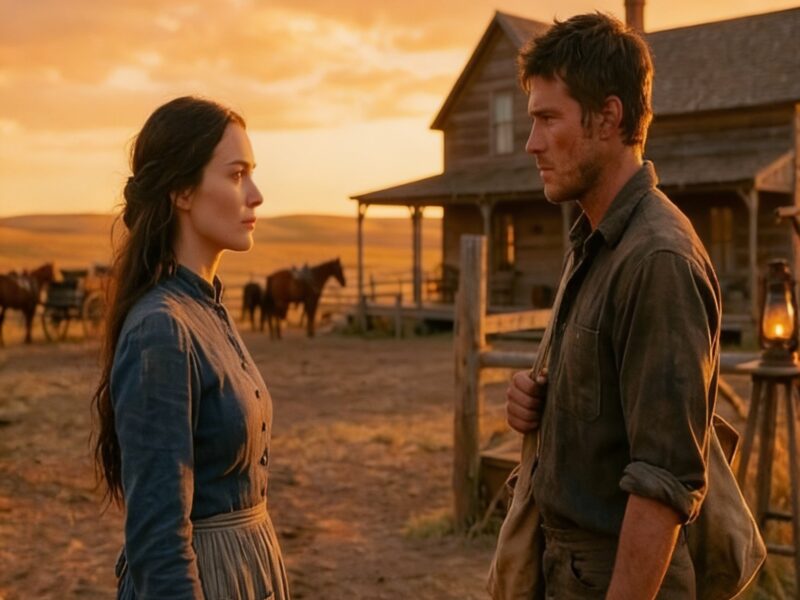
The woman stood on the porch with her arms crossed.
Karen George was taller than most women, lean from work, with dark hair braided down her back and a face too controlled to be soft. She wore a faded blue work dress, boots muddied at the hem, and a man’s leather belt cinched at her waist with a knife tucked into it. Her eyes went first to Robert’s neck.
She saw the mark.
Then she looked at Hale’s man.
“You can turn around now,” she said.
The rider shifted uncomfortably. “Deputy said I was to witness—”
“You witnessed him arriving,” Karen cut in. “Now leave.”
The man looked at Robert, as if expecting help from him. Robert gave him nothing.
When the rider finally turned back toward the road, Karen came down the porch steps. She did not approach Robert. She looked him over the way a woman might inspect a damaged plow someone had dumped in her yard.
“You’re the tramp.”
“Robert Williams.”
“I know your name.” Her voice was steady, but anger lived beneath it, banked and hot. “I know they almost hanged you. I know Hale thinks putting a desperate man in my house will make me easier to manage. What I don’t know is why you said yes.”
“The other choice had a shorter future.”
Her mouth tightened.
For a moment, something like understanding crossed her face. Then it vanished.
“You sleep in the barn,” she said. “You eat after the hands. You keep your hands off me, off my things, and off any decision that concerns this ranch unless I ask for your opinion. In town they can call this a marriage. Here, it is work.”
Robert nodded once. “Understood.”
She seemed almost irritated that he did not argue.
“I mean it,” she said.
“I heard you.”
Her gaze dropped again to his throat. “Do not mistake me for your salvation, Mr. Williams.”
Robert looked past her to the house, the barn, the fields, the worn land holding itself together by will and wire.
“I don’t have that habit,” he said.
Karen turned away first.
The wedding happened that afternoon in the parlor, witnessed by a preacher too frightened of Hale to refuse and two ranch hands who looked anywhere but at Karen’s face. Earl, a grizzled man with a gray beard, stood by the fireplace with his hat in his hands. Doss, hardly more than nineteen, stared at the floorboards as if they might open and save everyone from the shame of it.
Karen did not tremble when she spoke her vows.
Robert noticed that.
She did not look at him either.
When the preacher pronounced them husband and wife, no one moved. Robert did not try to kiss her. Karen did not offer her hand. The preacher shut his Bible with shaking fingers and left in a hurry.
That night, Robert slept in the barn loft with a horse blanket and the smell of hay around him. He lay awake listening to coyotes in the distance and wind moving along the boards. His neck hurt. His ribs hurt from the beating Hale’s men had given him before the wagon. But pain was familiar. Pain was honest.
Marriage was something else.
He had been owned before, or nearly enough. By hunger. By employers with ledgers. By sheriffs with grudges. By the road itself. He knew the difference between shelter and a cage, and he could not yet tell which one this ranch meant to be.
For four days, Karen treated him like a tool she had not wanted but could not afford to throw away.
He rose before dawn, worked fence, hauled feed, repaired a broken gate, cleaned out stalls, and spoke only when spoken to. She watched him from a distance at first, then stopped watching when she realized he knew how to work. Earl grunted approval after Robert fixed a harness buckle with wire and patience. Doss asked him once where he had learned horses.
“Places,” Robert said.
The boy took that as an answer.
At supper, Robert sat at the far end of the table. Karen sat at the head, ledger open beside her plate. She counted every sack of grain, every payment owed, every calf born, every debt pressing its boot into the ranch’s throat.
It was not until the fifth evening that Robert heard the name Henry Cole.
He was outside the barn sharpening an axe when Earl and Doss came in from the south pasture. Their voices dropped low.
“Rider on the east line again,” Doss said.
Earl spat into the dirt. “Cole’s men don’t circle unless they’re measuring something.”
Robert kept the stone moving along the axe blade.
“Maybe we ought to tell Mrs. Williams,” Doss said.
Earl’s eyes flicked toward Robert.
Mrs. Williams.
The name settled strangely.
“She knows,” Earl said. “She always knows.”
At supper, Robert waited until Doss and Earl had gone.
“Who is Henry Cole?”
Karen’s fork stopped halfway to her mouth.
For several seconds she did not answer. Then she set the fork down and looked at him fully.
“A vulture with a land office.”
Robert leaned back.
“He works for men he never names,” she said. “Speculators, mine interests, rail men, whoever has enough money to keep his boots clean while others do the theft. For two years he has disputed our east boundary, filed claims over grazing sections my father owned free and clear, scared off buyers, poisoned credit, moved markers, cut wire, and sent men riding close enough to remind me I’m alone.”
Robert watched her hands. They were calm on the table.
That told him more than shaking would have.
“And Hale?”
Her mouth curved without humor. “Deputy Hale believes paperwork is complicated and women are emotional.”
“He knows.”
“Of course he knows.”
Robert looked toward the dark window. Outside, the ranch lay under moonlight. A place half-starved, half-defiant.
“Why this land?” he asked.
Karen’s expression changed. Not softened. Changed.
“Water,” she said. “There’s a spring draw on the east section. Runs even in dry years. My father bought this place because of it. If a rail spur ever comes near Milford, that water becomes worth more than cattle.”
“And Cole wants it.”
“Cole is paid to want it.”
Robert sat with that.
A woman alone. A ranch under pressure. A lawman who did nothing. A forced marriage arranged by that same lawman, involving a man with nothing and no reputation to defend.
He felt the shape of a trap before he saw its walls.
The next morning, Robert rode the east boundary alone.
He took the deed from Karen’s office before dawn—not stole, borrowed, though he knew she might not appreciate the distinction—and studied the survey marks by gray morning light. The land rolled flat and wide beneath a bruised sky. Quail scattered from the brush. Dust lifted behind his horse’s hooves.
By the second marker, he knew.
The boundary post had been moved.
Not much. Maybe twenty yards. Enough to seem like old error to a lazy eye. Enough, repeated across miles, to steal acres without firing a shot.
Robert dismounted and crouched beside the post. The dirt around it was fresher than the ground nearby. Whoever had moved it had packed the soil carefully, but not carefully enough.
He stayed there a long time, one hand on the post, looking east toward Cole’s range.
This was not his land.
Karen had made that plain. Everyone had.
And yet something in Robert’s chest tightened with a feeling so unfamiliar he almost mistook it for anger.
By sunrise he had the wagon loaded with timber, wire, a shovel, and a post driver. He pulled the false marker and reset it where the deed placed it, driving it deep into the earth with measured, punishing blows. Each strike rang out across the empty plain.
He did not hurry.
He did not look over his shoulder.
By the time he returned, the sun was high and Karen stood in the yard with her hands on her hips.
“You took my deed.”
“I brought it back.”
“You took my wagon.”
“Brought that back too.”
Her eyes flashed. “That is not the point.”
“No,” Robert said, stepping down. “The point was moved twenty yards east.”
Karen froze.
He pulled the deed from inside his coat and handed it to her. “Second marker from the old cottonwood. Dirt was fresh. I put it where it belongs.”
She stared at the paper, then at him.
“You did that alone?”
“Yes.”
“Cole’s men will notice.”
“Good.”
The word fell between them like iron.
Karen’s anger did not disappear, but it shifted shape. For the first time since he had arrived, she looked at him not as an intruder, not as a burden, not as a sentence handed down by a corrupt lawman.
She looked at him as a man who had chosen a side.
“That was dangerous,” she said.
“Most useful things are.”
Her lips parted slightly, then closed again.
Robert took the harness from the wagon horse and walked toward the barn.
“Mr. Williams,” she called.
He stopped.
Karen stood in the yard with the deed pressed against her skirt.
“Do not take my papers again without asking.”
He turned his head. “I won’t.”
A pause.
“And next time,” she said, voice quieter, “wake me.”
Robert looked at her for a long moment.
Then he nodded.
The raid came three nights later.
Robert heard the cattle first.
Not the ordinary low shifting of animals in the dark, but a panicked surge. Hooves. Men’s whistles. A sharp crack of a whip.
He was off the loft floor in seconds.
By the time he reached the yard, rifle in hand, Karen was already coming out of the house in her nightdress, boots unlaced, hair loose over her shoulders.
“South pasture,” he said.
“I know.”
They ran in different directions, him for his horse, her for the gun rack.
Moonlight silvered the land. Dark riders pushed the herd hard toward the east fence, where a section had already been cut. Four men, maybe five. They moved with practiced speed, driving the cattle through the opening before anyone could count the loss.
Robert fired into the air.
The riders scattered, then regrouped.
One came toward him.
Robert swung onto his horse bareback and drove straight at him.
The two horses nearly collided at the torn fence. The rider cursed and raised a pistol. Robert leaned low, slammed his rifle stock into the man’s wrist, and heard the pistol fall into the dirt. The rider wheeled away, but Robert caught his coat and dragged him half out of the saddle.
For one brutal second, they struggled in moonlight.
The man’s hat fell back.
Robert saw a scar down his cheek.
Then another rider shouted from the dark, and the scarred man tore free, leaving a strip of coat in Robert’s fist.
“Tell Cole,” Robert shouted after them, “the line holds.”
A shot cracked.
Wood splintered near his shoulder.
Then Karen was there, rifle leveled from horseback, her face pale and furious beneath her loose hair.
She fired once.
Not wild. Not warning. Close enough to make the last rider duck hard and spur east.
The cattle milled in terror. For the next hour, Robert and Karen worked side by side, turning the herd, pushing them back, repairing enough of the fence to hold until morning. Neither spoke except when necessary. Their horses moved close in the dark. Once, when a calf bolted, Karen leaned too far from the saddle and Robert caught her by the waist before she could fall.
For one breath, his hand stayed there.
Her body went still under his grip.
He let go first.
At dawn, they stood by the torn fence, muddy, exhausted, and alive. Earl and Doss arrived pale with shame for having slept through the first alarm, but Karen said nothing harsh to them. She only handed Doss a coil of wire and pointed.
Robert found blood near the fence. Not much. Enough.
He also found the pistol the rider had dropped.
On the grip, carved carefully into the wood, were the initials H.C.
Karen stared at it.
“They wanted us frightened,” she said.
Robert looked east, where the sun was rising red. “Then they should’ve sent better men.”
She gave a short laugh, startled out of herself by the roughness of him.
Then the laugh broke.
Not into tears. Karen did not cry easily. It broke into something worse, a trembling breath that seemed dragged up from two years of standing alone in a war nobody admitted was happening.
Robert looked at her.
Her face turned away quickly, but not before he saw it: the exhaustion, the fear, the humiliation of needing help from the man forced into her life like punishment.
He wanted to touch her.
The urge came so suddenly he stepped back from it.
Instead, he said, “Go inside. I’ll finish here.”
Her chin lifted. “This is my ranch.”
“I know.”
“Then don’t order me off it.”
“I’m not.” His voice lowered. “I’m asking you to rest before you fall down in the dirt.”
She stared at him, breathing hard.
The fight went out of her by inches.
“I don’t fall down,” she said.
“No,” Robert said. “You wait until nobody’s looking.”
That struck her.
He saw it land.
For a moment they stood in the wreckage of the fence with the rising sun behind them and cattle lowing at their backs. Karen looked at him as if he had reached into her chest and named something without permission.
Then she turned and walked toward the house.
At the porch, she stopped.
“Robert.”
It was the first time she had used his given name.
He looked up.
“There’s coffee,” she said. “When you’re done.”
Part 2
After the raid, the ranch changed its breathing.
It was not safe. Not even close. But the fear no longer belonged to Karen alone.
Robert felt it in the way Earl started carrying a shotgun to the far pasture, in the way Doss stopped whistling while he worked, in the way Karen checked the windows after dark when she thought no one noticed. He felt it most sharply in himself.
He had spent his life leaving before trouble found a name. This time, trouble had a name, a direction, and a scar-faced rider who would come again.
Robert did not leave.
He repaired the south fence stronger than before. He reinforced the barn doors. He moved the horses closer to the house at night. He marked the places along the eastern boundary where men could cross under cover. He cleaned rifles at the kitchen table while Karen worked her ledgers by lamplight.
At first, she objected to the rifles on the table.
Then one evening, without comment, she pushed a tin of oil toward him.
That was how trust began between them.
Not sweetly. Not with declarations.
With gun oil. Coffee. Shared silence. A second cup set near his elbow before dawn. His coat hung by the kitchen door instead of in the barn. A place at the supper table that no one questioned anymore.
He still slept in the loft.
But on the twelfth night after the raid, a storm rolled hard across Milford County, tearing rain sideways and shaking the barn walls until the horses screamed. Robert was up calming them when lightning struck the old cottonwood near the house. The crack split the night open.
Through the rain, he saw Karen on the porch, struggling to latch a shutter that had broken loose.
“Get inside!” he shouted.
The wind swallowed it.
He ran across the yard, mud sucking at his boots. The shutter slammed back and caught Karen across the temple. She staggered. Robert reached her before she fell, one arm around her waist, his other hand catching the shutter and driving it closed.
Blood ran down the side of her face.
“I’m fine,” she said immediately.
“You’re bleeding.”
“It’s nothing.”
He lifted her into his arms.
She fought him for exactly three seconds.
“Put me down.”
“No.”
“Robert Williams—”
“You can yell once I see how deep it is.”
He carried her through the front door, kicked it shut against the storm, and set her in a kitchen chair. The house smelled of rain, lamp smoke, and the sharp iron scent of blood. Karen sat rigid while he took a clean cloth from the stove rail and bent close to examine the cut.
“It doesn’t need stitches,” he said.
“I told you.”
“But you’re hardheaded enough to make it worse.”
Her eyes flashed. “You were almost hanged last week. I don’t need lectures on judgment.”
“Three weeks.”
“What?”
“It was three weeks ago.”
She looked at him, then despite herself, a breath of laughter escaped her.
It faded quickly.
Robert pressed the cloth gently to her temple. She winced but did not pull away. Rain battered the windows. The lamplight made her skin look warmer, softer, revealing the faint freckles across her nose, the tired shadows beneath her eyes.
He had not allowed himself to notice those things.
Now, with her face inches from his, he noticed too much.
Karen noticed him noticing.
The room seemed to draw tight.
His fingers were still against her jaw.
She swallowed.
“You don’t have to do this,” she said.
“Hold still.”
“I mean any of it.”
Robert’s eyes lifted to hers.
“The fence. The riders. The land office. Sitting in this kitchen as if Hale didn’t put you here like a bad joke.”
His hand stilled.
“You think I don’t know what I am?” she continued, voice low now, stripped by the storm. “A woman with debts, enemies, and a name men in town have been laughing at since the preacher left this house. You were forced into my ruin, and somehow you’ve started acting like it’s a home.”
The word hit harder than she meant it to.
Home.
Robert took the cloth away. The bleeding had slowed.
“I don’t know what home is,” he said.
Karen’s anger faltered.
He stepped back, rinsed the cloth, wrung it out.
“I know what a trap is,” he continued. “I know what a lie is. I know when a man smiles while putting a rope on somebody. Hale didn’t send me here to help you. He sent me here because he thought I’d break what was left.”
Karen’s face tightened.
“He thought right,” she whispered. “About me being breakable.”
Robert turned sharply. “No.”
The force of it startled them both.
He set the cloth down.
“No,” he said again, quieter but harder. “Breakable things don’t hold a ranch together for two years while men steal it by inches. Breakable things don’t ride into gunfire in their nightdress. Breakable things don’t look at a man with a rope burn on his neck and tell him exactly where he stands.”
Her eyes shone in the lamplight.
Not tears. Not yet.
Something more dangerous.
Belief trying to enter a room where it had never been welcome.
Robert wanted to cross the space between them. He wanted to take her face in his hands, wanted to know whether her mouth would soften or cut him. The wanting made him angry with himself.
Karen was his wife by law and not his by consent.
That mattered.
So he picked up his hat.
“The storm’s easing,” he said. “I’ll check the barn.”
He went out before either of them could make a mistake they would not know how to survive.
The next morning, Karen found him asleep in a chair beside the barn door, rifle across his lap. He had stayed there all night because the lightning had spooked the horses and because a storm was good cover for men who cut fences.
His head was tilted back. Rain had dried in his hair. In sleep, the hard lines of his face loosened, and he looked younger. Not harmless. Never that. But human in a way that made Karen’s chest ache.
She stood there longer than she meant to.
Earl came around the corner carrying a feed sack, saw her watching Robert, and wisely turned around.
Karen went back inside.
By noon, trouble came wearing a black coat.
Henry Cole arrived in a polished buggy, with the scar-faced rider beside him and two armed men behind. He stopped in front of the house as if paying a social call. Robert watched from the barn. Karen stepped onto the porch before anyone could stop her.
Cole removed his hat.
He was handsome in the way knives were handsome—clean lines, bright edges, made for damage. He smiled at Karen as if they were old friends.
“Mrs. Williams,” he said. “Though I confess, that name still surprises me.”
Robert began walking toward the porch.
Karen did not look at him, but she must have heard him. Her shoulders squared.
“What do you want?” she asked.
“To prevent unpleasantness.”
“You’re late.”
Cole’s smile thinned. “There is still time for you to make a sensible decision. Sell the east section. Keep the house, if sentiment requires it. No one wants to see you suffer.”
Robert stopped at the base of the porch steps.
Cole’s eyes flicked to him.
“Ah,” he said. “The husband.”
Robert said nothing.
Cole looked him over, pausing at the faded rope mark. “Milford does enjoy its miracles.”
Karen’s hand tightened on the porch rail.
Cole saw that too. His smile returned.
“I wonder, Mr. Williams, if you understand the fragile nature of your position here. A condemned drifter married under emergency circumstances to a woman under financial strain. One might question whether such a marriage could withstand legal scrutiny.”
Robert climbed one step.
Cole’s men shifted.
Karen said, “Robert.”
He stopped.
Cole enjoyed that. “How obedient.”
The scar-faced rider laughed.
Karen came down the steps so fast Cole’s expression changed. She crossed the yard and slapped him across the face with all the force two years of fear could give a hand.
The sound cracked through the yard.
Cole’s head turned.
For a moment, no one moved.
Then the scar-faced rider reached for his pistol.
Robert hit him before the gun cleared leather.
It was not a saloon brawl. It was quicker and uglier. Robert drove his fist into the man’s throat, knocked the pistol aside, and slammed him against the buggy wheel. One of Cole’s other men raised a shotgun.
Karen lifted her rifle from behind the porch post.
“I wouldn’t,” she said.
Her voice was cold enough to stop him.
Cole touched his split lip. Blood marked his glove.
“You have made a mistake,” he said.
Karen stood beside Robert now, shoulder nearly brushing his arm.
“No,” she said. “I made several. Letting you speak this long was one of them.”
Cole’s gaze moved between them.
Something in his expression sharpened.
Not fear.
Calculation.
“You think he stays because of honor?” he asked Karen softly. “Men like him stay until the next hunger takes them. Ask his kind what loyalty costs.”
Robert’s face went still.
Karen felt the words hit him, though his body did not show it.
Cole stepped back into the buggy.
“Seven days,” he said. “That is how long you have before the claim is finalized in Milford. After that, sentiment will not matter.”
“The claim is forged,” Robert said.
Cole smiled. “Then prove it.”
He drove away with his men in a spray of dust.
Karen did not lower the rifle until they were gone.
Only then did she turn to Robert.
His knuckles were bleeding. The scar-faced rider’s pistol lay in the dirt.
“Your hand,” she said.
“It’s fine.”
She almost smiled. “That’s my line.”
But he did not answer.
He was watching the road where Cole had vanished, jaw tight, eyes dark.
“He got under your skin,” she said.
Robert bent and picked up the pistol. “Men like that talk until something lands.”
“And did it?”
He looked at her.
For one breath, she saw the old wound. Not the rope mark. Something deeper. The wound of being believed worthless so often that part of him had stopped arguing.
Karen stepped closer.
“I don’t think you’ll leave because hunger takes you,” she said.
His expression changed almost imperceptibly.
“I think you’ll leave because staying scares you more than dying did.”
That landed harder.
Robert looked away first.
“Careful, Karen.”
His use of her name moved through her like heat.
“Or what?” she asked.
He stepped close enough that she had to tilt her head back.
For the first time, she felt the size of him not as threat but as shelter. Dangerous shelter. The kind that could burn as easily as protect.
“Or you might find out I’m not as decent as you’ve decided.”
Karen’s breath caught.
“I haven’t decided you’re decent.”
“No?”
“No.” Her voice softened despite herself. “I’ve decided you’re trying to be.”
He stared at her mouth.
She saw it.
The world narrowed to that glance.
Then Earl dropped a bucket loudly near the barn, and both of them stepped apart as if caught stealing.
That evening, Robert rode to Hartwell with Karen’s deed, survey records, the carved pistol grip, and the strip of coat torn from the raider. Karen insisted on going with him. He refused. She reminded him he had promised to wake her next time.
They argued for ten minutes in the yard.
She won.
Hartwell was larger than Milford, with brick buildings, a real courthouse, and enough people on the street that no one cared about a woman riding beside a man with a rough face and a healing rope mark. The territorial land office smelled of ink, paper, and pipe smoke. A thin clerk named Aldous looked at Robert as if expecting him to steal the counter.
Karen stepped forward and laid the deed down.
“This is my father’s land,” she said. “And men in Milford are trying to steal it with forged claims.”
Aldous blinked.
Robert added the pistol and the torn coat strip.
“They raided the herd three nights ago,” he said. “One of Cole’s men dropped this.”
Aldous looked from the pistol to Robert’s face. “You understand accusations of this kind require formal sworn statements.”
“I understand writing my name,” Robert said.
Karen glanced at him. There was pride in her eyes before she hid it.
They spent hours in that office. Karen gave dates, names, copies of notices, creditor letters that had appeared after Cole’s visits, a record of fence cuts and missing cattle. Robert spoke only when necessary, but when he did, Aldous listened. There was a steadiness in him men recognized even when they did not want to.
By dusk, Aldous had summoned Wallace Pruitt, a territorial investigator with a compact body, tired eyes, and a badge he did not display until he needed it.
Pruitt read everything without expression.
Then he looked at Karen. “Why did you not bring this sooner?”
Her mouth tightened.
“The deputy in Milford told me boundary disputes were civil matters.”
Pruitt’s eyes shifted to Robert. “Deputy Hale?”
“Yes,” Robert said.
Something unreadable crossed Pruitt’s face.
He leaned back.
“I’ll open an inquiry.”
Karen’s shoulders sagged so slightly only Robert noticed.
Pruitt saw more than he showed. “Do not misunderstand me, Mrs. Williams. An inquiry is not protection. If these men are as bold as this evidence suggests, they may try to pressure you before I can act.”
“We’re used to pressure,” she said.
Pruitt looked at Robert’s bruised knuckles. “I imagine.”
They rode home under a violet sky, the road silver with moonlight. For a long while, neither spoke.
Then Karen said, “You signed as my husband.”
Robert’s reins shifted in his hand.
“That’s what the paper asked.”
“You could have signed as witness.”
“I witnessed it as your husband.”
The words were plain. Legal. Almost nothing.
They still changed the night around them.
Karen looked ahead, heart beating strangely.
“You don’t have to mean that,” she said.
Robert’s horse slowed. “I don’t say things I don’t mean.”
She turned to him.
In the moonlight, his face was hard to read, but his eyes were not. They held fear, though no one else would have called it that. Robert Williams could face a hanging, armed raiders, Cole’s men, and a corrupt deputy without blinking.
But the truth between them made him look like a man at the edge of a cliff.
Karen’s voice lowered. “What do you mean?”
He looked away toward the dark fields.
“That I know what name I signed.”
Nothing more.
Nothing less.
It kept her awake all night.
Two days later, Milford made its judgment.
Karen went into town for supplies because the ranch could not live on danger and pride. Robert rode beside her despite her telling him not to. In town, people stared openly. Women whispered behind gloved hands. Men leaned in doorways, smiling with the small cruelty of those who enjoyed seeing private pain dragged into daylight.
At the mercantile, Mrs. Bell refused Karen credit.
Karen stood very still with flour, coffee, lamp oil, and salt stacked on the counter.
“My account has never gone unpaid,” she said.
Mrs. Bell’s face flushed, but her voice stayed sharp. “Deputy Hale advised us that the George property is under legal dispute. Until ownership is clarified—”
“Ownership is clear.”
“Not according to filings.”
Robert stood behind Karen, close enough to feel the tremor she refused to show.
“How much?” he asked.
Karen turned. “No.”
He ignored her and set coins on the counter.
Mrs. Bell looked surprised. So did Karen.
Robert had been saving his small wages in a tobacco tin beneath a loose board in the barn. Every coin he had earned since arriving went onto that counter.
“It isn’t charity,” he said before Karen could speak. “I eat too.”
The humiliation in her eyes did not disappear, but it softened around the edges.
Outside, Deputy Hale waited near the hitching post.
Robert saw him first.
Hale wore a clean shirt, polished boots, and the relaxed expression of a man who believed the world still favored him. His gaze moved from Robert to Karen and lingered there just long enough to be insulting.
“Mrs. Williams,” he said. “Town suits you poorly these days.”
Robert stepped forward.
Karen caught his sleeve.
The gesture was small. Intimate. Hale saw it.
His eyes brightened.
“Well,” he said. “Perhaps this arrangement has grown warmer than expected.”
Karen’s face went white.
Robert’s voice dropped. “Move.”
Hale smiled. “Careful, Williams. You’re alive because I allowed it.”
“No,” Robert said. “I’m alive because you needed something.”
For the first time, Hale’s smile faltered.
Robert stepped closer, forcing Hale to look up slightly.
“I’ve been thinking about that wagon,” Robert said. “About why a deputy so eager to hang me changed his mind in front of half the town. About why you chose Karen’s ranch. About why Cole files claims and you look away.”
Hale’s expression sealed shut.
“You have a restless imagination.”
“Maybe.”
Hale’s hand drifted toward his belt.
Karen’s rifle was in the wagon.
Robert’s pistol was under his coat.
The street seemed to hold its breath.
Then Hale smiled again, but this time it had no pleasure in it.
“You were nothing before I put you on that ranch,” he said quietly. “Remember that.”
Robert leaned in.
“I remember everything.”
Hale walked away first.
Karen’s fingers were still twisted in Robert’s sleeve.
When she realized, she let go.
“I’m sorry,” she said.
“For what?”
“For stopping you.”
“You didn’t.”
She looked up.
“I stopped because you touched me,” he said.
That silenced her completely.
They drove home with supplies rattling in the wagon and the town shrinking behind them. Halfway to the ranch, Karen said, “I hate that they saw me like that.”
“Like what?”
“Begging for credit.”
“You weren’t begging.”
“It felt like it.”
Robert looked at her. “Shame belongs to the person who uses hunger as a weapon. Not the person trying to buy flour.”
Her eyes filled so suddenly she turned away.
Robert pretended not to see.
That night, she came to the barn.
He was brushing down his horse by lantern light. Rain tapped lightly on the roof. Karen stood just inside the door, wrapped in a shawl, her hair loose from its braid.
“You paid with everything you had,” she said.
He kept brushing. “I’ll earn more.”
“That isn’t the point.”
“No?”
“No.”
He stopped.
She came closer, slowly, as if approaching a skittish animal.
“I don’t know what to do with you,” she admitted.
Robert’s mouth tightened. “Most people don’t.”
“I was cruel to you.”
“You had cause.”
“Not enough.”
He said nothing.
Karen’s fingers tightened around the shawl. “When you first came here, I thought you were another punishment. Something Hale had thrown at me because he could. I looked at your neck and saw danger. I looked at your hands and saw trouble. I didn’t see—”
She stopped.
Robert turned fully toward her.
“What?”
She swallowed.
“I didn’t see that you were hurt too.”
The barn grew very quiet.
Robert’s eyes darkened.
“That doesn’t matter.”
“It does to me.”
“You don’t want to make that your concern.”
“Maybe I already have.”
He moved then, not toward her, but away, as if distance could save them.
Karen followed one step.
“Robert.”
“No.”
The word was raw.
She stopped.
He gripped the stall rail, head bowed, shoulders rigid. “You don’t know what wanting does to men like me.”
Her breath shook. “Then tell me.”
He laughed once without humor. “It makes us stupid. Makes us think we can keep things. Makes us forget the world takes whatever we touch.”
“I am not a thing.”
His head turned.
Fire lit behind his eyes.
“No,” he said. “You’re not.”
The way he said it moved through her body like a hand.
She should have left. She knew that. The whole town already had its teeth in her name. This marriage was tangled in coercion, danger, debt, and fear. Robert was still half a stranger, still carrying violence in his hands and secrets in his silence.
But he had stood between her and humiliation.
He had ridden into gunfire.
He had signed his name beside hers.
He had seen her almost fall and not despised her for it.
Karen crossed the last of the space between them.
Robert did not touch her.
His restraint was almost painful to watch.
So she touched him first.
Just two fingers to the rope mark at his throat.
His eyes closed.
The sound he made was barely a breath.
“Karen.”
It was warning and plea together.
She rose on her toes and kissed him.
For one second, he went still.
Then his control broke in silence.
He caught her face in both hands and kissed her back with a hunger that frightened her because it answered something in herself. Not gentle. Not cruel. Desperate, restrained by force, as if he were holding himself back from a ledge even while falling.
When he pulled away, both of them were breathing hard.
Rain whispered over the roof.
His hands were still on her face.
“This changes things,” he said.
Karen’s eyes searched his. “They were already changed.”
He rested his forehead against hers, and for the first time since the wagon in Milford, Robert Williams looked defeated.
Not by Hale.
Not by Cole.
By the terrifying possibility that someone could need him and not regret it.
Part 3
The letter came nailed to the front door with a skinning knife.
Robert found it at dawn.
The blade had been driven so deep into the wood that he had to wrench it free with both hands. The paper fluttered in the cold morning wind, folded once, unsigned.
Vacate the George Ranch within seven days. Consequences will not be limited to land.
He read it twice.
Then he looked toward the road.
The yard behind him was quiet. The house still slept. In the barn, Doss was coughing awake. Smoke had not yet risen from the kitchen chimney. The world looked ordinary, which made the threat uglier.
Robert folded the letter and put it inside his coat.
Karen found him by the east fence an hour later, driving new staples into wire with more force than necessary.
“You didn’t come in for coffee,” she said.
He struck another staple.
“Robert.”
He stopped.
She stood a few feet away, wrapped in her brown coat, braid over one shoulder, eyes already knowing. Karen had become too skilled at reading the weather in him.
He handed her the letter.
She read it without speaking.
Her face did not crumble. That would have been easier.
Instead, it hardened until he could hardly bear to look at her.
“Seven days,” she said.
“They’re rushing.”
“Because of Hartwell.”
“Yes.”
She folded the letter carefully. “We should take this to Pruitt.”
“I’m riding today.”
“We.”
Robert’s jaw tightened. “No.”
Her eyes lifted.
He knew that look now. The calm before her anger.
“You don’t get to decide where I’m safe,” she said.
“If Hale is behind this, he may be watching the road.”
“Then he can watch both of us ride.”
“Karen—”
“No.” She stepped close. “You do not get to kiss me in the barn like I’m yours to want, sign your name as my husband, stand in my kitchen bleeding for my land, and then treat me like something to be locked in the pantry when danger comes.”
His expression changed.
The words had struck deeper than she expected.
“I’m trying to keep you alive,” he said.
“I was alive before you.”
“You were surviving.”
“So were you.”
They stared at each other across the fence line.
The wind moved through the grass.
Finally, Robert looked away first. “Saddle your horse.”
They rode to Hartwell under a sky heavy with storm. Pruitt was not in his office when they arrived. Aldous looked nervous enough to confirm trouble before he opened his mouth.
“He left for Milford yesterday,” the clerk said.
Robert went still. “Why?”
“To question Deputy Hale.”
Karen’s hand tightened around the letter.
Aldous glanced toward the window. “He sent a wire this morning. Said he had obtained financial records from the county office. He asked that you remain at the ranch and avoid town until he contacts you.”
Robert’s mouth became a hard line. “Hale knows.”
Karen looked at him. “Knows what?”
“That Pruitt has something.”
They left Hartwell without supplies, without food, without the comfort of believing the law was moving faster than violence.
Halfway home, they found Pruitt’s horse.
It stood riderless near a dry wash, reins dragging, saddle streaked with blood.
Karen made a sound she swallowed immediately.
Robert dismounted.
“Stay mounted.”
This time she did not argue.
He followed the marks down into the wash and found Pruitt alive beneath a cottonwood, hat gone, face bloodied, one hand pressed to his side. He had taken a bullet low, not clean through.
Robert crouched beside him.
Pruitt’s eyes opened. “Hale.”
“I know.”
“Records…” Pruitt coughed, grimacing. “Inside coat.”
Robert pulled a folded packet from Pruitt’s inner pocket. Bank drafts. Payment records. Letters with Hale’s initials carefully hidden but not well enough. Henry Cole’s name appeared again and again. So did the name of a rail syndicate out of St. Louis.
Karen came down despite Robert’s sharp look.
When she saw the blood, her face paled, but she knelt and helped bind the wound with strips torn from her petticoat.
Pruitt gripped Robert’s wrist. “He’ll come now. No more paper. No more delay.”
Robert looked at Karen.
The last of whatever innocence remained between them died there in the wash.
They got Pruitt to a line shack two miles off and sent a passing freighter toward Hartwell for a doctor and marshal. Then they rode hard for the ranch.
Smoke was rising when they crested the ridge.
Karen screamed.
Not a word. A sound.
Robert drove his horse faster.
The barn was burning.
Flames crawled up the hayloft wall, black smoke boiling into the sky. Earl and Doss were dragging horses out, coughing and stumbling. One of Cole’s men lay unconscious near the trough. Another was running east with Doss’s shotgun blast tearing dirt near his heels.
Karen flew from her saddle before her horse fully stopped.
Robert caught her arm. “House first!”
“My horses—”
“Earl has them. House!”
She tore free but obeyed.
Inside, drawers had been pulled open. Papers scattered. The office desk smashed. Someone had come looking for the deed, the survey, anything that proved ownership. They had not found the originals because Robert had hidden them beneath a loose hearthstone after the first raid.
Karen saw the destruction and went silent.
That silence frightened Robert more than any scream.
He grabbed the deed packet from the hearth and shoved it into his coat.
Outside, the barn roof collapsed inward with a roar.
Doss cried out.
Earl dragged him back as sparks flew.
Karen ran to them. Robert joined the bucket line, working until his arms burned and smoke tore his lungs raw. By dusk, the barn was a blackened skeleton. Two horses were dead. Half the stored hay was gone. Doss’s left arm was burned from wrist to elbow. Earl sat on an overturned barrel, face gray with exhaustion.
Karen walked through the ashes after sunset.
Robert followed at a distance.
She stopped near the place where the loft ladder had been.
“This was my father’s first barn,” she said.
Her voice was flat.
Robert said nothing.
“He built it before the house. Slept in it the first winter. My mother used to say he loved this barn more than most people.”
Ash drifted between them.
Karen bent and picked up a blackened horseshoe. Her hand shook.
Then she threw it into the ruins with sudden violence.
“I am so tired,” she said.
The words broke open.
Robert reached her as she folded, not fainting, not collapsing prettily, but bending under a weight no human being could carry forever. He caught her against him, and this time she did not resist. She gripped his shirt in both fists and pressed her face to his chest.
“I hate them,” she whispered. “I hate them for making me afraid of my own land.”
Robert held her tight, one hand at the back of her head, his cheek against her hair.
“I know.”
“I hate Hale for putting you here like another humiliation.”
His arms tightened.
“And I hate myself,” she said, voice shuddering, “because if he hadn’t, I never would have known you.”
Robert closed his eyes.
There it was.
The cruel root of them.
Their bond had grown out of coercion, shame, and another man’s scheme. Love, if that was what this terrible thing becoming between them was, had been planted in poisoned ground.
He pulled back enough to look at her.
Ash streaked her cheek. Her eyes were wet now. Furious with it.
“You don’t owe me love because I stayed,” he said.
Her breath caught.
He had used the word first.
Not as confession. As warning.
“You don’t owe me your body because the town says I’m your husband. You don’t owe me softness because I fought men who needed fighting.”
“I know that.”
“Do you?”
She stared at him, wounded.
Robert’s own voice roughened. “Because I need you to know it. I need one thing in my life not to be taken.”
Karen lifted a shaking hand to his face.
“You weren’t taken from me,” she said. “You came back. Again and again. You keep coming back.”
He turned his face into her palm.
For a moment, the ranch burned behind them and neither looked away.
Then a rider appeared on the road.
Not Cole’s man.
A boy from Milford, pale and breathless, with a note from Deputy Hale.
Robert read it by lantern light while Karen stood beside him.
Mrs. Williams is to present herself at the Milford jail by noon tomorrow to answer charges of fraud, conspiracy, and attempted murder of a territorial officer. Failure to appear will be considered admission of guilt.
Karen laughed once.
It was a dead sound.
“He shot Pruitt,” she said. “And now he’ll say I did it.”
Robert crumpled the paper in his fist.
Earl swore under his breath.
Doss, arm bandaged, looked near tears. “They’ll hang her.”
“No,” Robert said.
Everyone looked at him.
His face had gone calm.
Too calm.
Karen knew then what Cole’s men must have known at the fence, what Hale had nearly discovered in the street. Robert’s violence was not loud when it was most dangerous. It went quiet. Focused. Merciless.
She touched his arm. “Don’t.”
His eyes stayed on the road. “Don’t what?”
“Don’t go into town tonight and kill him.”
Earl and Doss went still.
Robert looked at her then.
“He will not put a rope on you,” he said.
“No,” she whispered. “And he will not put one back on you either.”
The words struck.
Robert’s throat worked.
Karen stepped closer, speaking only to him now. “That is what he wants. He wants the man everyone feared. The drifter. The brawler. The condemned fool he can hang without questions. Do not give him that man.”
Robert’s breathing changed.
“I don’t know how to beat him clean,” he said.
“Then we beat him true.”
At noon the next day, Karen rode into Milford beside Robert Williams wearing her black Sunday dress and her father’s old revolver on her hip.
Behind them came Earl with a shotgun, Doss pale but mounted, and Wallace Pruitt lying in the back of a wagon, alive, feverish, and furious. The doctor from Hartwell rode beside him. Behind them rode the Hartwell marshal and two deputies Aldous had sent after receiving the freighter’s message.
Milford stopped breathing.
People poured from storefronts and saloons. Mrs. Bell stood in the mercantile doorway, one hand at her throat. The preacher stepped off the boardwalk. Men who had laughed at Robert’s hanging now looked at the armed riders coming down Main Street and found sudden interest in the dirt.
Deputy Hale came out of the jail.
For the first time, Robert saw fear in him.
It was small. Quickly hidden.
But it was there.
Hale’s hand rested on his gun. “Karen Williams, you are under arrest.”
“No,” Pruitt called from the wagon, voice weak but clear. “She is not.”
The crowd shifted.
The Hartwell marshal dismounted. “Silas Hale, you are relieved of authority pending arrest for conspiracy, fraud, attempted murder, and unlawful coercion.”
Hale laughed. “On whose word?”
Pruitt raised one bloody hand. “Mine.”
Robert stepped down from his horse.
Hale looked at him then, and all the hatred between them stood naked in the street.
“You,” Hale said softly. “You should have died on that wagon.”
Robert walked toward him.
Karen’s heart slammed once.
But Robert stopped ten feet away.
“No,” he said. “That was your mistake.”
Hale drew.
He was fast.
Robert was faster, but he did not shoot to kill.
His bullet struck Hale’s wrist and spun the gun into the dust. The marshal tackled Hale before he could recover. Hale fought like a cornered animal, cursing, kicking, shouting that the town owed him, that Karen was a liar, that Robert was gutter trash.
No one moved to help him.
Not one soul.
Henry Cole tried to slip from the back of the crowd.
Earl cocked his shotgun. “Afternoon, Mr. Cole.”
Cole froze.
By sundown, Hale and Cole were both in irons.
By morning, the territorial ruling came through Hartwell: all claims against the George Ranch were fraudulent, the eastern boundary confirmed, the water rights restored. Hale’s financial records tied him to Cole, Cole to the syndicate, and the syndicate to a planned rail spur that would have made Karen’s land a fortune once she was forced off it.
The town that had watched Robert nearly hang now watched Karen walk out of the land office with the ruling in her hand.
No one laughed.
Mrs. Bell tried to apologize in the street.
Karen looked at her for a long moment and said, “My account will be paid in cash from now on.”
Then she walked away.
Robert followed, and for once no one questioned whether he had the right.
The ranch did not heal quickly.
The barn had to be rebuilt. The dead horses had to be buried. Doss’s arm took weeks to mend. Pruitt recovered slowly in Hartwell and sent word that Hale would stand trial before summer. Cole, faced with papers and witnesses, began naming men richer than himself, which pleased Pruitt immensely.
But the George Ranch held.
Neighbors who had been too afraid or too comfortable to help before began appearing with lumber, nails, labor, pies, excuses. Karen accepted the lumber. She accepted the labor. She accepted no excuses.
Robert worked like a man trying to drive every old ghost into the ground with a hammer. He raised beams, hauled stone, broke horses, rode the boundary, slept little, spoke less. At night, he still went to the barn.
Or what remained of it.
Karen let him for three nights.
On the fourth, she found him standing in the unfinished frame under moonlight.
“You’re avoiding the house,” she said.
He did not pretend otherwise. “Yes.”
“Why?”
His hand rested on a new beam. “Because I don’t know what happens now.”
She walked closer. “We rebuild.”
“The barn, yes.”
“Not just the barn.”
He turned.
Moonlight cut across his face. The rope mark had faded to a pale line, but Karen saw it still. She thought she always would.
“The law says we’re married,” Robert said. “Hale made sure of that. But Hale’s gone. The threat is gone. You can undo it.”
Her chest tightened.
“Is that what you want?”
He looked away.
“That is not an answer,” she said.
His jaw worked. “What I want has never been the question.”
“It is now.”
He laughed under his breath, bitter and afraid. “You say that like wanting doesn’t ruin people.”
“It can.”
His eyes returned to hers.
Karen stepped into the frame of the new barn, into the house of beams and shadows he had been building with his own hands.
“But so can being afraid of it,” she said.
Robert’s face shifted.
She took off her gloves slowly, because her fingers were trembling and she refused to hide it.
“I was humiliated when they forced you on me,” she said. “I hated every eye in that parlor. I hated you a little because it was easier than hating how powerless I was. Then you stayed. You worked. You listened. You fought without making me feel weak. You saw the ugliest parts of my life and did not turn away.”
He was very still.
“I don’t love you because Hale put you here,” she said. “I love you because you chose, every day after, not to be the man he believed you were.”
Robert looked as if the words had hurt him.
Maybe love did, when it entered places built for punishment.
Karen moved closer.
“I am asking you plainly,” she said. “Do you want to remain my husband?”
His breath left him slowly.
“Yes.”
The word was rough. Almost broken.
She closed her eyes for a second.
When she opened them, he was closer.
“I don’t know how to be gentle with something I’m afraid to lose,” he said.
“Then learn.”
“I may fail.”
“You will.”
A startled sound escaped him, almost a laugh.
Karen touched his chest. His heart was beating hard beneath her palm.
“And I will fail too,” she said. “I will get proud and sharp and try to carry too much alone. I will say I’m fine when I’m bleeding. I will probably order you out of my kitchen at least twice a month.”
“At least.”
She smiled through tears.
His hand rose to her face with the restraint she had come to know as one of his deepest forms of tenderness.
“I love you,” he said.
No flourish. No poetry.
Just the truth, surrendered at last.
Karen broke then, but not from sorrow. She leaned into him, and Robert caught her as if holding her was the one skill life had been preparing him for all along. He kissed her beneath the bones of the barn they would rebuild together, and this time there was no shame in it, no fear of stolen consent, no shadow of Hale standing between them.
Only hunger.
Only relief.
Only the fierce, terrifying mercy of being chosen.
Spring came hard and green to Milford County.
The new barn went up stronger than the old one. Robert carved the year into the main beam, and beside it Karen carved her father’s initials, then hers, then Robert’s. Earl pretended not to notice. Doss noticed loudly until Earl told him to shut up.
The eastern fence line held.
So did the marriage.
It was not soft. Neither of them knew how to make a soft thing last. They argued over money, over pasture rotation, over Robert riding alone too often and Karen climbing ladders she had no business climbing. He got quiet when afraid. She got sharp when wounded. Some nights they stood on opposite sides of the kitchen with silence between them like barbed wire.
But he always came back.
And she always opened the door.
By summer, the rail surveyors did come, hats bright under the sun, maps rolled beneath their arms. They offered Karen more money for a right-of-way than her father had ever seen in his life. She negotiated until one of them looked ready to cry. Robert watched from the porch, arms crossed, pride hidden badly beneath his stern expression.
That evening, Karen found him at the boundary post he had reset months before.
The first place he had chosen her.
He stood looking out over the land, hat low, hands resting on his belt.
She came beside him.
“You’re thinking too hard,” she said.
“Probably.”
“About what?”
He looked at the post.
“The day I fixed this, I told myself it wasn’t my land.”
Karen waited.
He touched the weathered wood, thumb moving over the grain.
“I think part of me knew I was lying.”
She slipped her hand into his.
The sun went down slowly over the George Ranch, laying gold across the grass, the fences, the rebuilt barn, the house no longer standing like a woman braced against a blow but like a place ready to endure.
In town, some people still whispered.
They whispered that Karen George had married a condemned man and somehow made him respectable. They whispered that Robert Williams had taken a ranch wife for survival and ended up bound harder than any rope could make him. They whispered because people always did when they could not understand devotion forged in fire.
Robert did not care.
Karen cared less every day.
That night, they sat on the porch steps where months before they had sat with almost enough distance between them to pretend nothing had changed. Now Karen leaned against his shoulder and Robert’s hand rested over hers, rough thumb moving slowly across her knuckles.
“You could have left,” she said.
He looked down at her. “Still saying that?”
“Sometimes I need to hear the answer.”
His expression softened in the way it did only for her.
“I stayed because leaving you became impossible.”
She took that in quietly.
Then she said, “Good.”
Robert smiled.
It was rare, that smile. Small. Devastating. Hers.
The prairie darkened around them. The cattle moved as shadows beyond the fence. The new barn stood black and strong against the fading west. Somewhere far off, a train whistle sounded from a line not yet laid but coming, carrying with it a future men had tried to steal before it reached them.
Karen rested her head against Robert’s arm.
He bent and kissed her hair.
The man Milford had nearly hanged had become the man no one crossed lightly. The woman Milford had expected to break had become the owner of the most valuable water rights east of town. They had been thrown together by cruelty, tested by fire, marked by scandal, and nearly destroyed by men who mistook loneliness for weakness.
But loneliness had not been weakness.
It had been the empty ground where love, once planted, grew wild and stubborn.
Robert held Karen as the first stars came out over the ranch.
And this time, when the dark settled, neither of them faced it alone.