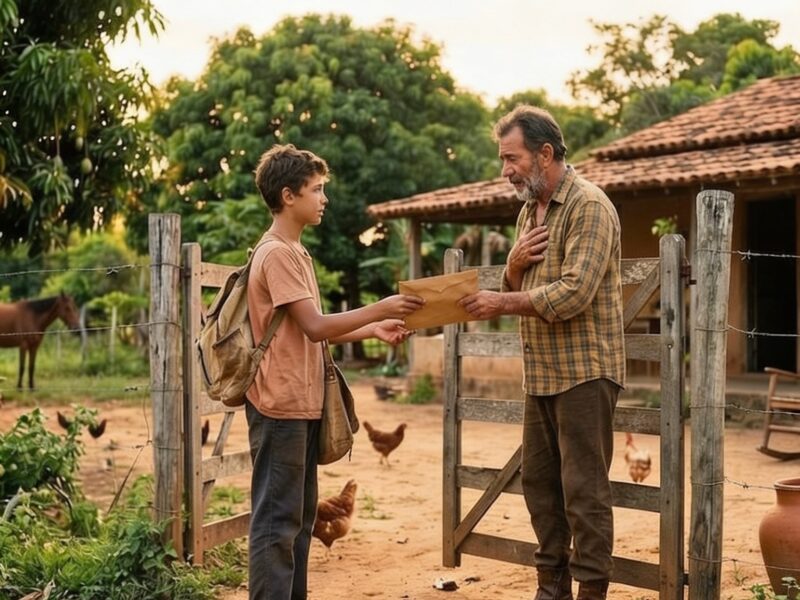
“I Lost My Father… But I’ve Come to Pay His Debt” — What the Farmer Did Next Will Surprise You
Part 1
The morning Arthur Miller died, the wind came down from the Bitterroot Mountains with a sound like somebody whispering bad news through the cracks of the cabin.
Clara Miller sat at the edge of her father’s bed with her hands folded so tightly in her lap that her knuckles had gone white. She was twenty-four years old, old enough to understand death, old enough to have seen it take cattle in winter and neighbors in fever seasons and her own mother when Clara was still too young to braid her hair without help.
But knowing death and watching it pull breath by breath out of the only man who had never abandoned her were two different things.
Arthur Miller had once looked immovable. He had been the kind of man who could lift a split rail alone, mend a gate in a storm, and walk into town with nothing but a clean shirt and his name and still be treated like he carried money. He had never been rich. Never even close. But in the valley, people had respected him because Arthur Miller’s word had always been worth more than another man’s signature.
Now his face was gray against the pillow, his beard untrimmed, his chest rattling beneath the quilt Clara’s mother had sewn before Caleb was born.
Caleb stood in the corner, thirteen and too thin, trying so hard not to cry that his whole body trembled with it.
Arthur’s eyes opened.
“Clara.”
She leaned close at once. “I’m here, Daddy.”
His hand moved weakly over the blanket. She took it between both of hers and felt, with a terror that seemed to empty the room, how little strength remained in him.
“Listen to me,” he whispered. “Both of you.”
Caleb came forward, wiping his face with his sleeve.
Arthur’s gaze moved from his son back to Clara. “The drought took more than the cattle. Took more than seed. I went to Silas Sterling last spring.”
Clara’s stomach tightened.
Everyone in the Bitterroot Valley knew Silas Sterling. His ranch lay north of town, a vast sweep of white fences, black cattle, river pasture, and high ridge timber. Some called him the richest man in the county. Others called him the hardest. He was thirty-six, widowed, and feared in the quiet way men feared another man who did not need to raise his voice to ruin them.
Clara had seen him only twice. Once at church, standing alone near the door in a black coat, his face stern and weather-browned, his eyes too still. Once in town, when a drunken teamster shoved a stable boy and Silas Sterling crossed the street, seized the man by the collar, and dropped him into a horse trough without removing his gloves.
“Sterling holds our note?” Clara asked.
Arthur closed his eyes.
That was answer enough.
“How much?”
“Five thousand.”
Caleb made a small, frightened sound.
Clara felt as if the cabin floor had tilted.
Five thousand dollars might as well have been a railroad fortune. Their cabin, forty acres of stubborn ground, two milk cows, one old mule, and her mother’s wedding ring together would not fetch half of it.
Arthur’s fingers tightened around hers with sudden desperation. “I meant to pay. I swore I would. Harvest was supposed to come in, then pneumonia—”
“Don’t,” Clara said, because she could not bear hearing shame in his voice. “Don’t spend breath on that.”
“A Miller pays what he owes.”
“I know.”
“No.” His eyes opened, sharp now with the last fire in him. “Promise me. Don’t let our name be carried around town like dirt on a boot. Don’t let Caleb grow up hearing his father died owing and his sister ran from it.”
Caleb started crying then, quietly, silently, one hand over his mouth.
Clara wanted to say the promise was too large. That she was not her father. That she was a woman with two cows, a dying fire, a boy to raise, and no money hidden under the floorboards. She wanted to ask why honor always seemed to demand payment from the people who had the least left to give.
But Arthur Miller was dying.
And his eyes were on her.
So Clara bent her head and pressed her lips to his cold hand.
“I’ll pay it,” she whispered. “Every dollar. I swear.”
Arthur’s face changed.
Not peace, exactly. But release.
He died before noon.
By evening, word had crossed the valley.
By morning, people came with covered dishes and downcast eyes and careful voices. Mrs. Gable brought ham, biscuits, and a jar of preserves. Mr. Vance came by long enough to stand awkwardly in the yard, remove his hat, and tell Clara her father had been a good hand. Wade Harlan, who had once promised Clara a ring and a house of her own before deciding grief and debt made a woman less attractive, did not come.
Silas Sterling sent no flowers.
He sent a man in a dark coat carrying a sealed envelope.
Clara opened it at the kitchen table while Caleb watched.
Inside was a formal notice acknowledging Arthur Miller’s death and requesting that Clara present herself at the Sterling ranch within thirty days to discuss settlement of the note.
The words were polite.
The meaning was not.
Thirty days before the valley knew whether the Millers would lose everything.
Caleb stared at the paper. “What are we going to do?”
Clara folded the letter carefully.
She had not slept. She had not eaten. Her black mourning dress was one her mother had worn, taken in at the waist with quick stitches because there had been no time to make grief fit properly.
“We’re going to work,” she said.
She started at Mrs. Gable’s orchard.
The widow found Clara at the gate just after sunrise, a black shawl wrapped over her work dress and her father’s old boots on her feet.
“Clara Miller,” Mrs. Gable said, softening at once. “Honey, you ought to be home.”
“I need work.”
Mrs. Gable’s expression changed. “You need rest.”
“I need ten dollars by sundown more than I need rest.”
The widow’s mouth pressed thin. “I won’t insult you with pity.”
“Thank you.”
“I’ve got stones in the back pasture that need clearing before the fence crew comes. It’s hard work.”
“I know hard work.”
Mrs. Gable looked at her hands. “You’ll blister.”
“I already have.”
The widow gave her a long look, then pointed toward the pasture.
Clara worked until her back screamed and her palms split. Every stone she hauled to the edge of the field felt like a small piece of the debt moved from impossible to merely brutal. At noon, Mrs. Gable tried to make her come in. Clara ate standing up. By sunset, the assigned stretch was clear, and the widow paid her twelve dollars instead of ten.
Clara tried to refuse the extra two.
Mrs. Gable glared. “Don’t make me regret admiring you.”
So Clara took it.
For three weeks, she worked wherever work could be found.
She scrubbed troughs for Vance until her fingers smelled of algae and rot. She mended sacks at the grain mill. She carried feed. She washed linens at the boarding house. She hauled firewood for a woman who inspected every stick as if Clara might cheat her out of heat. At night, she returned to the cabin, helped Caleb with chores, counted money by lamplight, and tucked the coins and bills into a canvas pouch that had once held her father’s tobacco.
The pouch grew heavier.
Not enough.
Never enough.
The valley watched.
Some watched with pity. Some with admiration. Some with a hunger Clara recognized too well—the appetite of people waiting to see whether someone else’s life would collapse spectacularly enough to entertain them.
Wade Harlan finally approached her outside the mercantile, three days before she meant to go to Sterling.
He leaned against the hitching rail in a clean coat, handsome in the shallow way that had once fooled her. “Clara.”
She tried to pass him.
He stepped into her path. “I heard you’re working like a hired mule.”
“That mule earns.”
His jaw tightened. “You don’t have to make yourself ugly over this.”
She looked at him then. “Move.”
“Sterling will take the place anyway. Men like him don’t lend money because they’re kind.”
“Then I’ll pay him.”
“With what? Your hands?” Wade’s eyes flicked over her worn gloves, her faded dress, the exhaustion beneath her eyes. “You should’ve married when you had the chance.”
A year ago, that might have hurt.
Now it only clarified things.
“I did have the chance,” Clara said. “That was the problem.”
She walked around him.
He caught her arm.
Before she could pull free, a voice spoke from behind them.
“Take your hand off her.”
The street quieted.
Clara turned.
Silas Sterling stood outside the blacksmith shop with his hat low and his coat open over a work shirt. He was taller than Wade by several inches, broad through the shoulders, with the settled strength of a man who spent more hours in a saddle than behind a desk. His face was harder than she remembered. Not cruel. But carved by weather, grief, and command.
Wade released her.
“Mr. Sterling,” he said, trying for a laugh. “Just a private conversation.”
Silas’s eyes dropped to Clara’s arm, then returned to Wade. “Didn’t look private. Looked unwelcome.”
Color rose in Wade’s face.
Clara felt every eye on the street.
Silas looked at her. “Miss Miller.”
His voice held no softness, but it held recognition.
She lifted her chin. “Mr. Sterling.”
“I received word you planned to come see me.”
“I do.”
“Come tomorrow. Nine o’clock.”
“I’ll be there.”
His gaze moved once over her face, taking in grief, exhaustion, pride, and whatever else he was too controlled to show he noticed.
Then he looked back at Wade. “You still in her way?”
Wade stepped aside.
Clara walked away without thanking either man.
She hated that Silas Sterling had protected her.
She hated more that some deep, tired part of her had been relieved.
The Sterling ranch looked less like a ranch and more like a country kingdom.
White fences ran in clean lines along the road. Black cattle moved across river pasture, sleek and heavy. The main house stood on a rise beneath old cottonwoods, its wide porch facing the valley as if the whole world had been arranged for its approval. Beyond it lay barns, bunkhouses, corrals, sheds, and men moving with the discipline of a place where work was expected to be done right or done again.
Clara arrived at nine o’clock in her father’s boots with the canvas pouch beneath her shawl.
The foreman at the gate, a narrow-eyed man named Grant Harrow, looked her over with undisguised contempt.
“You looking for kitchen work?”
“I’m here to see Mr. Sterling.”
Harrow smirked. “About what?”
“A debt.”
His smirk widened. “Plenty of girls come up here owing something.”
Clara’s face heated.
Before she could answer, Silas’s voice cut across the yard.
“Harrow.”
The foreman turned.
Silas stood on the porch steps, hat in hand. He had heard. Clara knew he had.
The air changed around him.
Harrow’s smile vanished. “Sir?”
“You speak to Miss Miller like that again, you’ll be looking for work in another county.”
Harrow stiffened. “I didn’t mean—”
“I heard what you meant.”
The yard went silent.
Clara wished the ground would swallow her. She wished Silas had not defended her in front of his men. She wished Harrow’s words had not struck so close to the shame she already carried.
Silas opened the office door. “Miss Miller.”
Inside, his office smelled of leather, paper, wood smoke, and cold coffee. A large desk dominated the room. A rifle hung above the mantel. On one shelf sat a framed photograph of a woman with pale hair and serious eyes.
His wife, Clara guessed.
The dead wife people still whispered about.
Silas sat behind the desk. Clara remained standing.
She set the canvas pouch before him.
“I lost my father,” she said, her voice rough but steady. “But I’ve come to pay his debt.”
Silas looked at the pouch.
Then at her.
He did not touch the money.
“How much is there?”
“Five hundred and eighty-six dollars.”
His expression did not change. “The note is for five thousand.”
“I know.”
“And you came anyway.”
“I said I’d pay. I didn’t say I could do it all at once.”
For the first time, something moved in his eyes.
Not amusement.
Interest.
“You plan to bring me money by handful until you’re old?”
“If that’s what it takes.”
Silas leaned back slowly. “Arthur Miller was a proud man.”
“He was an honest one.”
“Yes,” Silas said quietly. “He was.”
The softness in his voice caught her off guard. It disappeared before she could understand it.
“I don’t need your pennies, Miss Miller. I need value.”
Her jaw tightened. “My money is value.”
“Your money is blood squeezed out of a stone. I know what you’ve been doing.”
That embarrassed her more than his contempt would have.
“I’m not asking for mercy.”
“No.” He stood. “You’re asking for a mountain to move because you brought it a spoon.”
Clara flinched despite herself.
Silas saw it.
His jaw tightened, as if he regretted the cruelty but would not recall it.
“I have a fence line on the north ridge,” he said. “Elk tore it down. Winter’s coming early. The men hate working it because the wind is mean, the ground is rock, and the hut up there leaks. I’ll credit you five dollars an hour against the debt. Ten hours a day if you can stand it. Cash wages for anything past that.”
She stared at him.
It was generous.
It was brutal.
It was also a test.
“For how long?”
“Until the snow closes the ridge or you quit.”
“I don’t quit.”
His eyes held hers. “Most people say that before the ridge.”
“I’m not most people.”
“No,” he said. “I’m beginning to see that.”
The work on the north ridge was hell with a beautiful view.
Clara slept in a shepherd’s hut that smelled of dust, cedar, and mice. The roof leaked near the stove pipe. The wind hit the walls at night like fists. During the day, she dug post holes into ground that seemed made more of spite than soil. Her palms split open again. Barbed wire tore her sleeves and scored her forearms. Twice she hammered her thumb so hard she nearly vomited.
She stayed.
Silas rode up every third day to inspect progress.
He did not praise easily. He did not hover. He did not soften the labor because she was a woman, which angered her until she realized it also respected her. He corrected her knots. Showed her how to brace a corner post against winter pressure. Once, when she snapped at him that she knew how to use a hammer, he calmly took the hammer from her, fixed the brace in half the time, handed it back, and said, “Then use it better.”
She hated him for an hour.
Then she copied what he had done.
On the twelfth day, a storm came over the mountain fast.
Clara saw the clouds but misjudged their speed. By the time the wind shifted, snow already blurred the ridge. She had three posts left in the section and knew if she stopped, the ground would freeze wrong by morning.
She kept working.
Her fingers went numb. Her breath burned. The wire fought her like something alive.
A black horse appeared through the snow.
Silas rode out of the white like judgment.
“Pack up,” he called.
“Three posts.”
“Now.”
“The ground will freeze.”
“So will you.”
She ignored him and drove the post-hole digger down again.
A moment later, he dismounted beside her. She expected anger. Instead he took hold of the post, braced it with both hands, and nodded toward the shovel.
“Then hurry.”
They worked without speaking while the storm thickened around them. He held, she tamped. He stretched wire, she stapled. Snow gathered on his shoulders and in the brim of his hat. His hands were bare because he had given her his gloves after seeing her fingers shake.
By the time the last post held, Clara could barely feel her feet.
Silas took the hammer from her hand.
“That’s enough.”
“I can walk.”
“I didn’t ask.”
Before she understood, he lifted her onto his horse, swung up behind her, and wrapped his coat around both of them.
The heat of him at her back shocked her more than the cold.
She went rigid.
His arm tightened around her waist only enough to keep her from falling. “Don’t make pride the death of you, Clara.”
It was the first time he used her given name.
She closed her eyes.
Not from weakness.
From the dangerous comfort of being held when she had been carrying too much alone.
Part 2
After the storm, Silas moved Clara into the bunkhouse against her will.
She argued from beneath three blankets in the main house kitchen while the cook, Mrs. Bell, forced hot broth into her hands and pretended not to listen.
“I can stay in the ridge hut.”
“The ridge is closed.”
“Then I’ll go home.”
“The creek road is under two feet of snow.”
“I can walk.”
Silas stood near the stove, arms crossed, face unreadable. “No.”
Her temper flared. “You don’t own me.”
The kitchen went silent.
Mrs. Bell froze with the ladle halfway to the pot.
Silas’s expression changed.
The words had struck something. Not anger, exactly. Something darker. Shame, maybe, though Clara could not imagine Silas Sterling allowing shame to show.
“No,” he said quietly. “I don’t.”
He took a ledger from inside his coat and laid it on the table.
“Your ridge hours have been credited. You’ve paid more than a third of the debt in labor and cash. You can continue here through winter in the stables, kitchen, or office records. Your choice. Or you can leave when the road clears. Also your choice.”
Clara looked at the ledger.
Her name was written in his hand.
Not Arthur’s daughter.
Not debtor girl.
Clara Miller.
Her throat tightened.
“I’ll work stables,” she said.
Silas nodded once. “Start tomorrow.”
He left before she could thank him.
The Sterling stables were warmer than the cabin and crueler than the ridge in different ways. Horses cared nothing for grief. They needed feed, water, grooming, stalls cleaned, tack mended, hooves checked. Clara liked that. Work with animals had honesty in it. A horse either trusted your hands or did not.
The men were harder.
Most treated her with wary respect after Silas’s warning. A few resented her. Grant Harrow most of all.
Harrow had worked for Silas for six years and wore authority like a borrowed coat he intended to steal. He was handsome in a thin, cruel way, with fair hair, pale eyes, and a smile that appeared only when someone else was smaller. He watched Clara when he thought she did not notice.
She always noticed.
One morning, he cornered her in the tack room while she was oiling bridles.
“You think he’ll forgive your debt because you bleed pretty?” he asked.
Clara did not look up. “Move.”
“You Miller girls always this proud? Or just the ones hoping to climb into the big house?”
She stood, bridle in hand. “Say it louder. Mr. Sterling enjoys repeating himself.”
Harrow’s face hardened.
Before he could answer, Silas appeared in the doorway.
He did not shout.
He did not need to.
“Harrow,” he said. “The south calves need doctoring. Take two men and go.”
Harrow looked between them, jaw tight. “Yes, sir.”
When he left, Clara went back to the bridle, though her hands shook.
Silas stepped inside.
“What did he say?”
“Nothing worth paying for.”
“I’ll decide that.”
She turned on him. “No, you won’t. Because every time you defend me in front of him, he hates me more after you walk away.”
Silas’s face hardened. “You want me to ignore it?”
“I want you to understand that your protection has consequences when you are not the one left in the room.”
That landed.
For a moment, neither spoke.
Then Silas removed his hat and looked down at it like a man studying a difficult truth.
“You’re right,” he said.
Clara had been prepared for anger. Agreement left her unsteady.
He looked up. “But I will not let a man under my roof speak filth to you.”
“Then remove him for your standards. Not for me.”
A faint, grim smile touched his mouth. “You give orders like you own the place.”
“I’m paying for enough of it.”
The smile deepened by one dangerous degree.
Then faded.
“Mrs. Bell needs help with inventory after supper,” he said. “Office records pay better than stalls.”
“I chose stables.”
“I’m offering both.”
“Why?”
His gaze held hers. “Because you’re better with numbers than most of my men and too stubborn to admit when your hands need rest.”
Clara looked down.
The cuts across her palms had reopened.
She hated that he had seen.
That winter, the distance between them narrowed in small, dangerous increments.
Silas taught her ledgers by lamplight in his office while snow pressed against the windows. Clara learned quickly, partly because she had a sharp mind and partly because every column reduced the debt she had sworn to pay. Silas sat across from her, sleeves rolled to the forearm, dark hair damp from melted snow, his presence too large for the quiet room.
He was not gentle in any obvious way. He corrected mistakes bluntly. Expected accuracy. Asked questions that forced her to think three steps ahead. But coffee appeared at her elbow when she worked late. A better pair of gloves appeared on the tack room shelf without a note. When Caleb came to visit and tried to hide how hungry he was, Silas ordered Mrs. Bell to pack enough food for “the Miller household accounts” and glared Clara into silence before she could protest.
Caleb adored him immediately.
That frightened Clara.
Her brother had been starving for a man to admire, and Silas Sterling was exactly the sort of man boys mistook for invincible.
“He ain’t like folks say,” Caleb told her one evening when they rode home in a Sterling wagon.
“No?”
“He’s hard, but he listens.”
Clara looked toward the dark shape of the main house shrinking behind them.
“Yes,” she said softly. “He does.”
At Christmas, Wade Harlan announced his engagement to Lottie Fairchild at church and made sure Clara heard it. Lottie’s mother looked Clara up and down as if debt were contagious. Wade caught Clara near the church steps afterward.
“You still working up at Sterling?” he asked.
“Yes.”
His smile curved. “Dangerous place for a woman’s reputation.”
Clara’s cheeks burned.
“My reputation survived you,” she said. “It’ll survive work.”
Wade stepped closer. “People are saying Sterling keeps you close for reasons that don’t show up in the ledger.”
Before Clara could answer, Caleb launched himself at Wade.
He was thirteen, furious, and no match for a grown man. Wade shoved him hard enough that Caleb fell into the snow.
Clara moved toward her brother, but Silas got there first.
He had come up silently, black coat unbuttoned, eyes fixed on Wade with a coldness that made nearby conversations die.
He helped Caleb stand, then looked at him. “You all right?”
Caleb nodded, humiliated.
Silas removed his gloves slowly.
Wade paled.
“Mr. Sterling,” he began.
Silas hit him once.
Not wildly. Not in rage. A short, controlled blow that dropped Wade to his knees in the churchyard before God and half the valley.
Silas bent close. “You touch the boy again or put Clara Miller’s name in your mouth, and the next thing you lose won’t be dignity.”
He straightened and looked around at the silent crowd.
“Anyone else confused about her position at my ranch can come ask me directly.”
No one did.
Clara stood frozen, Caleb pressed against her side.
Silas looked at her only once.
There was no triumph in his face. Only fury held on her behalf and something beneath it he seemed determined not to show.
The next day, she found him in the foaling barn with one of his best mares, a gray named Mercy, who was struggling through a difficult birth.
Silas had been there all night. His shirt was rolled to the elbows, his hands bloody, his face drawn with exhaustion. The stable hands hovered uselessly because when Silas Sterling loved anything openly, it was his horses, and none of them wanted to be present if the mare died.
Clara took one look and tied on an apron.
Silas glanced up. “You don’t have to—”
“I know.”
She knelt beside him.
For two hours, they fought for the mare and foal. Silas guided. Clara steadied, cleaned, fetched, held, whispered nonsense to Mercy when the mare thrashed. At last the foal came slick and trembling into the straw, alive by the narrowest margin.
Silas sat back, breathing hard.
Clara laughed once, shaky and bright.
Mercy lifted her head and nickered weakly at her foal.
Silas looked at Clara then, and the expression on his face undid something in her.
Not gratitude.
Wonder.
As if he had not expected her to stand with him in blood and fear and bring something living through it.
“You’re shaking,” he said.
“So are you.”
He looked at his hands and seemed surprised to find it true.
Clara reached for a cloth and wiped blood from his wrist. The gesture was practical. Necessary. But when her fingers touched his skin, the air changed.
Silas went still.
Clara should have pulled away.
She didn’t.
His hand turned under hers, not gripping, only meeting.
The barn was warm with animal breath. Snow tapped softly against the roof. The newborn foal struggled on uncertain legs while Mercy watched with tired devotion.
Silas’s voice lowered. “Clara.”
She knew warning when she heard it.
Her own voice barely rose above a whisper. “Don’t.”
“Don’t what?”
“Don’t say all the reasons.”
His eyes darkened.
“There are many.”
“I know them.”
“You owe me money.”
“I’m paying it.”
“I’m older.”
“You’re not ancient.”
A faint, unwilling smile crossed his mouth, then vanished.
“I employ you.”
“Yes.”
“And men already talk.”
“Men talked when I was starving honestly. They’ll talk when I breathe.”
His gaze dropped to her mouth.
The space between them became unbearable.
Then Harrow’s voice came from the barn door.
“Sorry to interrupt.”
Silas rose at once.
Clara pulled her hand back, heart pounding.
Harrow stood in the doorway, eyes moving between them with poisonous satisfaction.
“Payroll’s short,” he said. “Thirty dollars missing from the bunkhouse box. Thought you’d want to know.”
The accusation did not come that night.
It came the next morning.
In front of the men.
Harrow claimed the money had disappeared after Clara helped Mrs. Bell carry ledgers between the office and bunkhouse. A stable boy swore he had seen Clara near the box. Another man muttered that debt made honest people desperate.
Clara stood in the yard, cold spreading through her body.
Silas said nothing at first.
That hurt worse than accusation.
His face was unreadable, his eyes on Harrow, then the box, then Clara.
“Search my things,” she said.
Silas looked at her. “No.”
The yard stirred.
Harrow’s brows rose. “Sir, with respect—”
“You have none,” Silas said.
Clara’s breath caught.
Silas stepped toward Harrow. “You will say plainly what you are accusing her of, and then you will prove it.”
Harrow’s mouth tightened. “I’m saying money vanished after she had access.”
“Half the ranch had access.”
“She owes you thousands.”
Silas’s voice went low. “And you think a woman who hauled stone, mucked stalls, worked ridge fence in a blizzard, and carried her father’s honor like a cross would steal thirty dollars from a bunkhouse box?”
Harrow flushed. “Honest people break.”
“Yes,” Silas said. “They do. But dishonest men count on that fact to hide behind.”
He turned to the stable boy. “Who told you to say you saw her?”
The boy went white.
Harrow moved too fast, grabbing the boy’s shoulder. Silas grabbed Harrow’s wrist and twisted until the foreman dropped to one knee with a strangled sound.
“Careful,” Silas said.
The boy burst into tears.
By noon, the truth came out.
Harrow had taken the money himself, planted suspicion, and meant to force Clara off the ranch before she became “a problem.” It was not his first theft. The ledgers showed small discrepancies going back months. He had expected Silas to ignore them because Harrow’s older brother owned land Silas needed for a railroad grazing lease.
Silas fired him before sunset.
Harrow left with murder in his face.
That night, Clara found Silas in the office, staring at the ledger with a glass of whiskey untouched beside him.
“You defended me,” she said from the doorway.
“I should have seen him sooner.”
“That isn’t what I said.”
His jaw tightened.
She stepped inside. “Thank you.”
“I don’t want thanks.”
“What do you want?”
He looked at her then.
The answer was in his eyes, so naked and restrained that her breath caught.
He stood. “You should go.”
She did not move.
“You asked,” he said roughly. “Don’t make me answer badly.”
Clara walked to him.
Every reason stood between them. Debt. Power. Reputation. His dead wife. Her father’s promise. The valley watching, waiting, sharpening its teeth.
She lifted her hand to his face.
He closed his eyes.
“I’m not asking for mercy,” she whispered.
His hand covered hers.
“No,” he said. “You never have.”
Then he kissed her.
It was not soft. It was controlled only by force, a deep, devastating surrender held back at the edges because Silas Sterling did not take what was not freely given. Clara felt that restraint in every line of him, and it broke her more than hunger would have. She kissed him back with months of grief, anger, longing, and the terrible relief of being seen.
When he pulled away, his forehead rested against hers.
“This changes nothing until the debt is settled,” he said.
Her laugh came out wounded. “Still the ledger?”
“Not because of money.” His voice was rough. “Because I won’t have you wonder, even once, whether you chose me freely.”
Tears stung her eyes.
She stepped back.
“Then settle it,” she said.
Part 3
Grant Harrow burned the Miller cabin in February.
He chose a night when Silas was in Helena meeting railroad men and the snow had crusted hard enough to carry a rider without leaving deep tracks. Clara and Caleb were at the Sterling ranch because Mrs. Bell had insisted the boy stay through the cold snap, and that saved their lives.
It did not save what was inside.
By dawn, the cabin was a blackened shell beneath a sky the color of old iron. Clara stood in the yard where she had grown up and watched smoke curl from the beams her father had set with his own hands.
Caleb sank to his knees in the snow.
Her mother’s quilt was gone.
Arthur’s Bible was gone.
The kitchen table where she had counted the debt money night after night was gone.
Clara did not cry. Not then. The loss was too large and too intimate. It moved past tears into a silence so complete that even the men around her seemed afraid to breathe.
Silas rode in before noon, having turned back from Helena when a ranch hand found him on the road.
He dismounted hard, took in the ruins, Caleb in the snow, Clara standing still as a fence post in a field of ash, and something in his face shut down.
“Who?” he asked.
Clara did not answer.
She was looking at the chimney stones, where the fire had burned hottest.
Silas came to her. “Clara.”
“My father’s note copies were in the desk,” she said. “The old ledger. Everything showing what he borrowed and what he paid before he died.”
Silas’s jaw tightened.
“Harrow?”
“He said I was a problem.”
Silas looked toward the ridge, and for one terrifying second Clara saw the kind of man he kept leashed beneath discipline. The man who could ride out, find Harrow, and end him without waiting for a sheriff or a court.
She caught his sleeve.
“Don’t.”
His eyes came back to hers.
“He burned your home.”
“And if you kill him, they’ll say I made you do it.”
“I don’t care what they say.”
“I do.” Her voice cracked at last. “I have nothing left but what people can’t burn. Don’t make my name a scandal soaked in blood.”
His breathing changed.
Caleb was watching them.
So were the men.
Slowly, Silas unclenched his hands.
“We do this clean,” he said.
But Harrow had already made the next move.
By evening, word reached town that Clara Miller had burned her own cabin for sympathy and to destroy evidence of money hidden from Silas Sterling. By morning, Wade Harlan claimed he had seen her near the cabin after dark. By noon, Deputy Price arrived at the Sterling ranch with papers suggesting Clara be held for questioning in connection with suspected fraud and arson.
Silas met him in the yard.
“No.”
Deputy Price shifted in his saddle. “Sterling, don’t make this hard.”
“You brought a paper signed by a justice who drinks with Wade Harlan and owes Harrow’s brother money. That is not law. That is theater.”
Clara stepped onto the porch before Silas could continue.
“I’ll go.”
Silas turned. “No.”
She came down the steps. Her mourning dress was gone now, replaced by a work skirt, boots, and a coat too thin for the wind. Her face was pale, but her chin was high.
“If I hide behind your gates, the lie grows.”
“You think I’ll let them put you in a cell?”
“I think you’ll stand beside me while they try.”
The town gathered before they reached the sheriff’s office.
People always knew where to assemble for another person’s humiliation.
Clara walked through the street with Silas on one side and Caleb on the other. Men whispered. Women stared. Wade leaned outside the mercantile with a smugness Clara wanted to strike from his face. Harrow was nowhere visible, which meant he was close enough to watch and coward enough not to stand in daylight.
Inside, Deputy Price asked questions designed less to find truth than to make her sound guilty.
Why had she been staying at the Sterling ranch?
Why had she removed items from the cabin weeks before?
Was it true Silas Sterling had shown her personal favor?
Had she hoped the destruction of papers might alter the debt?
Clara answered each one until her mouth tasted of blood from biting back rage.
Then Wade was brought in.
He claimed he had seen her riding near the cabin after midnight.
Clara stared at him.
“You liar,” Caleb whispered.
Wade smiled faintly. “I’m sorry, Clara. I know grief makes folks desperate.”
Silas moved.
Clara caught his hand beneath the table.
Not to stop him entirely.
To remind him.
He looked down at her fingers wrapped around his and went still.
The office door opened.
Mrs. Gable entered first, carrying a basket in one hand and fury in the other. Behind her came Vera Ott from Red Tail, Mr. Vance, Old Pete from the Henderson sawmill, the saloon keeper, two orchard workers, and a half dozen people Clara had worked for since Arthur died.
Mrs. Gable set the basket on the desk. “That girl was at my place the night Wade claims he saw her. Caleb had a fever. She came for willow bark and stayed until near one, because I made her sleep in the chair while the tea steeped. She left my house at dawn, not midnight, and I’ll swear it on any Bible in this town.”
Wade’s face changed.
Vance stepped forward. “And I saw Harrow buying lamp oil two days ago. Enough to burn a barn.”
Old Pete spat into the stove. “Harrow tried hiring two mill boys to ride south that night. They said no. He said Sterling needed humbling.”
The room shifted.
Silas looked at Clara.
She looked back, stunned.
For months she had believed she was paying alone. Stone by stone. Dollar by dollar. But the people she had worked for had been watching too. Not all cruelly. Not all idly. Some had seen. Some had remembered.
Mrs. Gable turned on Wade. “And you ought to be ashamed to breathe near decent folks.”
Wade tried to leave.
Caleb tripped him.
No one corrected the boy.
By sundown, Harrow was found drunk in a line shack north of town with soot on his coat and Clara’s mother’s silver hair comb in his pocket. He claimed she had given it to him. Then Silas stepped close enough for Harrow to remember what fear was, and the story began changing.
By midnight, Harrow confessed enough to hang himself legally if not literally.
He had burned the cabin to destroy Arthur’s ledger because he had discovered something while stealing from Silas’s office: Arthur Miller’s debt had been misrecorded.
Not by Silas.
By Harrow.
Months earlier, Harrow had altered the interest schedule and inflated the note, hiding payments Arthur had made before his illness. The true remaining debt had been far less than five thousand. Harrow had planned to force Clara into default, buy the Miller forty through his brother, and sell the creek access to the railroad at a profit.
Arthur had died believing he owed more than he did.
Clara had nearly worked herself into the grave for a lie.
When Silas heard the confession, he said nothing.
That silence frightened everyone.
He went to the jail cell where Harrow sat bruised, shaking, and newly sober. Clara followed because she knew better than to let Silas face that particular rage alone.
Harrow looked up, panic flooding his face. “I didn’t mean for anyone to get hurt.”
Clara stepped forward before Silas could speak.
“My father died ashamed.”
Harrow swallowed.
“He died thinking he had left us buried under a debt he had already almost paid. He looked at me with that shame in his eyes because of your greed.”
“I needed money.”
“So did we,” she said. “We worked.”
Harrow lowered his head.
Clara turned and walked out before hatred made her smaller.
Silas followed.
Outside, snow had begun again, soft and silent over the town that had nearly devoured her.
She stood beneath the jail awning, shaking now that it was over.
Silas removed his coat and wrapped it around her shoulders.
“I’m sorry,” he said.
She looked up.
He seemed almost unable to bear the words.
“I held the note,” he continued. “I let another man near my books. I let you carry a weight that should have been checked the moment you walked into my office.”
“You didn’t know.”
“I should have.”
Clara wanted to argue.
But his guilt was not arrogance. It was responsibility. The same terrible code that had driven her from orchard to sawmill to ridge.
So she said, “Then make it right.”
His eyes lifted.
The next morning, Silas Sterling called half the valley into the church hall.
He did not ask whether they wanted to come. When Silas Sterling sent riders with messages, people came.
Clara stood near the back with Caleb, Mrs. Gable beside them like a small, wrathful guard dog. She had not asked what Silas planned. She feared if she knew, she would lose courage.
Silas stood at the front with Arthur’s original note, Harrow’s altered ledgers, Mrs. Gable’s statement, Vera’s witness record, and the corrected account.
He spoke without flourish.
He told them Arthur Miller had borrowed money honorably. He told them Arthur had paid most of it before illness took him. He told them Harrow had altered the books and used the false debt to pressure a grieving family off valuable land.
Then he looked straight at Clara.
“She came to my office with five hundred and eighty-six dollars earned by her own hands and asked to pay a debt that was never hers in full and no longer existed in the amount she was told. She worked my ridge in storms men refused. She kept my books cleaner than my foreman. She saved a mare and foal I would not have sold for more than most men in this room are worth. She paid in labor. She paid in courage. She paid in honor.”
The room was utterly silent.
Silas lifted the note.
“The Miller debt is settled.”
He tore it once.
Then again.
Then he walked to the stove and fed the pieces into the fire.
Clara watched the paper blacken.
For a moment, she was back in the cabin, bent over her father’s dying hand, promising what she did not know how to carry. The promise had not vanished. It had become something else. Not a chain. A foundation.
Caleb began to cry beside her.
Clara did too, though she stood straight while it happened.
Silas turned back to the room.
“And let this be understood,” he said, voice dropping into the tone that made men remember they had bones. “Anyone who repeats filth about Clara Miller to cover their own shame will answer to me publicly. But more important, they’ll answer to the truth, and that will last longer.”
No one spoke.
Afterward, people came to her.
Mrs. Gable hugged her. Vance cleared his throat and said her father would have been proud. Old Pete gave Caleb a jackknife. Even Deputy Price apologized badly enough that Clara almost pitied him.
Silas waited outside near his black horse.
Clara went to him after the crowd thinned.
Snow clung to his hat brim. His face was stern, but his eyes were unguarded now in a way she had never seen.
“You’re free,” he said.
The word hurt.
She understood why he said it. Understood what it cost him. The debt was gone. Her obligation ended. She could walk away from Sterling ranch, from gossip, from the dangerous tenderness between them, and no one could say she owed him anything.
Clara stepped closer.
“Yes,” she said. “I am.”
His jaw tightened as if bracing for a blow.
“So now,” she continued, “when I tell you I love you, you can believe it has nothing to do with a ledger.”
For once, Silas Sterling looked shaken.
“Clara.”
“No.” She smiled through tears. “You gave me all the reasons once. Let me give you mine. You are difficult. You are hard when gentleness would do, and gentle when no one expects it. You interfere. You command. You look at danger like it personally offended you. You carry your dead wife like a man afraid loving again would betray her.”
Pain crossed his face.
Clara touched his chest.
“But you saw me when everyone else saw debt. You let me work instead of pitying me. You protected my brother. You stood beside me when standing beside me cost you. And when the truth came, you did not hide it to save your pride.”
His hand rose to her cheek, rough and warm.
“I loved Ruth,” he said quietly. “I will always have loved her.”
“I know.”
“I thought that meant the best of me was buried.”
“It wasn’t.”
His thumb moved once along her cheekbone.
“I love you,” he said.
No poetry. No performance. Just the truth, stripped bare.
Clara stepped into him, and he held her in the falling snow outside the church hall while the valley pretended not to watch and watched anyway.
The kiss came softly at first.
Then not softly at all.
Months of restraint broke in the space between one breath and the next. Silas bent to her like a man finally coming home after years of refusing to name the place. Clara held onto his coat and kissed him with grief, relief, anger, devotion, and the fierce knowledge that whatever came next would be chosen.
They married in spring.
Not quickly. Clara insisted on waiting until the Miller cabin was rebuilt, because she would not leave her father’s land as ashes behind her. Silas did not argue. He sent lumber, then arrived with tools and men and worked harder than any of them. Caleb helped set the first beam. Mrs. Gable supervised the kitchen corner. Old Pete carved Arthur Miller’s initials into the new mantel.
The cabin rose smaller than the Sterling house and dearer than any mansion.
On the wedding day, Clara wore a cream dress Mrs. Gable altered from her mother’s old one. Caleb walked her halfway down the aisle, then stopped because his face crumpled, and Silas came forward to meet them both.
No one gave Clara away.
She had already given herself back to life.
After the vows, Silas did not take her straight to the Sterling house. He drove her first to the north ridge.
The snow had melted. The fence line stood clean and strong beneath a bright Montana sky. Wind moved through the pines, carrying the smell of thawed earth and wild grass.
Clara stepped down from the wagon and looked across the valley.
“This is where I hated you most,” she said.
Silas came beside her. “Only most?”
“I kept a list.”
“I’m sure you did.”
She slipped her hand into his.
He looked at the fence posts she had set before the storm, still straight after winter.
“You built that line,” he said.
“We built it.”
His mouth curved faintly. “You allow me some credit?”
“Five dollars an hour.”
He laughed.
It was rare and low and hers.
Clara leaned against him, and for a while they said nothing. The valley below held everything now: graves, debts, lies, work, shame, rescue, truth. The cabin rebuilt. The Sterling ranch waiting. Caleb somewhere below teaching Mrs. Bell’s nephew how to swear at a mule. A life not made easy, but made solid.
“My father told me not to let our name be whispered in shame,” Clara said.
Silas kissed her hair. “It won’t be.”
“No.” She looked up at him. “But I think he meant more than that. I think he wanted me to know a name isn’t protected by never falling. It’s protected by getting up where people can see.”
Silas’s eyes softened.
“You got up,” he said.
“So did you.”
He turned fully toward her then, taking both her hands.
“I cannot promise you gentleness every day,” he said. “I’ve been alone too long and hard too long. I’ll make mistakes.”
“Yes.”
His brows drew together. “You could pretend to argue.”
“I could. But you will.”
A reluctant smile touched his mouth.
Clara rose on her toes and kissed him once, lightly. “And so will I. I’ll get proud. I’ll refuse help. I’ll work until I drop just to prove I can stand.”
“I’ve noticed.”
“You married me anyway.”
“I did.”
“Then we’ll learn.”
Below them, the Bitterroot Valley shone in spring light. The wind moved through the ridge fence Clara had built one post at a time, back when she believed she was paying off a dead man’s shame and did not yet know she was building the road to her own future.
Arthur Miller’s debt was gone.
But his promise lived.
It lived in Caleb growing straight and strong under the eyes of people who now knew better than to pity him. It lived in the rebuilt cabin, in the Sterling ledgers kept clean, in every man who thought twice before turning another person’s grief into opportunity. It lived in Clara’s hands, still calloused, still capable, now held gently inside Silas Sterling’s.
The valley would always whisper.
All valleys did.
But now, when the wind came through the pines and over the cabin roof and along the white fences of Sterling land, it did not sound like shame.
It sounded like a name made whole.
And when Clara looked at the man beside her—the hard rancher who had held the note, tested her strength, defended her dignity, and finally burned the debt that had brought her to him—she understood that love, real love, did not erase the burden.
It helped carry it.
Then, when the time came, it set it down.