Mountain Man’s Mail-Order Bride Arrives with a Secret Skill That Instantly Saves His Dying Ranch
Part 1
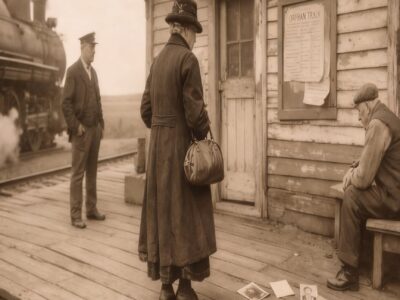
The stagecoach arrived in Stevensville with one wheel cracked, two horses lathered white, and a woman inside who had crossed half the country under a dead woman’s name.
Gabe Montgomery watched from the shadow of the mercantile awning, his hat pulled low, his shoulders hunched against a wind sharp enough to skin bone. Snow moved sideways down Main Street, needling through the gaps between false-front buildings and rattling loose signs on their chains. The Bitterroot Mountains stood beyond the settlement like a wall of black iron, their peaks buried in cloud, their slopes swallowing what little daylight Montana had bothered to offer that December afternoon.
He should have sent her away before she stepped down.
That was the decent thing.
The honest thing.
But Gabe had discovered long ago that decency was a luxury men tended to discuss when their bellies were full, their debts were paid, and no cattle lay frozen in their pastures with blood-dark ticks swelled under their hides.
He had answered the advertisement six months ago in a night of whiskey, grief, and stupidity.
Mountain rancher, forty-one, solvent, hardworking, seeks practical wife willing to share frontier life. Must be sturdy, honest, and unafraid of isolation.
Solvent.
He almost laughed now.
Three years of drought, one brutal winter, two bad loans, and a sickness tearing through his herd had taken that word and buried it deeper than any grave. The Broken Ridge Ranch, once the envy of the valley, now stood one bank notice away from belonging to Josiah Rutherford, the richest cattle baron west of Missoula and the kind of man who smiled as if mercy were a poor investment.
Gabe had meant to write the woman again.
He had meant to tell her not to come.
Then the last payment notice arrived. Then four more cattle died. Then Rutherford’s men rode up to the ranch house with a deed transfer already folded in one slick leather folder.
After that, Gabe stopped writing altogether.
The coach door opened.
A man’s boot came out first, then another passenger stumbled down, coughing into a scarf. The driver climbed down and swore at the wheel. A trunk thudded onto the street. Then another.
Then she appeared.
Not timidly.
Not as a bride stepping toward the dream promised in a lonely man’s letters.
She descended from the stagecoach with one gloved hand on the brass rail and the other wrapped around the handle of a black leather satchel she did not allow the driver to touch. She wore a dark traveling dress cut plain but fitted well, its hem dusted with road filth and snow. Her cloak was too thin for Montana and too fine for poverty, though its edges had been mended more than once. Mahogany hair was pinned beneath a small hat, severe and practical, but the wind tore loose one strand and drove it across her cheek.
Her eyes were green.
Not soft green. Not spring green.
Sharp green, like glass held up to sunlight.
She looked at the town, the mountains, the men pretending not to stare, and finally at Gabe.
Recognition moved over her face without surprise. She had expected a mountain man. She had expected size, beard, scars, silence. Maybe she had expected hardness too.
She had not expected, Gabe thought with a bitter twist, to find ruin wearing a man’s coat.
He stepped forward.
The crowd shifted away from him the way people did when they remembered the stories. Gabe Montgomery had once dragged a wounded bull elk six miles through snow after killing the wolf pack that brought it down. Gabe Montgomery had broken a rustler’s arm over a hitching post. Gabe Montgomery had buried his younger brother in frozen ground with his own hands after a spring flood took the boy’s horse. People admired him when he was useful, feared him when he was angry, and avoided him when they could not decide which was worse.
“Miss Harding,” he said.
The woman looked up at him. “Mr. Montgomery.”
Her voice carried cleanly through the wind. Educated. Controlled. Eastern, but not fragile.
He touched the brim of his hat. “Long road.”
“Longer than advertised.”
“I reckon most things are.”
The corner of her mouth moved, not quite a smile. “That has been my experience.”
The stage driver tossed a third iron-bound trunk into the mud. Gabe frowned. “You bring an anvil with you?”
“A woman entering the wilderness should not arrive empty-handed.”
“Most women bring quilts.”
“I brought what I know how to use.”
He looked again at the satchel.
Her gloved fingers tightened around it.
There it was—the first locked door.
Gabe had enough of his own not to rattle hers in the street.
He loaded her trunks onto his pack mule himself. They were too heavy for clothes. The driver watched with open curiosity as Gabe lifted the last one, his jaw flexing at the weight.
“Books?” he asked.
“Among other things.”
“You read a lot?”
“I prefer useful knowledge.”
He should have liked that. Instead, it made shame crawl under his coat. He had sold three shelves of books the year before to pay a feed bill.
When he offered his hand to help her onto Goliath, his draft horse, she hesitated only a fraction. Then she placed her gloved hand in his.
The contact landed harder than it had any right to.
Her fingers were slim and cold. His hand swallowed hers. But there was strength in her grip, a steady pressure that suggested she did not intend to be hauled like baggage. He lifted her into the saddle anyway, one hand at her waist, and felt her body tense beneath his touch.
Not fear.
Awareness.
It passed through him like heat under the skin. He released her too quickly.
The ride to Broken Ridge began in silence.
Gabe walked beside the mule while she rode Goliath, because there was no second saddle horse left worth risking on an icy trail. The best mare had gone down two days earlier, breath rattling, eyes hollow. He had put a bullet through her head at dawn before the suffering drew wolves.
The thought sat in him like lead.
They climbed out of Stevensville and into the foothills, where pines gathered thick along the trail and snow lay in the shadows like old ash. The mountains pressed close. The woman—Selene Harding, according to the letter forwarded through the agency—sat straight despite fatigue, her gaze moving constantly. Creek bed. Tree line. Tracks in snow. Sagging fence. Distant smoke.
Assessing.
Always assessing.
After an hour, Gabe stopped at a ridge where the trail overlooked the valley. Below, the Broken Ridge Ranch spread along the frozen creek: cabin, barn, bunkhouse, corrals, lower pasture, hay shed, and the long line of split-rail fence he had built with hands that had bled through two summers.
It should have looked like a kingdom.
It looked like something dying too stubbornly to lie down.
Black shapes dotted the far pasture.
Carcasses.
Selene saw them.
Gabe removed his hat and ran a hand over his hair. The wind caught at his beard. He could not put this off another step.
“I lied to you,” he said.
She looked down from the saddle.
“When I wrote, this ranch was hard but standing. I had debt, same as most men out here, but I could manage it. I had a herd strong enough to build on. I had stores laid in. I had…” He stopped. Pride made the next words difficult, but pride had become a poor blanket. “I had a future to offer.”
She waited.
“Now I don’t. Something’s killing my cattle. Folks call it blood fever. I’ve lost almost half the herd in six weeks. Bank has me in default by Friday if I can’t show stock value or payment. Josiah Rutherford is waiting to take the land. I brought you into a funeral, Miss Harding, and you didn’t deserve that.”
The wind moved her loose hair against her cheek.
“Why did you not write and tell me?”
“I meant to.”
“That is not an answer.”
“No,” he said. “It ain’t.”
Her eyes held his without mercy. He appreciated that more than comfort.
“I was ashamed,” he said. “And I was alone. Those are poor reasons, but they’re the true ones.”
For a moment, he thought she would ask to be taken back. He even hoped she would, because then the decision would be clean. He could watch the coach carry her away and hate himself honestly.
Instead, she looked down at the dead cattle in the pasture.
“How many remain alive?”
The question struck him oddly. Not how much money. Not how bad is the house. Not what can you give me.
“How many?” she repeated.
“Seventy-two this morning. Maybe fewer by now.”
“How many showing symptoms?”
“Near thirty.”
“Describe them.”
Gabe stared.
“Mr. Montgomery.”
“Weight loss. Weakness. Fever sometimes, though not always. Red water in some. Eyes go dull. Hide crawls with ticks I’ve never seen thick before. Then they drop.”
Something flashed across her face before she buried it.
“Have you burned the carcasses?”
“Ground’s too frozen. I dragged them downwind. Figured I’d burn when thaw comes.”
“Do not wait for thaw.”
Her voice had changed. Sharpened. The woman who had stepped from the coach was still there, but underneath her stood someone else—someone who expected to be obeyed because the stakes were not social.
Gabe’s eyes narrowed. “You know cattle?”
“I know sickness.”
“That wasn’t in your letters.”
“Neither was your bankruptcy.”
A harsh laugh broke from him before he could stop it.
Her face did not soften, but something like approval moved through her eyes. “Take me to the ranch.”
He should have argued.
He led the horse down.
The ranch yard was empty when they arrived except for Micah Boone, his oldest hand, who came out of the barn with a pitchfork in one hand and exhaustion carved into his long face. Micah’s gaze went from Gabe to Selene to the trunks.
“So she came,” Micah said.
“Mind your tongue.”
“I was only observing.”
“Observe quieter.”
Selene dismounted before Gabe could help her. Her boots hit the frozen dirt. She stood looking at the house, then the barn, then the pasture, and Gabe felt an unreasonable stab of dread. The place had been grand once by valley standards. Now one shutter hung crooked, the porch needed repair, and smoke leaked from the kitchen pipe where the seal had cracked.
A wife deserved welcome.
All he had was work.
The cabin door opened. Mrs. Alder, the widowed cook and housekeeper, stepped onto the porch wiping flour from her hands. Her expression hardened the moment she saw Selene.
“Lord preserve us,” she muttered. “She’s pretty.”
Gabe sighed. “Mrs. Alder.”
“Pretty women don’t last here. They either cry, freeze, or make men stupid.”
Selene looked at her. “I have no plans to do the first two.”
Micah coughed into his glove.
Mrs. Alder’s eyes narrowed, but not with dislike exactly. More like reluctant interest. “And the third?”
“That depends on the men.”
Gabe felt the laugh in his chest and strangled it.
Mrs. Alder turned toward the house. “Supper in an hour. If she’s staying, she’ll need the back room.”
“She is standing here,” Selene said.
The older woman paused.
Selene lifted her chin. “And she would appreciate hot water if the ranch can spare it.”
For one second, the air held.
Then Mrs. Alder grunted. “Maybe not useless, then.”
That was the closest thing to a blessing Gabe had heard from her in years.
They married that evening because the preacher was already in the valley and because no one saw sense in pretending propriety survived long in a place where death walked the fences.
The ceremony took place in Gabe’s front room before the fire. Reverend Pike read from a worn Bible while Micah stood witness, Mrs. Alder watched with folded arms, and Selene Harding held herself so still she might have been carved from winter itself.
When Gabe took her hand, he noticed her fingers were ink-stained beneath the glove line.
Not seamstress hands.
Not society hands.
A scholar’s hands, maybe. Or a doctor’s.
The preacher asked if he would cherish and protect.
Gabe’s throat closed around the word protect. He had failed at that more than once. His mother, dead of fever when he was seventeen. His brother, drowned in runoff. His first small ranch, burned out by raiders before Broken Ridge. Every living thing he loved eventually seemed to face something his hands could not fight.
“I will,” he said, and the vow felt like stepping onto thin ice.
Selene’s turn came.
She looked at him then, really looked. In her eyes he saw calculation, fear, defiance, and something guarded so fiercely it might have been grief.
“I will,” she said.
He slipped a plain gold band onto her finger. It had belonged to his mother. He had kept it wrapped in cloth inside a tobacco tin for twenty-three years.
Selene looked down at it, and for the first time since the stagecoach, her composure cracked.
Only a little.
But Gabe saw.
That night, he showed her to the back room and placed her trunks inside himself. He did not enter after setting them down.
“The door latches,” he said. “Window sticks, but it opens if you push hard. Mrs. Alder sleeps near the kitchen. My room is across the hall.”
Selene studied him. “You are informing me how to escape?”
“I’m informing you how to feel less trapped.”
Her expression shifted.
“Marriage doesn’t make me blind to what this is,” he said. “You arrived to find a different life than promised. You’ll have privacy.”
“We are husband and wife.”
“On paper.”
“And in law.”
“I’ve seen law do ugly things to women.”
Her hand tightened on the bedpost. “Have you?”
“Yes.”
She looked away first.
Gabe turned to leave.
“Mr. Montgomery.”
He paused.
“Gabe,” she corrected, as if testing the name.
It went through him with the quiet force of a door opening.
“Yes?”
“If I ask questions tomorrow about the cattle, I need truthful answers. Not pride. Not guesses meant to sound certain. Truth.”
“You’ll have it.”
“And if I tell you to do something strange?”
His mouth curved slightly. “I reckon strange walked off the stage with three iron trunks.”
She almost smiled.
Almost.
“I need two weeks,” she said.
“For what?”
“To know whether this ranch is dying or being murdered.”
The words stayed with him long after he crossed the hall and shut his door.
Part 2
By the fifth day of their marriage, Gabe knew three things about Selene Harding.
She slept lightly.
She carried a loaded Remington beneath her pillow.
And she knew far too much about blood.
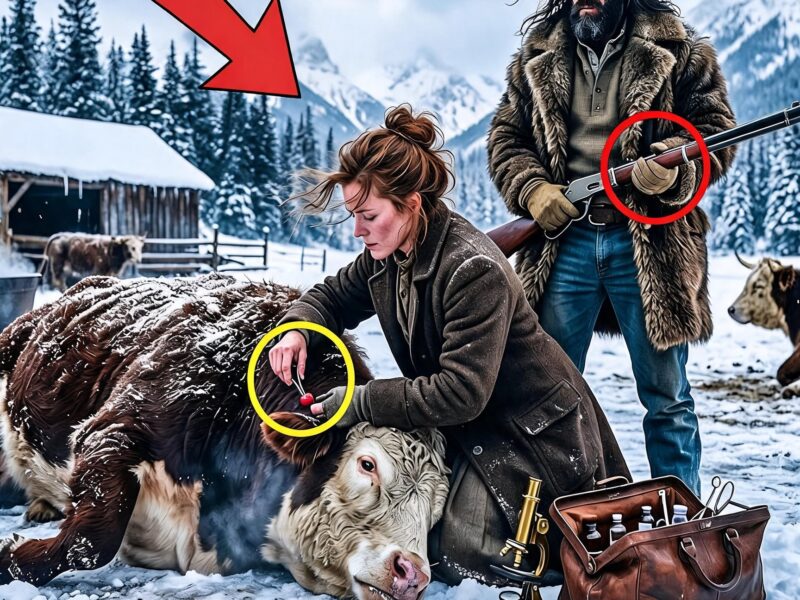
The last discovery came at dawn, when he found her in the barn kneeling over a dead heifer with her sleeves rolled to the elbow, a scalpel in one hand, a notebook open beside her, and Micah Boone standing ten feet away looking like he had stumbled upon witchcraft and was too polite to say so.
“What the hell are you doing?” Gabe demanded.
Selene did not startle. That bothered him. Most people startled when he used that voice.
“Examining the spleen.”
“You cut open my cow.”
“She was dead before I arrived.”
“That ain’t the point.”
“It is exactly the point. The dead are rarely useful unless examined quickly.”
Micah made a faint choking noise.
Gabe looked at him. “Go check the upper trough.”
“With pleasure,” Micah said and left at a speed that injured his dignity.
Gabe stepped into the stall. The smell was coppery and sour. Selene’s hands were red to the wrist. A lock of hair had fallen loose from its pins, brushing her cheek. There was no disgust in her face. No thrill either. Only concentration.
“You told me you knew sickness,” he said.
“I do.”
“You didn’t tell me you carried surgical tools.”
“You did not ask.”
“Women don’t usually bring scalpels to a marriage.”
“Men do not usually bring bankruptcy.”
His jaw flexed. “You enjoy that answer too much.”
“It remains useful.”
Despite himself, Gabe felt the corner of his mouth move. Then he looked down at the opened animal and all humor left him.
“Did she suffer?”
“Yes.”
He closed his eyes briefly.
Selene’s voice softened, not much. “Less than she would have without a quick end.”
He opened his eyes. “Did you shoot her?”
“No.”
“I did,” Mrs. Alder said from the barn doorway.
Gabe turned.
The older woman stood with his Winchester in the crook of her arm, chin raised. “She told me the heifer was done. I believed her. You were out at the west line.”
Gabe stared at them both.
The women stared back.
A man could survive wolves, winter, debt, and Rutherford’s hired guns, but no one had warned Gabe Montgomery that marriage might mean waking to find his household had made decisions over livestock, firearms, and death without him.
Selene wiped her scalpel carefully. “I need your help.”
“With what?”
“Burning the carcasses. All of them. Today.”
“Ground’s frozen.”
“Then we stack timber.”
“Do you know how much wood that takes?”
“Yes.”
“You planning to split it?”
“If necessary.”
He looked at her wrists, narrow but steady. Then at the set of her jaw.
“No,” he said. “You’ll tell us what needs doing. Micah and I will do the heavy work.”
“I am not ornamental, Gabe.”
“I noticed.”
The brief silence that followed was warmer than it should have been.
She looked away first, but not before he saw color rise along her cheekbone.
They burned the dead that afternoon.
The smoke rose black and oily into the winter sky, carrying with it the sweet-sick smell of wasted money, lost labor, and animals Gabe had raised from calves. He stood with a shovel in hand and watched flames take the bodies. Each one felt like a debt added to a ledger no man could pay.
Selene stood beside him with a scarf over her mouth, making notes.
At first, resentment stirred in him. Not because she was wrong. Because she could look directly at what broke him and remain functional. Gabe had survived by force. By endurance. By tightening himself around pain until pain became another tool.
Selene survived differently.
She dissected grief. Labeled it. Tracked it to source.
That frightened him more than her pistol.
When the last carcass caught, she closed her notebook. “The ticks are the key.”
“Ticks don’t kill a herd this fast.”
“Some do. Not by themselves, perhaps, but as carriers.”
“Carriers of what?”
She hesitated.
Gabe saw the door again. Locked. Guarded.
“Selene.”
“That is not my name.”
The confession came so quietly that the fire almost swallowed it.
Gabe turned toward her.
She stared into the flames. “Not truly.”
He waited.
“My real name is Selene Miller.”
The name struck something in memory. Newspaper scraps in saloons. Men laughing over editorials. A disgraced scientist back east. A laboratory burned. Accusations of madness, dangerous experimentation, disease panic.
“Miller,” he said slowly. “Harrison Miller?”
“My father.”
“The butcher doctor.”
Her eyes flashed. “He was not a butcher.”
Gabe held up one hand. “I’m saying what they called him, not what I believe.”
“You do not know enough to believe anything.”
“Then tell me.”
She looked at him, and for the first time he saw the young woman beneath the steel. Not soft. Not innocent. Young in the way of someone who had been forced to become hard before her face had grown used to it.
“My father worked with federal animal disease researchers,” she said. “He believed Texas fever was not caused by bad air or northern weakness, but by ticks carried from infected southern cattle. He believed quarantine could stop it. Cattle barons hated him for that. Quarantine cost money. Dead small ranchers cost them nothing.”
Gabe’s gaze moved toward the valley where Rutherford’s land began.
Selene continued, voice tightening. “When my father refused to retract his findings, they destroyed him. Papers called him a fraud. Men came at night and burned his laboratory. My mother had already died. My father lasted one month after the fire.”
“I’m sorry.”
She laughed once, bitter and small. “Men said that at his grave while stepping over his work.”
“And you?”
“I was his assistant. I wrote notes they published under other men’s names. I prepared samples. I knew more about the disease than half the fools who mocked us, but I was a woman, so I was invisible until they needed someone to blame.”
The fire snapped.
“They said I had encouraged his madness. That I had performed indecent experiments. That no decent woman handled animal blood and microscopes.” Her gloved hand tightened around the notebook. “I could not work under my name. I could not publish. I could not even find safe lodging once certain men discovered I had kept copies of his research.”
“Rutherford know who you are?”
“Not yet.”
“Then why come here?”
Her eyes met his.
This was the part that cost her.
“I needed a dying herd.”
Gabe went still.
Selene’s voice did not tremble, which somehow made it worse. “I needed a desperate rancher. Someone with nothing left to lose. Someone far enough from eastern newspapers that my name would not reach him first.”
The burn pile roared between them.
“You used me,” Gabe said.
“Yes.”
No pleading. No excuse. Only truth.
The kind he had promised her and now received like a blade.
“I answered a marriage advertisement because I needed legal shelter,” she said. “A husband’s name offered protection mine no longer could. Your ranch offered proof. If I could treat the disease here, document the recovery, and expose the mechanism, I could restore my father’s work.”
“My cattle were an experiment.”
“Your cattle were dying.”
“That supposed to make it better?”
“No.”
He stepped back from her. Snow hissed where sparks landed.
Selene’s face remained composed, but something in her eyes looked frightened now. Not of him physically. She was too proud for that. Frightened that the truth had done what truth often did—made shelter collapse.
“If you want me gone,” she said, “I will leave after I organize my notes and tell you what treatments to attempt.”
“You think I’d send a woman into mountain winter?”
“I think anger makes men feel righteous.”
Gabe’s jaw clenched.
She knew where to cut.
“Damn you,” he said softly.
“Yes,” she replied. “Many have.”
He walked away before fury became speech he could not pull back.
That night, he slept in the barn.
Or tried to.
Sable, his remaining saddle mare, shifted in her stall. Goliath snorted. Wind battered the barn walls. From outside came the distant coyotes’ song and, beneath it, the silence of a ranch waiting to learn whether dawn would bring more bodies.
Gabe sat on an overturned bucket, elbows on knees, staring at nothing.
Used.
The word should have been simple.
Men had used him before. Bankers, land agents, cattle buyers, a brother who borrowed money and left Gabe to pay it. The world ran on use.
But Selene’s confession hurt because some foolish part of him had begun to think of her not as a bargain or burden but as a presence. The light under the back room door. The sound of pages turning late at night. The way she stood at the edge of the pasture, not seeing ruin the way others did, but a puzzle she meant to solve. The way she looked at his hands when he poured coffee, then looked away before being caught.
A man in a dying house should not notice such things.
Near midnight, the barn door opened.
Selene entered carrying a lantern and a covered plate.
“I brought food,” she said.
“I ain’t hungry.”
“You have not eaten since morning.”
“I said I ain’t hungry.”
She set the plate on a barrel. “Then do not eat.”
He almost smiled despite himself.
She stood in the lantern glow, wrapped in a wool shawl, her hair braided over one shoulder. Without her coat and severe hat, she looked smaller. Not weaker. Just more human, and that angered him because he preferred fury clean.
“Did you ever mean any of it?” he asked.
Her throat moved. “Yes.”
“Which part?”
“The part where I said I wanted sanctuary in the mountains.” She looked around the barn. “The part where I said I had attended enough funerals. The part where I said I would see about your dying ranch.”
“And the part where you took my name?”
Her eyes lowered to the ring on her hand.
“At first,” she said, “I meant to borrow it.”
The words were honest enough to bruise.
“And now?”
She looked at him.
The wind pushed against the barn walls.
“I do not know,” she said.
It would have been easier if she lied.
Gabe stood. In the lanternlight, he towered over her. He saw her pulse beat in her throat, quick but steady. She did not retreat.
“You carry secrets like other women carry prayer books,” he said.
“My secrets kept me alive.”
“And what do they do to everyone else?”
Pain crossed her face then, sharp enough that he regretted the question before she answered.
“They burn laboratories,” she said. “They bury fathers. They make a woman marry a stranger because nowhere else remains safe.”
Silence settled.
Gabe exhaled hard and looked away.
There it was. The thing he kept forgetting because anger offered easier shapes. Selene had used him, yes. But she had also come to him hunted, cornered by men with money, reputations, and the power to make truth sound obscene.
He knew something about being cornered.
A terrible sound rose from the lower pasture.
Both turned.
Gabe grabbed his coat and rifle. Selene seized her satchel.
Thunder, his prize breeding bull, lay near the frozen watering hole, legs thrashing weakly, nostrils flared, breath coming in wet, panicked pulls. He had been the future once—two thousand pounds of red hide and muscle, bought with money Gabe could not spare. Now he looked already halfway gone.
Gabe stood over him, heart folding inward.
“No,” he whispered.
Thunder groaned.
Gabe drew his revolver.
Selene’s hand closed around his wrist.
“Don’t.”
“He’s drowning in his own blood.”
“He is not dead yet.”
“Don’t make him suffer for your proof.”
Her eyes blazed. “Do not mistake my science for cruelty.”
The words struck him silent.
She dropped to her knees in the snow, opened the satchel, and for the first time Gabe saw the full contents: brass microscope, glass vials, syringes, scalpels, folded cloth packets, bottles labeled in precise handwriting, journals worn soft at the corners.
This was not baggage.
This was a war chest.
Selene worked with terrifying speed. She plucked ticks from Thunder’s neck and sealed them in vials. Mixed a dark solution. Found a vein beneath the bull’s hide with hands steady enough to shame any surgeon. Gabe watched her drive the needle in and press the plunger.
“What is that?” he asked.
“Arsenic and sulfur compound in measured dilution. Dangerous if mishandled. Necessary if correct.”
“If wrong?”
“He dies.”
Thunder jerked.
Gabe dropped to one knee near the bull’s head, his hand on the animal’s horn. “Easy, boy.”
Selene looked at him briefly. Something in her expression changed at the sight of him murmuring to a dying animal he had nearly shot because mercy demanded it.
“We also need to kill the ticks on the hide,” she said. “Not one by one. All of them. The entire herd.”
“How?”
“A dipping vat.”
“In winter?”
“Yes.”
“With sick cattle?”
“Yes.”
“With what lumber? What men? What time?”
Her face lifted to his.
“With whatever you have left.”
Before he could answer, horses sounded from the timberline.
Gabe rose with the revolver in his hand.
Four riders emerged from the trees. Three hired guns. One man in a fur-lined coat too fine for the valley, his boots polished even in snow, a silver-handled cane balanced across his saddle.
Josiah Rutherford smiled down at them.
“Well now,” Rutherford called. “I had hoped to find you mourning, Montgomery, but this is better. Playing doctor with your new bride over your last good bull. There’s poetry in that.”
Gabe stepped in front of Selene.
“Turn around.”
Rutherford laughed. “Still making demands on land you won’t own come Friday.”
“It ain’t Friday.”
“Close enough for men who understand arithmetic.”
Gabe’s thumb eased the hammer back on his revolver.
Rutherford’s gaze slid past him to Selene, kneeling in snow beside the open satchel.
“I heard you ordered yourself a wife,” he said. “Didn’t hear she came with knives. Though I suppose a bankrupt man takes comfort where he can afford it.”
The world narrowed.
Gabe’s vision darkened at the edges.
Then Selene stood and stepped out from behind him.
The Remington derringer in her hand pointed directly at Rutherford’s face.
“In Pennsylvania,” she said, voice calm as a scalpel, “men who speak filth to another man’s wife are sometimes shot before they finish the sentence.”
Rutherford’s smile vanished.
His hired guns shifted.
Gabe felt a savage, inconvenient surge of admiration.
Selene continued, “You are trespassing near an infected herd and interfering with emergency treatment. If you do not remove yourself, I will put a bullet through your left eye and spend the evening documenting the depth of penetration.”
For once, Josiah Rutherford had no immediate reply.
Gabe looked at his wife and thought, with deep and helpless certainty, that no man alive could have prepared him for her.
Rutherford recovered with a sneer, though his color had changed. “Friday at noon. Sheriff, bank manager, papers. Be packed.”
He turned his horse and rode out, his men following.
Only when they vanished into the pines did Selene lower the derringer.
Gabe stared at her.
She snapped her satchel shut. “We need lumber.”
He blinked.
“And tar. Pitch if you have it. Cauldrons. Every able-bodied hand. I need water heated and a trench dug by morning.”
“You just threatened to dissect Rutherford’s brain.”
“I was improvising.”
“You enjoyed it.”
“He has an irritating face.”
Gabe laughed then.
Not much. Not long. But enough that the sound startled both of them in the frozen field beside a dying bull and a ranch on the edge of seizure.
Selene looked at him, and some of the cold distance between them cracked.
“Do I still have two weeks?” she asked quietly.
Gabe looked down at Thunder, then at the dead-still pasture, then at the woman who had lied to him, saved his bull from a bullet, and aimed a pistol at his enemy without trembling.
“You have until Friday,” he said. “And every damned thing I can lift.”
They worked for seventy hours without mercy.
Gabe dug the trench himself, swinging pick and shovel until his shoulders burned and his hands split open. Micah and the two remaining ranch hands hauled lumber from the old sheep shed. Mrs. Alder boiled water in every pot on the ranch and cursed Selene’s chemical instructions until the kitchen smelled like brimstone, lye, and judgment day.
Selene moved between them all with a precision that bordered on frightening.
“More pitch.”
“Not that measure. Half.”
“Keep the calves separate.”
“Burn that bedding.”
“No, Micah, if you touch that bottle without gloves I will amputate your fingers and preserve them as an educational display.”
Micah looked at Gabe. “Your wife scares me.”
Gabe hauled a beam into place. “Good.”
By Wednesday morning, the dipping vat was built: a long plank-lined trench sealed with pitch, filled with a steaming chemical wash Selene guarded like a priestess over poison.
The cattle fought.
Of course they did.
Sick, weak, terrified, they still resisted being driven down the chute into foul-smelling liquid. Gabe worked the pole at the vat’s edge, guiding heads under just long enough to saturate the hide. Selene stood ankle-deep in mud, skirts pinned up, shouting instructions over bawling cattle and sloshing wash. More than once, she slipped. More than once, Gabe caught her by the arm or waist and set her upright.
Each touch burned longer than the arsenic on his skin.
By Thursday night, the last calf had gone through.
Gabe collapsed onto the porch steps, clothes stiff with frozen sweat and chemicals, eyes stinging, hands blistered raw. Selene emerged from the house with a basin of warm water and a jar of yellow salve.
He started to protest.
She gave him one look.
He shut up.
She knelt before him and took his hands.
No woman had touched him like that in years. Not with desire, though something dangerous lived beneath it. Not with fear. With care so deliberate it seemed almost violent in its refusal to be sentimental.
His hands looked monstrous in hers.
She washed the chemical burns gently, her fingers moving over cracked knuckles and old scars. The moon silvered her hair, turned her lashes dark against her cheeks. Weariness had stripped some of her armor away, leaving the person beneath visible in fragments.
“You believed me,” she said.
“I had no choice.”
“Yes, you did.”
He looked at her.
She did not lift her eyes from his hands. “Most men would have called me mad.”
“I considered it.”
Her mouth curved faintly.
“Still might,” he added.
“But you worked.”
“So did you.”
“I had something to prove.”
“And I had something to save.”
Her fingers stilled.
The air changed.
Gabe knew he should pull away. She was exhausted. He was angry still, somewhere beneath gratitude and admiration and the terrible want that had been building between them since she stepped off the stagecoach with secrets in her trunks. Their marriage was made of paper, necessity, lies, and vows neither of them had fully understood when speaking.
But her hand rested over his palm.
Her ring caught the moonlight.
His mother’s ring.
His wife’s hand.
Selene looked up.
That was all it took.
Gabe reached out and brushed a streak of soot from her cheek with his thumb.
She closed her eyes.
His self-control broke quietly, like ice under deep water.
He leaned down and kissed her.
It was not tender enough to be safe.
Selene made a sound against his mouth—surprise, then surrender, then hunger. Her hands closed around his wrists. Gabe pulled back half an inch because some torn remnant of honor demanded it.
“Tell me no,” he said roughly.
Her eyes opened. They were dark green in the moonlight, furious with wanting and fear.
“No,” she whispered.
He went still.
Then her fingers tightened.
“No more being alone beside you.”
The words entered him like a blade and a blessing.
He kissed her again, and this time she rose into him, one knee on the porch step, one hand sliding into his hair as if she needed something solid to hold while the world shifted. Gabe’s arms came around her carefully at first, then with the strength of a man holding back a storm too long. He tasted smoke, winter, exhaustion, and the salt of one tear she would never admit had fallen.
Inside the house, Mrs. Alder dropped something loudly in the kitchen.
Selene froze.
Gabe rested his forehead against hers and laughed under his breath.
“She did that on purpose,” Selene whispered.
“Likely.”
“Does she always interfere?”
“Only when breathing.”
Selene’s laugh trembled against him.
For a moment, on the porch of a failing ranch under a merciless Montana moon, they let themselves have it: warmth, breath, hands, the impossible fragile belief that survival might leave room for something more than endurance.
Then Thunder bellowed from the lower pasture.
Gabe and Selene separated at once.
The sound was not death.
It was challenge.
Part 3
Friday morning broke hard and bright over the Bitterroot Valley, the kind of cold that made every nail in the barn walls groan and turned breath to ghosts before it left the mouth.
Gabe woke before dawn with Selene’s side of the bed empty.
For one disoriented second, panic took him.
Not fear that she had run from him.
Fear that he had dreamed her.
Then he saw the indentation in the pillow, the hairpin on the washstand, the open medical journal beside the lamp, and something inside him steadied. She had not disappeared. She had gone to the work. That was worse and better. It meant he knew her.
It meant losing her would have shape now.
He dressed quickly and stepped outside.
The ranch lay in blue shadow. Smoke rose from the dipping vat, now drained but still reeking faintly of sulfur. The yard was silent except for Goliath stamping in his stall and Mrs. Alder banging pans with unnecessary force, a sure sign she was worried.
Gabe walked toward the lower pasture.
He made himself look.
Thunder stood near the fence.
Gaunt, stained yellow from the wash, breath steaming in the cold, but alive. The bull tore at frozen winter grass with stubborn, irritated strength. Around him, the remaining herd moved slowly but with purpose. Eyes clearer. Heads higher. The dead ticks that had plagued their hides lay shriveled in the trampled snow like black seeds.
Gabe gripped the fence rail.
His vision blurred.
For ten years, he had fought the mountains, the weather, the banks, predators, drought, loneliness. He had believed strength meant outlasting whatever came. But strength had not saved the herd. Pride had not. His rifle had not.
Selene had.
Brilliant, furious, impossible Selene, who had arrived under a false name carrying poison, steel, and a mind sharp enough to cut through ruin.
He removed his hat.
“Thank you,” he said, though no one stood near enough to hear.
Then he saw her.
She was not at the barn or the vat. She knelt near the warm spring that fed the lower watering hole, her medical satchel open beside her, skirts muddy, one gloved hand pressed to the ground. Her posture was wrong. Too still. Too controlled.
Gabe started toward her.
“Selene.”
She did not turn.
“They’re standing,” he called. “It worked.”
“I know.”
Her voice carried flatly.
He slowed.
She rose, and when she faced him, the cold fury in her expression killed the joy in his chest.
“It was not natural,” she said.
Gabe looked toward the spring.
“What?”
“The ticks. They should not have survived a Montana freeze in these numbers. Not unless they had warmth, blood, and shelter.”
She pointed toward a pile of dead brush near the runoff, half buried in snow and steam.
Gabe drew his knife and moved the branches.
The smell hit him first.
Rot. Blood. Hides left too long in wet heat.
He slashed open the nearest burlap sack. Decaying cattle hides spilled into the mud, crawling with dead and dying ticks. A red stamp marked the sack.
Rutherford Cattle Co.
For a moment, Gabe heard nothing.
Not the spring.
Not the herd.
Not Selene saying his name.
Everything in him went quiet in the way the forest went quiet before a predator struck.
Rutherford had not waited for the ranch to fail.
He had poisoned it.
Seeded the warm spring with infected hides so the ticks could breed where winter could not kill them. Watched cattle die. Watched Gabe borrow, sell, bleed. Then rode up with offers wrapped in sympathy and legal paper.
“I’m going to Missoula,” Gabe said.
Selene grabbed his arm. “No.”
“I’ll drag him from his office.”
“No.”
“He killed my herd.”
“And if you kill him, he wins.”
Gabe turned on her, rage stripping his face bare. “Do not ask me to stand still.”
“I am asking you to think.”
“He brought plague onto my land.”
“Yes.”
“He sat on his horse and smiled while my cattle died.”
“Yes.”
“He would have taken the ranch, thrown you into the snow, and laughed.”
“Yes!” Selene shouted. “And if you ride into town and shoot him, the law hangs you, the bank takes this land, Rutherford’s lawyers bury the evidence, and I become exactly what men already accuse women like me of being—a hysterical widow with blood on her hands and no proof anyone will hear.”
The words struck hard enough to break through.
Gabe stood breathing like an animal.
Selene’s hand remained on his arm.
“We use the law,” she said.
He laughed once, ugly and hollow. “The law belongs to men like him.”
“Then we make it too expensive for them to keep.”
He looked at the sacks.
She continued, voice fierce now. “I have samples. I have notes. I have the recovered ticks. I have the brand on the bags. I have soil from the spring. If Sheriff Ryman is honest, he will act. If he is not, I wire federal authorities myself. Transporting infected hides across quarantine lines is not a valley dispute. It is federal disease spread.”
Gabe stared at her.
She had become again what she had been beside Thunder: not a bride, not a fugitive, not a woman begging protection, but a commander in a war most men did not understand.
“Rutherford comes at noon,” she said. “Let him come.”
“He may bring guns.”
“So will you.”
His mouth twisted despite the fury. “You always this confident?”
“No. I am often terrified. I simply find terror inefficient.”
God help him, he loved her.
The realization came not softly, not sweetly, but like a tree splitting under lightning. Obvious after the strike. Irreversible.
He loved her with mud on her skirts, anger in her eyes, and the proof of his enemy’s crime rotting at her feet. He loved the mind that had saved his herd, the courage that stood between rage and ruin, the loneliness she tried to hide under precision, the way she had taken his name for shelter and somehow made it matter to him again.
He could not say it then.
No words would survive the size of it.
Instead, he covered her hand with his.
“All right,” he said. “We do it your way.”
Her breath left her in a small cloud.
“Thank you.”
“But if he draws first?”
Her eyes sharpened.
“Then,” she said, “try not to kill him before he can testify.”
By noon, the ranch yard was swept clean.
Not because cleanliness mattered, but because Mrs. Alder said no cattle baron should see defeat in their dirt. Micah stood near the barn with a shotgun. Two hands waited by the corral, rifles visible. Gabe stood on the porch with his Winchester resting casually against his shoulder, a pose so relaxed any man with sense would distrust it.
Selene stood beside him holding a locked wooden case.
She wore her dark traveling dress—the same one she had worn stepping from the stagecoach—but now it looked different. Not like armor she had carried into exile. Like a uniform.
From the road came the sound of wheels.
Josiah Rutherford arrived in a polished carriage with three hired gunmen, Bank Manager Thaddeus Boon, and Sheriff Thomas Ryman riding behind. Rutherford stepped down smiling, cane tapping the frozen dirt.
“Montgomery,” he called. “Lovely day to surrender.”
Gabe did not move. “You always did talk too much when nervous.”
Rutherford’s smile thinned. “Sheriff, serve the paper.”
Sheriff Ryman was a square-built man with tired eyes and a mustache gone white at the ends. He had known Gabe fifteen years. He looked like he hated every step he took toward the porch.
“Gabe,” he said quietly. “Bank says payment failed. Unless you can present value or funds, I have to enforce.”
“The debt is fraudulent,” Gabe said.
Rutherford laughed. “Desperation makes poets of failures.”
Selene stepped forward.
“My name is Selene Miller,” she said.
The sheriff’s eyes flicked to her. Boon frowned.
Rutherford went very still.
Not much. But enough.
Selene saw it.
So did Gabe.
“I am the daughter of Dr. Harrison Miller and former research assistant in infectious livestock disease,” she continued. “Over the last three days, I treated this herd for tick-borne Texas fever using methods derived from my father’s research.”
Boon blinked rapidly. “Texas fever? Here?”
“Impossible naturally,” Selene said. “Exactly.”
She opened the wooden case and removed one sealed jar containing engorged ticks, another containing soil, then a stained piece of burlap marked with Rutherford’s company stamp.
Rutherford scoffed. “Parlor tricks.”
“This was recovered from burlap sacks of infected hides buried in the warm spring runoff that feeds our lower water source,” Selene said. “The location allowed the ticks to survive Montana winter and spread to Mr. Montgomery’s herd. I have documented microscopic confirmation, dates of outbreak, treatment response, and physical evidence linking the source to Rutherford Cattle Company.”
Ryman’s tiredness vanished.
He looked at Rutherford. “Josiah?”
“Do not be a fool,” Rutherford snapped. “She is a woman with a scandalous reputation and a bag of bugs.”
Selene’s face went white.
Gabe stepped forward, but she lifted one hand slightly.
Stopping him.
Rutherford smiled when he saw the blow had landed. “Yes, I know who you are, Mrs. Montgomery. Or Miss Miller. Or whatever name you hide behind now. Eastern papers called you unfit for decent company. Said you helped your mad father torture animals in the name of science.”
Gabe’s grip tightened on the Winchester.
Selene stood very still.
Rutherford turned to the sheriff. “You would take the word of a disgraced female over mine?”
The yard went silent.
Then Mrs. Alder stepped out onto the porch with a cast-iron skillet in one hand. “I would.”
Every eye turned.
The old woman’s face was hard as fence stone. “I watched that woman save this herd while you circled like a buzzard. I watched Gabe Montgomery work seventy hours near dead because she told him how. I watched cattle stand this morning that should’ve been carcasses. I don’t know eastern science, Sheriff, but I know rot when I smell it, and I know Rutherford’s stamp when I see it.”
Micah called from the barn, “I saw wagon tracks by the spring. Wide-set iron rims. Same as Rutherford’s freight wagons.”
One of Rutherford’s hired guns shifted.
Gabe’s eyes snapped to him.
The man froze.
Sheriff Ryman looked at the burlap, then the jars, then the road. “Boon?”
The banker swallowed. “If the disease was intentionally introduced, the bank may have to suspend seizure pending investigation.”
Rutherford’s mask cracked. “You little worm.”
Boon stepped back.
Selene said, “There is more.”
Rutherford’s gaze shot to her.
“My father’s laboratory was burned by men paid through a cattle syndicate account. I could never prove whose money funded it. Until I saw the initials on the freight tags stitched into the sacks. J.R. Same supplier. Same method. Same arrogance.”
“You lying bitch,” Rutherford hissed.
Gabe came off the porch.
Not rushed. Not wild. A controlled descent that made the hired guns reach toward their holsters by instinct.
“Careful,” Gabe said.
Rutherford’s face twisted. “You think marrying her makes her respectable? She used you. Everyone in this valley will know it by nightfall. She came here because she needed your dying cattle. Needed your name. Needed a bed in a house too desperate to ask questions.”
Each sentence hit because it held pieces of truth sharpened into poison.
Gabe stopped in front of him.
“Yes,” he said.
Selene went still behind him.
Rutherford faltered.
Gabe’s voice carried across the yard. “She came here under another name. She came with secrets. She came needing my ranch for proof. That is the truth.”
Selene’s breath caught audibly.
Gabe did not look back at her because if he did, he might not finish.
“And I came to this marriage with debt, dying stock, and shame I dressed up in silence. I brought her into ruin and called it a home. So if we’re measuring honesty, Josiah, there ain’t a clean man standing here.”
Rutherford sneered. “How touching.”
“But here is the difference.” Gabe stepped closer. “She used what she found here to save it. You used what you had to destroy it.”
The wind cut through the yard.
Gabe’s eyes never left Rutherford’s. “You call her disgraced again, and I will forget she asked me to keep you alive.”
Rutherford’s hand moved toward his coat.
The world broke open.
Selene shouted.
Ryman drew.
Rutherford pulled a derringer.
Gabe moved faster.
He swung the Winchester stock upward, catching Rutherford under the jaw before the man could fire. Bone cracked. The derringer flew into the snow. Rutherford collapsed like a puppet with cut strings.
The hired guns drew halfway before Micah, Mrs. Alder, and both ranch hands had weapons leveled at them.
Sheriff Ryman cocked his revolver. “Drop them.”
For one frozen heartbeat, pride wrestled sense.
Sense won.
Three gun belts hit the snow.
Ryman stepped over Rutherford’s unconscious body and looked at Selene. “Mrs. Montgomery, I’ll need all your evidence.”
Her face was pale but steady. “You shall have copies.”
“Copies?”
“I am not a fool, Sheriff.”
Mrs. Alder muttered, “Amen.”
By sunset, Rutherford was in custody, the bank seizure suspended, and the surviving hired guns eager to confess just enough to avoid joining their employer in federal prison. One admitted to transporting the hides from a southern rail shipment. Another named the foreman who buried them. The third claimed he had only followed orders, which impressed no one but his own conscience.
The valley changed its story quickly, as valleys do.
By morning, men who had called Selene a witch wanted to discuss treatment. By afternoon, ranchers rode to Broken Ridge with hats in hand and fear in their eyes. By Sunday, the preacher spoke vaguely of God working through unexpected vessels until Mrs. Alder loudly asked whether God required a microscope or simply borrowed Selene’s.
Through it all, Selene grew quieter.
Gabe noticed.
She answered questions. Organized samples. Wrote letters to federal offices and scientific men who had once ignored her father. Directed quarantine protocols with ruthless clarity. But when the house emptied and the ranch settled, she retreated to her back room.
Her door latched again.
On the fourth night after Rutherford’s arrest, Gabe found her in the barn.
She stood beside Thunder, one hand on the bull’s neck, her forehead resting briefly against his rough hide. The animal breathed steadily beneath her palm.
“I thought you’d be in your room,” Gabe said.
“I thought you would be asleep.”
“I don’t much.”
“I noticed.”
The silence between them was not easy.
Gabe stepped into the stall. Thunder huffed but tolerated him.
“Federal marshal comes tomorrow,” he said. “Ryman says Rutherford’s records were seized in Missoula. Looks like they found letters about your father.”
Selene closed her eyes.
“Good,” she said, but the word came hollow.
Gabe leaned against the stall rail. “A man who spent years looking for justice ought to sound happier when it arrives.”
“A woman too.”
He waited.
Selene’s hand moved slowly over Thunder’s hide. “I thought if I proved it, I would feel restored. My father’s name. My own. The work.” Her mouth trembled once before she mastered it. “But proof does not resurrect laboratories. Or fathers. It does not give back years spent being called indecent because I preferred truth to embroidery.”
“No.”
“And now everyone will know. Not just Rutherford. Not just you. Every rancher, every paper, every man who wants the cure but not the woman who made it possible. They will come here.”
“Yes.”
She looked at him. “Your life will be dragged into mine.”
His brow furrowed. “Woman, have you looked around? My life was already halfway in the grave when yours climbed off a stagecoach and started giving orders.”
“That is not an answer.”
“It is if you listen.”
Her eyes flashed. “Do not be charming when I am trying to be honorable.”
“I have never been accused of charm in my life.”
“You are avoiding.”
“So are you.”
She turned away.
Gabe stepped closer, then stopped himself. He had learned something in the weeks since she arrived: Selene did not fear strong hands. She feared having no choice.
“I heard what Rutherford said,” she whispered.
“Rutherford is a dead-hearted son of a bitch.”
“He was not entirely wrong.”
Gabe’s jaw tightened.
“I used you,” she said. “I used your name, your land, your desperation. Then you defended me in front of half the valley as if what I did did not matter.”
“It matters.”
She looked back, wounded despite asking for truth.
He held her gaze. “It matters because trust matters. It matters because you could have told me sooner. It matters because when I reached for my gun that first day by Thunder, you knew more than I did and still waited until the moment forced you.”
“I was afraid.”
“I know.”
“I have spent years learning that men only respect truth after it has made them money.”
“I know that too.”
Her voice broke. “I did not know how to be honest and safe at the same time.”
Gabe’s anger, what remained of it, went out of him.
He crossed the distance then, slowly, and lifted one hand. He did not touch her until she nodded once. Then his palm settled against her cheek.
“You are safe here,” he said.
Her eyes shone.
The words were too small for what he meant. Too plain. Yet they seemed to strike her harder than any vow.
“I don’t deserve that from you,” she whispered.
“Maybe not.”
A tear slipped down her face.
His thumb caught it. “Stay anyway.”
She looked at him like he had offered something impossible.
“As what?” she asked. “Your wife because papers say so? Your scientist because the herd needs me? Your scandal because the valley has finally found a story big enough for winter?”
Gabe’s throat tightened.
“As the woman I love.”
The barn went utterly still.
Even Thunder seemed to stop chewing.
Selene’s lips parted.
Gabe had not planned to say it there, with the smell of hay and medicine and cattle around them. He had imagined, if he imagined at all, that love deserved a cleaner room. A table. Firelight. Maybe something polished enough to hide how raw it made him.
But their love had not grown in clean places.
It had grown beside carcass fires, in chemical burns, in the space between a drawn gun and a better choice. It had grown through lies told for survival and truths told too late. It had grown because neither of them had been saved by softness, yet somehow both had reached for it.
“I love you,” he said again, because the first time seemed to have stunned her. “Not the name you used. Not the help you brought. You. The woman who scares ranch hands, insults cattle barons, threatens dissection in polite conversation, and looks at dying things like she can argue them back to life.”
A laugh escaped her, broken by a sob.
“I love you,” he said, voice roughening, “because you fought for this ranch when you could have taken your proof and left. Because you held me back from murder when rage felt like the only honest thing left. Because you know what it is to be ruined by powerful men and still stand straight enough to make them afraid.”
Selene covered his hand with hers.
“I do not know how to be loved without earning it,” she said.
“Then learn lazy.”
She laughed again, crying now.
“I love you too,” she whispered.
Gabe closed his eyes.
The words entered him like warmth after frostbite, painful because life returned where he had gone numb.
He pulled her into his arms.
She came without hesitation this time.
For a long while they stood in the stall beside the bull that had nearly died and the woman who had refused to let him, wrapped in the kind of silence that did not ask anything. Gabe held her with all the care his strength could manage. Selene pressed her face into his coat and shook once, hard, before stilling.
“I want to publish under my own name,” she said against him.
“Then you will.”
“They will mock me again.”
“Likely.”
“They may come after us.”
“Let them.”
She lifted her head. “You cannot shoot every critic.”
“I was thinking every third.”
“Gabe.”
His mouth curved. “I’ll try to restrain myself.”
She touched his beard with ink-stained fingers. “This life will not be quiet.”
“It never was.”
“I am difficult.”
“I noticed.”
“I keep dangerous chemicals in the pantry.”
“Mrs. Alder already moved them next to the preserves. Said if any fool drinks arsenic thinking it’s peach syrup, that is natural selection.”
Selene laughed fully then, and Gabe felt the sound settle into the barn rafters like something the ranch had been missing for years.
Spring came late to Broken Ridge.
Snow held the high passes into April, and mud swallowed the lower road for weeks after. But the herd lived. Thin, scarred, reduced, but alive. Thunder recovered slowly and meanly, which Gabe took as a promising sign. Calves were born in May, long-legged and slick under a wet dawn, and Selene cried over the first one when she thought no one saw.
Gabe saw.
He told no one.
The federal case against Rutherford became the largest scandal the valley had ever known. Newspapers arrived with words like biological sabotage, quarantine violation, extortion, and female researcher printed in columns that men read aloud in saloons with varying levels of disbelief. Some tried to make Selene sound unnatural. Others made her sound saintly. She hated both.
“I am neither witch nor angel,” she snapped one morning over breakfast after reading a particularly foolish article.
Mrs. Alder buttered toast. “No. Angels are quieter.”
Micah choked on coffee.
Letters came from Washington. Then from eastern universities. Then from ranchers who had once laughed at Harrison Miller and now wanted his daughter’s methods. Selene answered some, ignored others, and once used a particularly condescending letter to light the stove.
Gabe built her a laboratory off the east side of the barn.
Not a grand one. Not yet. But it had windows for light, shelves for jars, a long workbench, a lock on the door, and a sign Mrs. Alder painted herself:
Dr. Selene Miller Montgomery
Livestock Disease Research
Knock or Bleed
Selene stood before the sign for a long time.
“You made me a doctor,” she said softly.
“No,” Gabe answered. “I made you a door. You were the doctor before you arrived.”
She turned and kissed him in front of Micah, two ranch hands, Mrs. Alder, and an offended rooster.
By summer, Broken Ridge began to recover not as it had been, but as something new.
Neighboring ranchers brought sick animals. Selene charged fairly and terrified them into following sanitation protocols. Gabe expanded quarantine pens and managed the ranch with a patience he had not possessed before almost losing it. Together, they built a reputation stronger than the old one: not just a ranch with good stock, but a place where science and stubbornness met the wilderness on equal terms.
Their marriage changed too.
Slowly, then all at once.
At first, Selene still apologized when working late. Gabe learned not to crowd her fear. He brought coffee instead. He sharpened her scalpels without comment. He sat nearby when letters from the East made her hands shake. On nights when nightmares dragged her back to the fire that took her father’s laboratory, she woke to find Gabe awake beside her, not asking questions, only there.
He had his own ghosts.
Rutherford’s sabotage had broken something open in him too. Rage did not vanish simply because justice had come. Some nights Gabe walked the fence lines until dawn, rifle in hand, listening for threats that were not there. Selene never mocked him for it. Sometimes she walked with him. Sometimes she let him go and left a lamp burning in the window.
Love, they discovered, was not rescue.
It was witness.
It was choosing not to leave the other alone with the worst thing.
On the first anniversary of her arrival, a stagecoach rolled through Stevensville under a pale winter sun. Gabe and Selene were in town for supplies when it stopped before the mercantile. The same driver climbed down, older and thinner, and stared when he recognized her.
“Well, I’ll be,” he said. “The bride with the iron trunks.”
Selene looked at Gabe.
Gabe’s eyes warmed beneath his hat. “Still brought too much baggage.”
She raised an eyebrow. “You married all of it.”
“Best bad judgment I ever had.”
The driver laughed.
From across the street, Sheriff Ryman lifted a hand. Two ranchers tipped their hats to Selene with a respect that still surprised her sometimes. Not because she had not earned it, but because earning and receiving remained, in her experience, unrelated more often than not.
Gabe loaded supplies into the wagon while Selene stood near the mercantile steps, watching new passengers descend from the coach.
One was a young woman traveling alone, clutching a small carpetbag, eyes wide with the terror of someone arriving at the edge of her known life.
Selene saw herself so sharply it stole her breath.
Gabe came to stand beside her.
“You all right?”
She nodded.
The young woman looked around, lost.
Selene stepped forward. “Do you need help?”
The girl blinked. “I was told there might be work.”
“What kind?”
“Any honest kind.”
Selene glanced back at Gabe.
He sighed as if put upon, though his mouth betrayed him. “Broken Ridge can always use honest hands.”
The girl’s shoulders sagged with relief.
As Gabe lifted the carpetbag into the wagon, Selene touched the ring on her finger—his mother’s ring, still plain, still worn thin, still hers.
She thought of the woman who had stepped from a stagecoach under a false name carrying secrets heavy enough to break her. She thought of the man who had stood in the mercantile shadow believing himself too ruined to offer anyone a future. She thought of dying cattle, rotting hides, gunfire, ash, testimony, midnight confessions, and the first time Gabe had said love without asking it to fix what came before.
The mountains rose around them, severe and beautiful.
The wilderness had not softened.
Neither had they, not entirely.
But the ranch lived.
The work lived.
Her father’s name lived.
And when Gabe climbed onto the wagon seat and held out his hand, Selene took it, letting him pull her up beside him. His palm was calloused, warm, certain. She settled close enough that their shoulders touched as the horses turned toward home.
Snow began to fall over the Bitterroot Valley.
Not like punishment this time.
Like a blessing tough enough for Montana.