No Food for Christmas Dinner — Until a Lone Rancher Brought a Feast and Became Family
Part 1
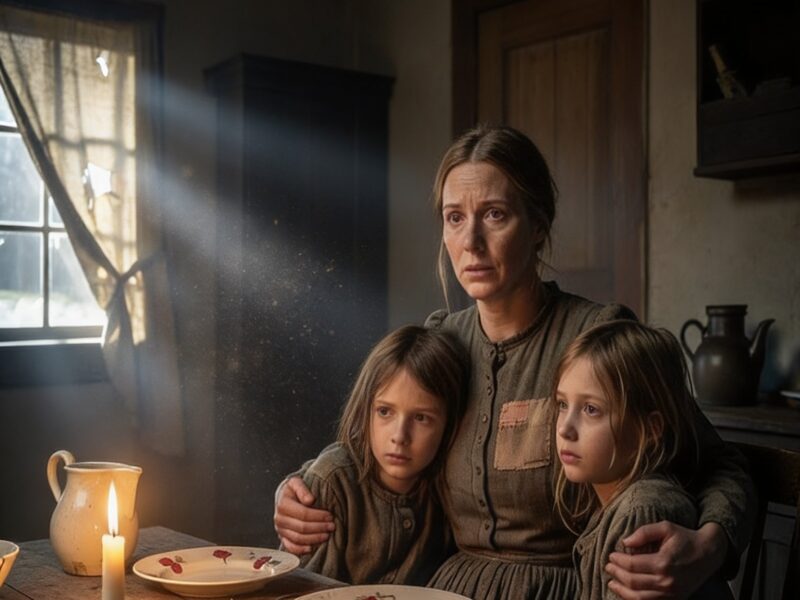
By the time Christmas Eve settled over the Miller farm, Sarah had already set three empty plates on the table.
She had done it from habit, not hope.
The plates were chipped white stoneware, the last of a set she had received on her wedding day when Henry Miller was alive and laughing and strong enough to carry her across the threshold of the little farmhouse as if hardship were something they could outrun by loving each other properly. Now the plates sat in a neat row beneath the weak yellow light of one dying candle, each one holding nothing but the reflection of flame and the shame of a mother who had no food to give her children.
Outside, the snow fell thick and silent over the valley, covering the failed corn rows, the broken fence, the empty woodpile, and the wagon ruts that led to a town where no one gave credit to widows who had already sold everything worth pawning.
Inside, the cold moved like a living thing.
It crept through the cracks around the door. It settled in the corners. It slid under Sarah’s skirts and climbed her spine until her teeth ached from holding back the chatter. The fire in the stone hearth had burned down to red crumbs. She had fed it the last split log before noon, then the last broken chair rung, then the wooden lid from the flour barrel, because there was no flour left to protect.
Across the table, Emma sat with her hands folded in her lap, trying to look older than eight years old. She had Henry’s serious brown eyes and Sarah’s stubborn chin, and that combination made her brave in a way that broke Sarah’s heart. Beside her, Noah curled in his chair, five years old and too thin, one hand pressed over his stomach as if hunger were an animal he could hold still.
His stomach growled.
The sound seemed enormous in the little room.
Noah’s cheeks flushed. “Sorry, Mama.”
Sarah smiled because mothers did that even when the smile felt like glass cutting from the inside.
“You don’t apologize for being hungry.”
Emma looked at the plates. Then at the window, where frost had grown in white feathers across the glass. “Maybe the storm will stop before morning.”
Sarah tucked her shawl tighter around her shoulders. “Maybe.”
The word was a lie kind enough to be spoken.
The storm would not stop. The road to Briar Bend had disappeared beneath drifts by dusk. Even if Sarah could walk it, even if she could leave the children wrapped in quilts and make the six-mile journey through blinding snow, there was no money waiting at the end of the road. The mercantile had refused her credit that morning. Mr. Alden had not been cruel about it, which somehow made it worse. He had looked at her with sad eyes, palms spread over the counter, and said, “Mrs. Miller, I’ve got my own accounts to settle.”
Behind him, Garrett Vail had watched from beside the stove.
Vail owned the feed mill, half the notes in the county, and a pew in the front row of the church where he bowed his head like a man who expected God to admire the angle. He had waited until Alden turned away before stepping close enough for Sarah to smell the clove oil on his gloves.
“A woman alone can’t carry a farm through winter,” he had said softly. “You know that. Your husband knew that too, or he’d have kept better books before dying and leaving you with his mess.”
Sarah had lifted her chin. “Henry left me land.”
“Henry left you debt.”
“A debt you keep changing.”
His smile had been small and private. “Careful, Sarah. Accusing a man of dishonesty is easy when you have no proof and nothing left to lose. But you do have something left.”
His eyes had moved toward the window, where Emma and Noah waited outside in the wagon under a blanket.
Sarah’s blood had gone cold.
Vail had leaned closer. “The county does not look kindly on children freezing in a house with no food. A reasonable marriage would solve many concerns.”
She had slapped him.
The sound had silenced the mercantile.
For one bright second, every man in the store stared at Garrett Vail’s reddening cheek and Sarah felt almost alive again.
Then Vail had turned back to her slowly, eyes dead with humiliation.
“You’ll regret that,” he said.
“I already regret plenty. You’ll have to stand in line.”
She had walked out without flour, without salt, without mercy from anyone.
Now, hours later, the children still did not know how bad things had become. They knew enough. Children always did. They saw the empty pantry. They saw the way Sarah skipped meals and said she had eaten while they were outside. They saw her wedding ring vanish, then Henry’s good coat, then the brass lamp, then the spare quilt.
But they did not know about Vail’s threat.
They did not know the payment was due on New Year’s Day.
They did not know he had already spoken to Judge Harrow about “the welfare of the Miller children.”
They did not know Sarah had been offered a bargain: marry Garrett Vail and keep the farm under his management, or refuse him and lose both land and children to the law.
Noah looked up. “Mama?”
“Yes, sweetheart?”
“Do you think Papa can see Christmas from heaven?”
Sarah’s breath caught so hard it hurt.
Emma stiffened, her eyes darting to Sarah as if she wanted to protect her from the question.
Sarah reached across the table and took Noah’s cold hand. “I think your papa sees us all the time.”
“Even when there’s no dinner?”
“Especially then.”
Noah considered this with solemn misery. “Will he be sad?”
Sarah swallowed. “He’ll know we’re doing our best.”
Emma stared at the empty plate in front of her. “I don’t need dinner.”
“Emma.”
“I mean it. I’m not that hungry.”
Her stomach betrayed her.
The little girl’s mouth pressed tight, and Sarah saw tears gather in her eyes. Not because of the hunger, not only that, but because she had failed at pretending not to need.
That undid Sarah.
She rose quickly and turned toward the hearth, blinking hard. The last embers glowed weakly. No warmth left to give. She wanted to scream at the cold, at the empty shelves, at Henry for dying, at herself for being unable to make bread from dust and strength from prayer.
Instead, she took the last candle from the table.
“Come here,” she said. “Both of you.”
They came at once. She sat on the floor near the dying hearth and pulled them close, wrapping the thin blanket around all three of them. Noah curled into her lap. Emma leaned against her side, rigid at first, then softening when Sarah kissed her hair.
“We’ll sleep here tonight,” Sarah said. “It’s warmer together.”
“Will Santa come if the fire’s out?” Noah whispered.
Emma closed her eyes.
Sarah looked at the black window.
“Noah,” she said gently, “some years Santa has to visit houses that need him most in other ways.”
He nodded, trying to understand disappointment as if it were a lesson.
“I don’t need toys,” he said. “I just thought maybe bread.”
Sarah’s eyes filled.
She looked up at the low ceiling, at the smoke-darkened beams Henry had repaired the autumn before he died. He had stood on a chair with a hammer in his hand, smiling down at her while sawdust fell into his hair.
“This house will hold,” he had told her. “Long as I’m breathing, Sarah, it’ll hold.”
But he was not breathing.
And the house was failing.
The candle flickered.
Sarah bowed her head over her children and prayed without words because words had begun to feel useless. She prayed in the language of arms around small bodies. In the language of not weeping loudly enough to frighten them. In the language of staying upright one more hour when the whole world seemed determined to knock her down.
The knock came just as she bent to blow out the candle.
Three hard strikes.
Not imagined. Not wind.
Knuckles against wood.
Sarah froze.
Emma’s hand clamped around her sleeve. Noah lifted his head, eyes wide.
Another knock came, slower this time.
Patient.
The kind of knock made by someone strong enough to break the door but choosing not to.
Sarah stood, setting Noah gently aside. Fear moved through her exhaustion. A woman alone did not open doors in storms without consequences. But the knock had come from the only door between her children and the cold. If it was Vail, she would face him standing. If it was a stranger, she still had Henry’s old shotgun above the mantel, though it had not been loaded since fall because she had traded the last shells for potatoes weeks ago.
She took it down anyway.
The wood was cold beneath her hand.
“Stay behind me,” she whispered.
The children obeyed.
Sarah crossed the room. The knock did not come again. Whoever stood outside waited.
She lifted the latch and opened the door a few inches.
Snow blew in.
A man stood on the porch.
He was so broad he seemed to fill the night. A thick sheepskin coat covered his shoulders, white with snow. His hat brim was frozen along the edge. A dark beard hid much of his face, but not the hard line of his jaw or the eyes beneath his brow—blue-gray, watchful, tired in a way that did not soften him. One hand held a lantern. The other held two heavy baskets. Behind him, at the edge of the yard, a big bay horse stood hitched to a sled loaded with split wood and burlap sacks.
For a moment, Sarah could not process what she was seeing.
The smell reached her first.
Bread.
Roasted meat.
Apples.
Her body recognized food before her mind did, and shame rushed up so violently she nearly shut the door.
The man shifted his weight. “Mrs. Miller?”
Her fingers tightened around the unloaded shotgun. “Who are you?”
“Thomas Rourke.”
The name landed.
Everyone knew Thomas Rourke, though few knew him well. He owned the high ranch beyond Widow Ridge, a hard piece of land most men considered too wild for cattle until he proved them wrong. He came to town rarely, spoke little, and was said to have buried three men during the railroad troubles before walking away from the law rather than accepting a badge. Children made stories about him. Women lowered their voices when he passed. Men either respected him or disliked him carefully.
Sarah had seen him twice.
Once at church, standing outside instead of entering, hat in hand, looking through the open doors with an expression so bleak she had remembered it for weeks. Once at the mercantile, where he had silently paid for a widow’s coal after her credit was refused, then left before she could thank him.
Now he stood on Sarah’s porch on Christmas Eve with snow on his beard and food in his hands.
“I was hoping I wasn’t too late,” he said.
Sarah’s throat closed. “Too late for what?”
His gaze moved past her.
Not rudely. Not searching for scandal. Just enough to see the children, the dead fire, the empty plates.
Something changed in his face.
Anger, maybe.
Not at her.
That made it worse.
“I brought supper,” he said.
Noah gasped behind her.
Sarah felt the sound like a wound.
She stepped back from the door, but pride made one last desperate stand. “Mr. Rourke, I can’t pay you.”
“I didn’t ask.”
“I don’t take charity.”
“Good.” He stepped inside only after she opened the door wider. “Then call it Christmas.”
“That is charity wearing a ribbon.”
His eyes met hers. “Then trade me.”
“With what?”
He glanced at the shotgun in her hand. “For one thing, you can stop pointing an empty gun at me.”
Heat rushed into her face.
His mouth did not smile, but something in his eyes moved.
“I know the weight of a loaded twelve-gauge,” he said. “That one’s light.”
She lowered it slowly.
He set the baskets on the table. The room seemed to change as soon as they touched wood. Emma and Noah stood motionless, staring as Thomas removed a cloth from the first basket.
A round loaf of bread.
A ham wrapped in paper.
A jar of preserves.
Four apples.
A sack of potatoes.
Another loaf.
Coffee.
Sugar.
Butter.
Noah made a small sound that was almost pain.
Sarah turned away quickly, pressing the heel of her hand to her mouth. She would not cry in front of this man. Not yet. Not over bread.
Thomas moved as if he understood not to look at her directly.
“Got wood on the sled,” he said. “I’ll bring it in.”
“The storm—”
“Storm’s not as bad close to the ground.”
“That sounds like something men say before freezing.”
This time, his mouth did move, barely. “I’ve frozen enough to know the difference.”
He went back outside.
The cold surged in with him and left behind the impossible smell of food.
Emma stepped to the table and reached one trembling hand toward the bread, then stopped. “Mama?”
Sarah’s control shattered quietly.
“Yes,” she said. “Yes, baby.”
Emma broke off a piece and handed it first to Noah.
That nearly did what hunger had not.
Thomas returned with an armload of split oak and saw Sarah standing by the table, one hand braced against it, fighting tears while her children chewed bread like communion.
He looked at the hearth instead.
“May I?”
Sarah nodded.
He built the fire quickly, efficiently, as if he had done everything in his life against weather and time. He laid kindling from his own sack, fed the embers patiently, coaxed flame instead of smothering it. His hands were large, scarred across the knuckles, rough from rope and iron. But he handled the fire gently.
Within minutes, warmth began to return.
Not enough to save the world.
Enough to change the room.
Sarah warmed the ham in a skillet and boiled potatoes while Thomas carried in wood until the box beside the hearth overflowed. He brought another sack from the sled and set it near the pantry.
“Flour,” he said. “Salt. Beans.”
Sarah stared at it.
Her voice came out thin. “Why?”
The children were too absorbed in food to hear the desperation beneath the question. Thomas did.
He stood near the door, hat in his hands now, snow melting dark into his coat.
“I saw you at Alden’s this morning.”
Sarah’s face hardened with remembered humiliation.
“I didn’t hear all of it,” he said. “Heard enough.”
“Then you heard me slap Garrett Vail.”
“I did.”
Her chin lifted. “Are you here to tell me I shouldn’t have?”
“No.”
“What, then?”
His eyes darkened. “I’m here because no woman should have to slap a man like Vail and go home to an empty pantry.”
The words nearly brought her to her knees.
She turned back to the stove. “Supper’s ready.”
They ate at the table.
At first, Thomas remained standing near the door as if intending to leave now that the food had been delivered. Noah solved that by patting the empty chair beside him.
“You can sit there,” he said through a mouthful of potato.
Thomas looked at Sarah.
She should have said no. It would have been safer. Cleaner. A woman with Vail’s threat hanging over her did not need a feared rancher at her table after dark. Briar Bend could turn kindness into sin before Sunday hymn.
But Emma had jam on her cheek and warmth was returning to her hands, and Thomas Rourke had come through a storm when no one else had.
“Sit,” Sarah said.
So he did.
He ate little. Mostly, he watched the children eat, though he tried not to make it obvious. Noah asked him whether he had wolves near his ranch. Thomas said yes. Emma asked whether he was afraid of them. Thomas said only foolish men weren’t afraid of wolves, but smart men made sure wolves knew there were easier meals elsewhere.
Noah considered this solemnly. “Are you a smart man?”
Thomas looked at Sarah, then back at Noah. “Depends who you ask.”
Emma smiled.
It was small, but Sarah saw it.
The first real smile in weeks.
After supper, Thomas told them stories—not grand ones, not polished ones, but plain tales of mountain weather, cattle gone stubborn in river crossings, a horse named Bishop who hated every man alive except a blind blacksmith, and a Christmas years ago when Thomas had eaten beans from a tin with one hand while holding off coyotes with the other.
Noah fell asleep halfway through the coyote story with his head on Thomas’s sleeve.
Thomas went still.
Sarah reached to lift the boy away, but Thomas shook his head once.
“It’s all right,” he said quietly.
The firelight softened the hard planes of his face. Noah’s small hand curled trustingly against his coat. For one dangerous moment, Sarah saw not the feared rancher, not the stranger at her door, but a man who looked as if he had forgotten how to be touched by anyone gentle.
Emma fell asleep next, curled under the quilt by the hearth.
Sarah carried her to the narrow bed in the corner and tucked Noah beside her. When she turned, Thomas was gathering his gloves.
“You can’t ride back in this,” she said.
“I’ve ridden in worse.”
“That doesn’t make it wise.”
“No.”
The wind struck the house hard enough to rattle the shutters.
He looked toward the window.
Sarah folded her arms. “The barn is empty except for two hens and a mule with poor manners. You can sleep there if you must keep pretending you aren’t half frozen.”
His gaze returned to her.
A silence opened.
She heard what she had said only after saying it. Heard the impropriety. The invitation that wasn’t one but could be twisted into one. Heat crept up her neck.
“I mean—”
“I know what you mean.”
His voice was calm, but his eyes had changed.
Not with insult.
With restraint.
That unsettled her more.
“I’ll bed down in the barn,” he said. “At first light, I’ll clear your path and be gone before anyone has reason to talk.”
“They already have reason. They invent it when bored.”
“Then I’ll give them no truth to use.”
He moved toward the door.
Sarah found herself speaking before caution could stop her. “Mr. Rourke.”
He turned.
“Thank you.”
His hand tightened on his gloves.
“You fed my children,” she said. “I don’t know how to repay that.”
For a moment, the loneliness in his face showed plainly.
Then it vanished.
“You let me sit at a Christmas table,” he said. “That was repayment enough.”
He stepped out into the storm.
Sarah stood with one hand on the door after it closed, feeling the cold through the wood.
She did not know that Garrett Vail had watched from the road.
She did not know he had seen Thomas’s horse, the sled, the firelight in the windows, and the broad silhouette of the rancher leaving her house long after dark.
She did not know that by morning, kindness would become scandal.
She only knew her children were warm, fed, and breathing softly beneath a quilt.
For the first time in months, Sarah slept.
Part 2
Christmas morning began with Noah shouting that Santa had brought wood.
He stood before the overflowing wood box in his nightshirt, hair sticking up in every direction, eyes wide with religious certainty. Emma sat up in bed and looked toward the pantry, where flour and beans rested on the shelf like a miracle organized in burlap.
Sarah tried to smile.
The smile came easier than expected.
Outside, the storm had blown itself thin. Pale sun struck the snowfields and turned the world bright enough to hurt. The little farmhouse, half-buried in white, no longer looked abandoned. Smoke rose from the chimney. The window glowed. A sled track curved in from the road and back toward the barn.
Thomas Rourke was gone by the time Sarah stepped outside.
He had split enough wood to last a week. Cleared the path from house to barn. Repaired the hinge on the chicken coop. Left a small sack of peppermint drops on the porch rail where the children would find it.
He had also stacked three fence rails near the broken south corner, as if he had noticed in darkness what she had been unable to fix in daylight.
Sarah stood in the yard wrapped in Henry’s old coat, staring toward the ridge road where Thomas’s sled tracks disappeared.
Emma came up beside her, chewing a peppermint with solemn joy.
“Will he come back?”
Sarah’s first instinct was no.
A man like that had done his good deed. Men came through storms, then returned to their own lives. That was how the world kept from tangling too much.
But the tracks in the snow looked like a promise she had no right to want.
“I don’t know,” she said.
Emma leaned against her. “I hope he does.”
That afternoon, Briar Bend came to them.
Not all at once. Not openly. Gossip preferred errands.
First came Mrs. Talbot from the church with a basket of laundry “mistakenly left” after the Christmas service. She stood on the porch and looked past Sarah into the house, nostrils flaring slightly at the smell of baking bread.
“Seems the Lord provided,” Mrs. Talbot said.
Sarah held the door half closed. “The Lord had help.”
“So I hear.”
There it was.
Sarah’s fingers tightened on the door edge.
Mrs. Talbot’s eyes flicked toward the barn. “Mr. Vail said Thomas Rourke was here after dark.”
“Mr. Vail watches widows’ houses on Christmas Eve?”
The woman flushed. “I only mean people are concerned.”
“People usually are when there’s nothing useful to do.”
Mrs. Talbot left stiff-backed.
Then came Harlan Pike, who claimed he was checking whether the road remained passable. He asked if Sarah needed anything, while looking disappointed to see that she did not visibly need enough to justify pity. Then two boys from town passed the gate too slowly, pointing at the sled tracks.
By dusk, Sarah knew.
Vail had started his work.
He came the next day.
She saw him through the kitchen window, riding a clean black horse along the road Thomas had cleared. He wore a dark wool coat, a gray scarf, and the expression of a man arriving not to visit but to collect.
Sarah sent Emma and Noah to the loft with books.
“Stay there,” she said.
Noah frowned. “Is it the bad man?”
Sarah’s heart clenched. “Noah.”
“Mr. Rourke said smart men make wolves find easier meals.”
Emma took her brother’s hand. “Come on.”
Sarah opened the door before Vail could knock.
He looked past her into the warm house. His mouth tightened at the visible evidence of food and fire.
“Merry Christmas, Sarah.”
“It was yesterday.”
“Still the season of mercy.”
“You’d know more about the season than the practice.”
His smile hardened. “You are determined to make this unpleasant.”
“I wasn’t expecting pleasant when I saw your horse.”
He stepped closer. She did not step back.
“I came to offer one last chance to handle this quietly,” he said. “The note comes due New Year’s Day. You cannot pay it. The farm is in poor repair. The children are underfed. And now you have given the town reason to question your judgment.”
“My judgment?”
“Allowing Thomas Rourke in your house after dark.”
“He brought food to hungry children.”
“He spent the night.”
“In the barn.”
“Do you think that distinction will matter in court?”
Sarah went cold.
Vail saw it and softened his voice, which made him uglier. “Marry me before New Year’s. I will assume the note, take management of the farm, and allow you to remain mother to your children without public embarrassment.”
“Allow me?”
“You know what I mean.”
“Yes,” she said. “That’s the trouble.”
His eyes narrowed.
She stepped onto the porch, pulling the door nearly shut behind her. “Henry never borrowed the amount you claim.”
Vail sighed. “Again with that.”
“He kept ledgers.”
“Ledgers you cannot find.”
Because Vail had taken them after Henry died. Sarah knew it with every part of herself, though knowing did not make proof.
“My husband was careful,” she said.
“Your husband was weak.”
The slap came before she decided on it.
Again.
His head turned.
Again.
But this time they were alone, and his mask fell.
Vail seized her wrist hard enough to grind bone.
“You stupid woman.”
Sarah did not cry out. She would not give the children that sound.
“You think Rourke will save you?” Vail hissed. “A half-savage rancher with blood in his past and no patience for law? One whisper from me and he becomes the reason you lose your children. Judges do not leave little girls in houses where men like that come after dark.”
Sarah’s breath shook.
He leaned close. “I can be merciful, Sarah. Do not make me prove I can be otherwise.”
A voice said, “Take your hand off her.”
Vail froze.
Thomas Rourke stood at the edge of the yard beside his horse, rifle in one hand, snow dusting his hat. He had approached so silently neither of them heard him over the wind.
Sarah’s heart slammed once against her ribs.
Vail released her wrist slowly and turned, smoothing his expression into outrage.
“Mr. Rourke. How convenient.”
Thomas walked toward the porch.
Not fast. Not dramatic.
Each step measured.
“I said take your hand off her,” he said. “You already did, so you’re learning.”
Vail’s face darkened. “This is private business.”
“Looked public from the road.”
“This woman owes a lawful debt.”
“Then bring papers, not bruises.”
Vail glanced toward the closed door, then back at Thomas. “You are doing her no favors by involving yourself.”
“That worries me less than you might think.”
“She is a widow with children. Her reputation is fragile.”
Thomas stopped at the foot of the porch steps. “No. Her reputation is what cowards reach for when they can’t touch her character.”
Sarah’s throat tightened.
Vail smiled thinly. “Noble. Dangerous, too. Do you intend to marry every woman you feed?”
The words struck the air.
Sarah felt heat rise in her face—not from shame alone, but from the sudden image Vail had forced between them. Marriage. Thomas. A table with four plates filled not by miracle but by belonging.
Thomas’s eyes never moved from Vail. “No.”
The answer was flat, immediate.
Of course it was.
Sarah hated herself for the sting.
Thomas continued, “I intend to break the hand of any man I see hurting this one.”
Vail swallowed.
He tried to laugh and failed. “Threats now?”
“Promise.”
The two men stared at each other until Vail stepped back.
“This will be remembered,” he said.
Thomas’s voice dropped. “Count on it.”
Vail mounted and rode away with more haste than dignity.
Only after he vanished down the road did Sarah realize she was shaking. She turned quickly, but Thomas had already seen. His gaze dropped to her wrist, where Vail’s fingers had left red marks.
“Did he hurt you?”
“No.”
“That wasn’t the question.”
She folded her arms to hide the wrist. “You shouldn’t have come.”
“I brought coffee.”
“Thomas.”
It was the first time she used his given name.
Both of them felt it.
He looked away toward the barn. “I also came to fix your south fence.”
“I didn’t ask.”
“I know.”
“I can’t pay.”
“I know that too.”
Anger rose because gratitude was too dangerous. “Then why do you keep appearing with things I can’t repay?”
His eyes returned to hers.
“Because I know what it is to sit in a house where no one knocks.”
The anger faltered.
Snow slid from the porch roof in a soft rush.
Sarah looked at his hands, at the scar across one knuckle, at the rifle he had lowered the moment Vail rode away. “People are talking.”
“They were before I came.”
“They’re saying I’ve taken you into my house.”
“Have you?”
“No.”
“Then let them freeze their tongues on lies.”
“It isn’t that easy for women.”
His face changed.
There was no defensiveness in it. Only recognition that she had named a law he had the privilege of ignoring.
“No,” he said. “I reckon it isn’t.”
She looked back at the house. Behind the curtain, two small faces disappeared too late.
“The children like you,” she said.
His expression softened before he could stop it.
“That a warning?”
“It should be.”
“I’ll mind it.”
She believed him.
That frightened her most.
Thomas spent the afternoon on the south fence.
Sarah tried to ignore him and failed repeatedly. From the kitchen window, she watched him work with an economy that made every motion seem necessary. He lifted rails that had taken her half a day to drag. Drove posts into frozen ground by heating iron and melting holes through crust. Showed Noah how to hold nails safely. Accepted Emma’s solemn inspection of his knots.
By evening, the fence stood straight.
Sarah brought coffee to the porch.
Thomas did not come inside until she asked.
Even then, he removed his hat, wiped his boots, and stood near the door as if the house were a church and he a man with sins too heavy for pews.
The children had decided he belonged at the table.
Noah dragged the chair out. Emma set an extra cup.
Sarah watched Thomas notice.
Watched him swallow whatever memory rose in him.
“You don’t have to stay,” she said.
“I know.”
“Do you want to?”
The question escaped too quietly to call back.
His eyes lifted to hers.
The fire popped. Emma went very still. Noah looked between them with innocent interest.
“Yes,” Thomas said.
A single word.
It warmed the room more than the hearth.
Over the next week, Thomas came every day.
He never arrived empty-handed, though he learned quickly to assign trade before Sarah could object. Flour in exchange for mending saddle blankets. A side of bacon for Emma reading aloud to him while he repaired a harness because, he claimed, he hated quiet. Coffee for Sarah’s help sorting accounts from the scraps of Henry’s papers she still possessed.
The accounts became his true reason for staying.
Or perhaps the excuse both of them needed.
They sat at the kitchen table after the children slept, ledgers spread between them, fire low, candlelight touching the hard planes of his face. Thomas studied numbers with the same silence he used on weather. Sarah watched his brow furrow, the way his lips compressed when something did not make sense.
“This note,” he said on the third night, tapping Vail’s copy. “Henry signed for two hundred dollars.”
“Yes.”
“Vail claims six hundred due.”
“Interest, he says.”
“That’s not interest. That’s theft dressed for church.”
Sarah leaned back, exhausted. “I know.”
“Where are Henry’s originals?”
“Gone. Vail came the day after the funeral. Said he needed to settle accounts. I was too numb to stop him from going through the desk.” Shame roughened her voice. “By the time I understood, the drawer was empty.”
Thomas’s jaw tightened. “He took the ledgers.”
“I think so.”
“You ever see Henry hide papers?”
Sarah closed her eyes, thinking. Henry had been careful. Not suspicious by nature, but careful. He had patched the house with secret cleverness: jars in floor hollows, coins sewn into lining, spare keys behind loose bricks.
“There was one place,” she said slowly.
She stood and crossed to the hearth.
Thomas followed but kept distance.
Sarah knelt, reached behind the left side of the mantel, and felt along the rough stone. There. A loosened mortar joint. Her fingers shook as she worked it free. A small flat packet wrapped in oilcloth slid into her palm.
She stared.
Thomas crouched beside her. “Sarah.”
She opened it.
Inside lay three pages, folded tight.
Henry’s handwriting.
Her vision blurred.
Thomas said nothing while she pressed the paper to her mouth.
When she finally unfolded it, the words struck like a door opening in a burning house.
If anything happens to me, Garrett Vail has been altering accounts on widow notes and seed loans. I found discrepancies in Pike, Miller, and Rawlins contracts. I mean to take proof to Judge Harrow after harvest.
There was more.
Names. Amounts. Dates.
And at the bottom, a line that made Sarah stop breathing.
Vail came tonight. He knows I suspect him. If I die before this is settled, Sarah, do not trust him. Do not sign anything. Take this to Thomas Rourke on Widow Ridge. He once saved my life near Elk Creek and owes me no favors, which makes him safer than friends.
Sarah looked at Thomas.
He had gone very still.
“You knew Henry?”
His eyes remained on the letter. “Years ago.”
“You never said.”
“I didn’t know he was your Henry until tonight.”
The words sounded true. Still, hurt moved through her.
“What happened at Elk Creek?”
Thomas looked toward the fire. “Bad winter. Rustlers cut through the ridge. I tracked them and got pinned in a ravine. Henry Miller found me half frozen and bleeding. He hauled me to his camp, kept me alive two days.” His mouth twisted. “Tried to make me accept Jesus and a better attitude. Failed at both.”
A laugh broke from Sarah, wet with tears.
That sounded like Henry.
Thomas’s gaze returned to her, and something passed between them then—not Henry’s ghost, not exactly, but his hand nudging open a door neither had touched.
“He trusted you,” Sarah said.
Thomas shook his head. “He trusted my dislike of crooked men.”
Sarah looked down at the letter.
Proof.
Not enough perhaps, but something. More than she had possessed an hour ago.
“We take this to Harrow,” she said.
Thomas’s expression darkened. “Harrow is close to Vail.”
“Then who?”
“County circuit judge in Hawthorne. Three days by wagon in fair weather. Longer in snow.”
“The note comes due New Year’s.”
“I know.”
She folded the papers carefully. Hope was dangerous. Hope could make a person reckless. But it moved in her now anyway, small and stubborn.
Thomas watched her. “You don’t have to fight this alone.”
She looked up. “Why?”
He knew what she was asking.
Why help past charity? Why return? Why sit at a widow’s table while the town sharpened gossip? Why look at her as if hunger were not the only thing he wanted to ease?
His hand rested on the table, scarred and strong. Not touching hers.
“My wife died on Christmas Eve nine years ago,” he said.
Sarah went still.
“Fever took her fast. Our boy too. I was snowed in up ridge, couldn’t get the doctor through. By the time the storm cleared, the house was quiet.” He stared at the fire as if it still held the old room. “After that, Christmas became a day to endure. I’d cook too much, drink too much, leave half of it untouched. This year, I saw you at Alden’s. Saw Vail smiling. Saw your children outside pretending not to be cold.”
His voice roughened.
“I went home and looked at a table full of food meant for ghosts.”
Sarah’s eyes filled.
“I couldn’t sit with them again,” he said. “So I brought the food here.”
The room held the confession gently.
Sarah reached across the table and placed her hand over his.
Thomas looked at their hands as if the contact might break him.
“I’m sorry,” she whispered.
His thumb shifted once beneath her palm. Not quite holding. Not quite letting go.
“So am I.”
The next morning, Briar Bend learned of the letter.
Not because Sarah told.
Because Vail came before dawn with Sheriff Cole and two men from the county office.
He had obtained an emergency petition claiming Sarah Miller was unfit, immoral, indebted, and under improper influence of a violent rancher. He carried it in his gloved hand like a holy writ.
Sarah stood in the doorway with Emma and Noah behind her.
Thomas stepped from the barn, where he had slept to protect her reputation and ruined it anyway simply by being near.
Vail smiled when he saw him.
“This is exactly the problem,” he said.
The sheriff looked miserable. “Sarah, there’ll be a hearing in town. Judge Harrow will decide temporary guardianship and property management until the debt is settled.”
“Guardianship?” Her voice nearly failed.
Vail’s eyes gleamed. “For the children’s welfare.”
Noah clutched her skirt. Emma began to cry silently.
Thomas crossed the yard.
The sheriff lifted a hand. “Rourke, don’t make this worse.”
Thomas stopped.
Every line of him promised violence held by a thread.
Sarah saw then what Vail wanted. If Thomas struck him, if he threatened the law, Vail would win. He would prove her household dangerous. He would take her children before noon.
She stepped off the porch into the snow.
Thomas’s eyes cut to her.
She shook her head once.
No.
He stood down.
It cost him. She saw it in his clenched jaw, the vein rising in his neck, the hand flexing near his gun belt. But he obeyed her.
Vail noticed.
His smile soured.
Sarah lifted Henry’s letter. “Then we’ll come to town.”
Vail’s eyes narrowed at the paper.
For the first time, he looked afraid.
Part 3
The hearing took place on New Year’s Eve in the Briar Bend church because the courthouse stove had cracked and Judge Harrow said no child custody matter should be decided in a room cold enough to punish witnesses.
Sarah sat in the front pew with Emma on one side and Noah on the other, both children pressed close enough that she could feel their trembling. Thomas stood at the back of the church near the doors, hat in hand, shoulders filling the entry like a barricade. He had agreed not to sit beside her because Vail would twist it. He had agreed not to speak unless asked because Harrow disliked him. He had agreed to surrender every obvious defense.
But he had not agreed to leave.
The church was full.
Of course it was.
Briar Bend loved a hearing more than a sermon, especially when the subject was a widow’s reputation. Women whispered behind gloves. Men murmured by the stove. Garrett Vail sat at a small table near the front with his account book stacked neatly beside him, his bruised cheek healed yellow at the edge. He looked solemn, righteous, offended by the duty of destroying a woman publicly.
Judge Harrow entered, red-nosed from cold, and took his place behind the communion table.
Sarah felt Henry’s letter hidden inside her bodice like a second heartbeat.
Vail spoke first.
He was good.
That was the worst of it.
He did not sound cruel. He sounded concerned. He spoke of unpaid debts, failed harvest, empty pantries, children exposed to hunger and cold. He spoke of Thomas Rourke’s presence at the Miller farm after dark. He spoke of appearances, moral hazards, and a widow’s vulnerability to manipulation. He never once said Sarah was a bad mother.
He only built a cage out of concern and invited everyone to admire the craftsmanship.
“Mrs. Miller is grieving,” Vail said gently. “No one disputes her affection for her children. But affection does not fill a pantry. It does not pay notes. It does not protect young minds from the confusion of improper attachments.”
Improper attachments.
Sarah stared straight ahead.
Noah’s hand squeezed hers. Emma’s breathing had gone shallow.
Judge Harrow looked grave. “Mrs. Miller, do you dispute the debt?”
“Yes.”
A murmur ran through the church.
Harrow frowned. “On what grounds?”
Sarah stood.
Her legs felt strangely steady.
“On the grounds that Garrett Vail altered the original amount, stole my husband’s ledgers after his funeral, and is using fraud to force marriage or seizure.”
The church erupted.
Vail rose, face flushed. “That is a vile accusation.”
Sarah removed Henry’s letter.
Vail went white.
She saw it.
So did Thomas from the back of the room.
Sarah handed the letter to Judge Harrow. “My husband wrote this before he died.”
Harrow unfolded it slowly.
The room went quiet as he read.
At first, the judge’s face showed irritation. Then concern. Then something tighter.
Vail found his voice. “A grieving widow can produce any paper and claim a dead man wrote it.”
Sarah turned toward him. “You know Henry’s hand.”
“I know forgery exists.”
“And so does Mrs. Gable.”
Every head turned.
Mrs. Gable rose from a side pew. The census widow’s hair was pinned neatly beneath a black bonnet, her hands folded around a worn ledger of her own.
“I recorded Henry Miller’s land filings, tax statements, and seed contracts for nine years,” she said. “I know his hand better than most. That letter is his.”
Vail’s eyes flashed. “You are hardly impartial. You’ve been bringing Sarah charity.”
Mrs. Gable looked at him coolly. “I brought a hungry child mittens. If that makes me criminal, I’ll await arrest.”
A few people shifted uncomfortably.
Thomas’s mouth almost moved.
Judge Harrow cleared his throat. “This letter claims broader irregularities. Claims are not proof.”
“No,” Sarah said. “But this is.”
She nodded to Thomas.
He came forward.
The entire church seemed to hold its breath as he walked the aisle. Thomas did not look left or right. He carried a leather satchel in one hand and placed it on the table before Harrow.
Vail’s voice sharpened. “What is that?”
Thomas looked at him. “What you should have burned.”
He opened the satchel.
Inside were ledgers.
Not Sarah’s.
Vail’s.
A sound moved through the church like wind over dry grass.
Thomas said, “Henry’s letter named four notes. I rode to Rawlins, Pike, and the old Lander place. Three widows. Same pattern. Original note doubled or tripled after death. Land transferred under pressure. Vail’s clerk keeps copies in the mill office. Clerk was willing to trade them for a promise he wouldn’t be named first.”
Vail lunged forward. “Those were stolen.”
Thomas turned his head.
“Interesting thing to say before knowing what they show.”
Judge Harrow’s eyes narrowed.
The room shifted again.
Vail had made his first mistake.
Harrow opened the top ledger. He read one page. Then another. His expression darkened.
Sarah stood gripping the pew. Hope and terror twisted together until she could barely breathe.
Vail recovered with admirable speed. “Your Honor, even if bookkeeping errors occurred, that does not change Mrs. Miller’s present condition. Her children were found hungry. Thomas Rourke has been at her farm daily. This proceeding concerns immediate welfare.”
“No,” Sarah said.
Her voice cut through his.
“It concerns your desire to own what you could not persuade me to give.”
Vail’s face hardened. “Careful.”
“I was careful when Henry died. Careful when you took his papers. Careful when you offered marriage like a noose covered in velvet. Careful when my children were hungry because every door closed after you whispered into the cracks.” Her voice shook now, but she did not stop. “I am done being careful with men who mistake restraint for weakness.”
Emma looked up at her mother with wide, shining eyes.
Sarah turned to the room.
“Yes, Thomas Rourke came to my house on Christmas Eve,” she said. “He brought food. He brought firewood. He sat at my table because my son asked him to. He slept in the barn because he cared more for my name than most of you did. If that is scandal, then shame on every warm house that watched my children starve politely.”
No one moved.
Mrs. Talbot looked down.
Mr. Alden closed his eyes.
Vail said, “Pretty speech.”
Thomas’s hands curled at his sides.
Sarah faced Vail. “You threatened to take my children.”
“I offered stability.”
“You offered a cage.”
“I offered marriage when no decent man—”
Thomas moved.
Not violently. Not yet.
One step was enough to make Vail stop speaking.
Judge Harrow stood. “Mr. Vail. Sit down.”
Vail looked at the judge and saw what Sarah saw.
The room had turned.
Not completely. Not safely. But enough.
Then the church doors opened.
Sheriff Cole entered with a young man beside him. Vail’s clerk. Pale, shaking, carrying a metal cash box.
Vail’s face collapsed into naked fear.
The clerk would not look at him.
“I have the original Miller note,” the young man said. “And the others. Mr. Rourke came last night, but I… I was too afraid. I went to Sheriff Cole this morning.”
Thomas looked surprised.
Sheriff Cole met his eyes briefly. “Some of us get there late. Doesn’t mean we don’t get there.”
The clerk set the box before Judge Harrow.
By the time the originals were compared, Garrett Vail was sweating through his collar.
The Miller debt was not six hundred dollars.
It was eighty-three.
Payable after spring thaw.
No seizure.
No guardianship.
No lawful claim.
Harrow dismissed the petition immediately and ordered Vail’s accounts seized pending county investigation. Sheriff Cole stepped toward Vail, but Vail backed away, eyes wild.
“This is absurd,” Vail snapped. “You think this ends me? Half this town owes me money.”
Thomas said, “Not anymore.”
Vail looked at Sarah then.
The hatred in his face was so sudden and complete that Emma whimpered.
“You ruined yourself,” Sarah said quietly.
Vail reached inside his coat.
Thomas moved faster than thought.
He crossed the space, caught Vail’s wrist, and slammed his hand against the table. A small pistol clattered onto the wood. Women screamed. Noah cried out. Sheriff Cole drew his revolver.
Thomas held Vail bent over the table, wrist pinned, face close to his.
“Threaten her again,” Thomas said, voice low enough to freeze blood, “and the law will be the kindest thing that reaches you.”
“Rourke,” the sheriff warned.
Thomas released him.
The sheriff took Vail into custody, and the church that had gathered to watch Sarah lose her children instead watched Garrett Vail stumble down the aisle in hand irons.
Noah ran to Thomas first.
That was what undid Sarah.
Her son flung himself at the rancher’s legs, sobbing into his coat. Thomas froze, then slowly lowered one hand to the boy’s back. Emma came next, quieter but no less desperate, pressing herself against his side. He looked over their heads at Sarah with something like fear.
As if the children’s trust frightened him more than Vail’s gun.
Sarah walked to them.
The whole town watched.
She did not care anymore.
She laid a hand on Thomas’s arm. “Thank you.”
His eyes moved over her face. “You saved yourself.”
“You helped me stand long enough to do it.”
He swallowed.
For one impossible moment, surrounded by whispers, ledgers, fallen lies, and the smell of church smoke, Sarah thought he might touch her face.
He did not.
Instead, he stepped back.
The children felt it. So did she.
“I’ll see you home,” he said.
The ride back to the Miller farm was quiet.
Snow began again before they reached the lane, softer than the Christmas storm but steady. Emma and Noah slept in the wagon under quilts, exhausted from terror and relief. Thomas rode beside them on his horse, rifle across his saddle, his face unreadable.
At the farmhouse, he carried Noah inside as if the boy weighed nothing. Sarah carried Emma. They tucked the children into bed together, moving around each other with the silent ease of people who had already shared more than words could hold.
When Sarah turned from the bed, Thomas stood near the hearth.
The same place he had stood Christmas Eve.
But everything was different now.
Vail’s immediate threat was gone. The debt remained, but small enough to fight. Spring might come. The farm might live. Her children were hers.
And Thomas Rourke had no reason to stay.
The thought opened cold inside her.
“I’ll head back before the snow thickens,” he said.
Sarah stared at him. “Of course.”
He put on his gloves.
Each movement felt like an ending.
She folded her arms, anger rising to cover hurt. “You’ve been waiting to leave.”
His head lifted. “No.”
“You brought food, fixed fences, found proof, protected my children, and now that the danger’s past, you’re going back to your ridge like none of this touched you.”
His face tightened.
“That ain’t fair.”
“No,” she said. “It isn’t. I am tired of fair.”
He looked toward the sleeping children, then back at her. “Sarah.”
“Don’t say my name like that if you’re leaving.”
The room went still.
The fire cracked once in the hearth.
Thomas removed his gloves slowly. “You think leaving is what I want?”
“I don’t know what you want. You arrive when needed and vanish when thanked. You stand near doors like you’re already halfway through them. You look at my children like they’re warming something in you, then you step away as if warmth is a trap.”
Pain crossed his face.
She had struck true.
Good, some wounded part of her thought.
Then he said, “My son died in my arms.”
Sarah’s anger vanished.
Thomas looked down at his hands. “I held him while his fever burned out. He was four. Smaller than Noah. My wife was already gone in the bed behind me. I sat there until morning because if I put him down, it meant he was dead.”
Sarah covered her mouth.
“I have not held a sleeping child since,” he said. “Not until last night. Not until Noah leaned on me like I was safe.”
His voice broke on the last word.
Sarah stepped toward him.
He shook his head once, not to refuse her, but to keep himself together.
“I want too much,” he said roughly. “That’s why I stand by doors. I want the chair at your table. I want Noah asking me about wolves. I want Emma reading by the fire. I want you looking at me like I’m not some hard old ghost on a ridge waiting for weather to finish him.”
Her eyes filled.
“I want to come in and stay,” he said. “And wanting that scares me worse than any gun Garrett Vail ever carried.”
Sarah crossed the rest of the room.
This time, he did not step back.
She took his bare hand in both of hers. His skin was rough, warm, scarred. Real.
“You think I’m not scared?” she whispered. “I buried a husband I loved. I watched my children go hungry. I stood in a church while a man tried to take them from me. I am terrified of needing anyone.”
“I know.”
“No, you don’t.” Her grip tightened. “I need you, Thomas. Not because I’m helpless. Not because you brought bread. I need you because when you are in this house, I remember how to breathe without counting what might be taken next.”
His eyes closed.
She continued, voice shaking. “And I want you. That is worse. Need I can excuse. Want feels like betrayal.”
“Of Henry?”
“Of grief. Of the woman who kept going alone because alone was all she had left.”
Thomas opened his eyes. “Henry sent you to me.”
A tear slipped down her cheek.
“Maybe,” she said. “But I choose you myself.”
He made a sound then, low and broken, and reached for her.
The first touch was careful. His hands settled at her shoulders as if she might bruise. Sarah stepped into him and wrapped her arms around his waist. For one breath, they only held on.
Then his mouth found hers.
The kiss was not soft enough to be innocent or desperate enough to be careless. It was slow, restrained, and devastating, full of everything they had not said beside ledgers and fences and sleeping children. Sarah felt the strength of him trembling under her hands. Felt his restraint, his longing, his fear of taking too much and his terror of being refused.
She rose into him.
His arms tightened.
For a while, the snow fell beyond the windows and the fire burned steady, and the Miller farmhouse held.
A month later, Thomas asked properly.
Not in the kitchen after a crisis. Not because scandal demanded repair. Not because the farm needed a man’s name, though plenty in Briar Bend assumed that was reason enough.
He asked on a cold Sunday afternoon after church, in front of the barn where the south fence stood straight and the children were building a snow fort with more ambition than skill.
Sarah had come outside carrying a basket of laundry when she saw Thomas standing near the gate with his hat in his hands.
Her stomach flipped like she was sixteen instead of thirty-two and weathered to the bone.
“What did Noah do?” she asked.
Thomas frowned. “Nothing.”
“Emma?”
“No.”
“Then why do you look like you’re about to face a firing line?”
“Feels similar.”
She set the basket down slowly.
Thomas stepped closer. “I spoke to Henry’s grave this morning.”
Sarah’s breath caught.
“Felt I ought to. Not to ask permission. You’re not property to be transferred between dead and living men.” His jaw tightened. “But to tell him what I should say to you. That I’ll honor the life you had before me. That I won’t ask you to make your grief small so I can feel large. That I’ll love his children as themselves, not as replacements for what I lost.”
Sarah’s eyes burned.
He reached into his coat and withdrew a ring.
It was plain gold, worn thin at the underside.
“My wife’s ring,” he said. “I kept it all these years because I didn’t know how to let go without feeling like I was killing her twice. But I think she’d understand. She always hated useful things sitting idle.”
Sarah let out a wet laugh.
Thomas smiled faintly, but his hand shook.
“I can buy you another if that feels wrong.”
“No,” Sarah whispered. “It doesn’t.”
“I love you,” he said. “I love your courage when you’re shaking, your temper when men deserve it, your children, your stubborn pride, your bread that could break a tooth before Christmas and is improving nicely—”
She laughed through tears. “Careful.”
“I love this farm because you love it. I love the table where you let me sit when I had nothing to offer but food I couldn’t eat alone.” His voice roughened. “Marry me, Sarah Miller. Not because you need saving. Because I am done pretending I don’t need a home.”
She looked past him.
Emma and Noah had stopped playing. Emma stood with both mittens pressed to her mouth. Noah looked ready to explode.
Sarah looked back at Thomas.
“Yes,” she said.
Noah shouted loud enough to startle the mule.
Thomas laughed as the boy barreled into him. Emma followed, crying openly, and Sarah watched the feared rancher of Widow Ridge sink to one knee in the snow to hold both children.
For the first time since Henry’s death, the future did not feel like betrayal.
It felt like mercy.
Spring came hard, with mud, broken wheels, and one last attempt from Garrett Vail to reclaim what he had lost.
He escaped formal prison through lawyers and money, but not disgrace. His mill accounts were seized. His pew sat empty. Men who owed him money began speaking boldly once they learned how many notes had been altered. He became a smaller man almost overnight, which made him more dangerous.
On the night before Sarah and Thomas’s wedding, he set fire to the Miller barn.
Emma smelled smoke first.
Thomas was at the house fitting a new latch to the pantry while Sarah kneaded bread. Noah was asleep by the hearth. Emma came down the ladder from the loft, face pale.
“Mama,” she said. “The sky’s orange.”
Thomas was moving before Sarah reached the window.
The barn roof glowed.
Sarah screamed for Noah. Thomas grabbed a blanket, soaked it in the water bucket, and ran into the night.
The barn held the mule, the two hens, Thomas’s spare saddle horse, and the seed sacks bought for spring planting with money recovered from Vail’s fraud. If it burned, the farm might still survive. Barely. But Thomas ran as if every living thing inside was family.
Sarah dragged Noah outside wrapped in a quilt and shoved him toward Emma. “Stay by the well!”
Then she ran after Thomas.
Smoke rolled from the barn doors. Flames climbed the hayloft wall. The mule brayed in terror. Thomas went in low, wet blanket over his shoulders.
“Thomas!”
“Get back!”
She ignored him.
Inside, heat slammed against her face. She covered her mouth and crawled toward the seed sacks while Thomas cut the mule loose. The animal bolted, nearly crushing her. Thomas caught Sarah around the waist and hauled her aside.
“I told you to get back,” he shouted.
“And I heard you.”
“That is not the same as listening.”
A burning beam crashed behind them.
They got the horse out. Lost the hay. Saved half the seed. The barn roof collapsed just as Thomas dragged the last sack into the snow, his coat smoking at the shoulder.
Then a gunshot cracked from the dark.
Thomas jerked.
Sarah saw blood bloom on his upper arm.
Vail stepped from behind the smokehouse, pistol in hand, face twisted by firelight.
“You should have stayed on your ridge,” he said.
Sarah moved before fear could freeze her.
She snatched Thomas’s rifle from where it leaned against the fence and aimed it at Vail with hands that did not tremble.
“Drop it.”
Vail laughed. “You won’t shoot me.”
Sarah cocked the rifle.
The sound carried cleanly through flame and snow.
“No,” she said. “I’ll kill you.”
Vail’s smile vanished.
Behind her, Thomas pushed himself upright, one hand pressed to his bleeding arm. “Sarah.”
“Don’t,” she said. “Not now.”
Vail’s pistol wavered.
Noah cried from the well. Emma stood in front of him with a shovel in both hands, eight years old and ready to fight the devil.
Sarah stepped closer.
“This is my farm,” she said. “My children. My life. You are done reaching for it.”
Sheriff Cole and two neighbors arrived then, drawn by fire. Vail tried to run. Thomas tackled him with one good arm and drove him into the snow hard enough to end the matter.
By dawn, Vail was bound for the county jail under arson, attempted murder, and fraud charges no lawyer could perfume away.
The barn was ruined.
The wedding was delayed one day because Mrs. Gable declared no woman should marry with smoke in her hair unless absolutely necessary, and Sarah said she had waited through worse.
They married in the Miller yard beneath a sky washed clean after snow.
The barn stood blackened behind them. The house leaned a little. The south fence needed repair again. The farm was wounded but alive.
So were they.
Emma wore a blue ribbon in her hair. Noah held the rings and dropped them twice. Mrs. Gable read the vows. Sheriff Cole stood witness. Mr. Alden came with flour and no mention of payment. Mrs. Talbot brought a pie and cried into her handkerchief with such dramatic remorse that Sarah almost forgave her on the spot.
Thomas wore his best black coat, though one sleeve had been cut loose to bandage his arm.
When Sarah walked toward him, carrying no flowers but wearing both Henry’s memory and Thomas’s ring-to-be with equal honesty, she saw tears in his eyes.
No one else would have noticed.
She did.
Mrs. Gable asked if he would take Sarah as his wife.
Thomas looked at Sarah, then at Emma and Noah.
“I will,” he said. “All of them.”
Noah beamed.
Emma cried.
Sarah nearly did.
When her turn came, she took Thomas’s hand carefully so she would not hurt his wounded arm.
“I will,” she said.
Then, quieter, for him alone, “And you may sit at my table as long as you like.”
His mouth curved. “Dangerous offer.”
“I know.”
When they kissed, Briar Bend cheered, and Sarah let them. Let the sound rise over the burned barn, the melting snow, the old grief, the hard winter, the empty plates that had once waited in the dark.
That Christmas Eve did not become a story of rescue in the way people later told it.
People liked to say Thomas Rourke saved Sarah Miller by bringing a feast through a storm.
Sarah knew better.
He had brought food, yes. Firewood. Warmth. A reason for her children to smile.
But he had also brought his loneliness to her door, and she had let it sit beside hers.
In time, the farm and the ridge ranch became one life stretched across two pieces of land. Thomas rebuilt the barn stronger than before. Sarah kept the accounts with a severity that made grown men sit straighter when asking credit. Emma learned to ride better than boys twice her age. Noah followed Thomas everywhere, asking questions about wolves, rifles, fences, stars, and whether heaven had barns.
Every Christmas Eve after that, Sarah set an extra plate.
Not empty.
Never empty.
She filled it first with bread, meat, apples, and whatever sweetness the year allowed. Then she opened the door to whoever had no table of their own.
Sometimes a miner.
Sometimes a widow.
Sometimes a child from a family too proud to ask.
Thomas would stand beside her in the doorway, older each year, still broad, still weather-cut, still looking at her as if he had found a light in a house he thought would stay dark forever.
And when the guests sat, when the children laughed, when the fire burned high and the storm pressed harmlessly against the windows, Sarah would look at the table and remember the night hunger sat where hope should have been.
Then a knock.
Then a man in the snow.
Then a choice that became a family.