They Stole the Apache Family’s Winter Supplies — The Cowboy Came Back With Twice as Much
Part 1
The winter stores were gone before sunrise, and Ama did not scream.
That was what Elias Cord noticed first when he rode down toward the lower bend of Arroyo Seco two days later—the absence of noise. No wailing, no frantic shouting, no useless running from one side of the camp to the other. Just stillness. The kind that came after a blow so deep the body had not yet decided how to survive it.
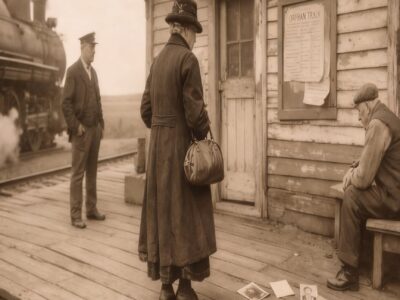
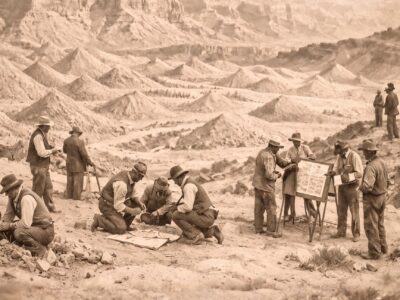
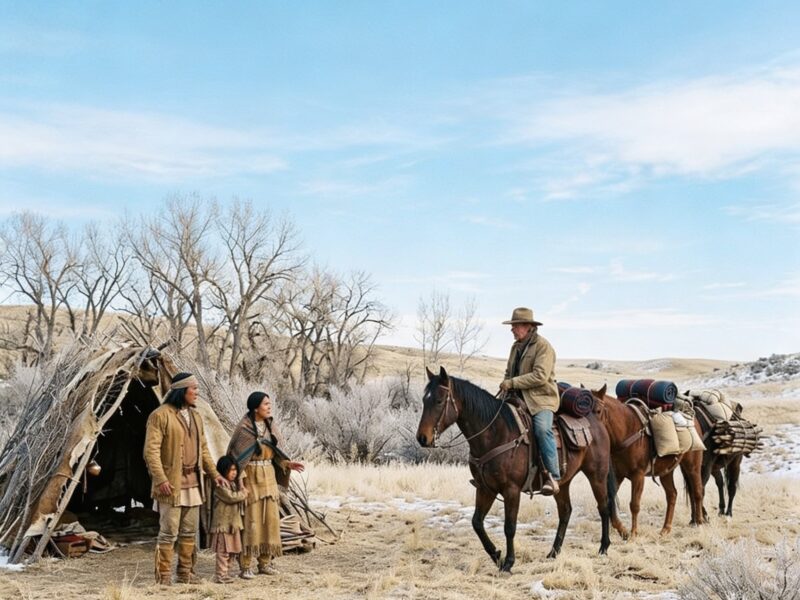
The camp sat back from the creek road in a shallow bowl of land protected by juniper, stone, and pale grass gone brittle from October frost. It was Apache camp, though smaller than the bands Elias had seen moving through the high country in other seasons. There was one hide shelter, one brush windbreak, a cooking place banked with ash, and a storage pit dug into the north-facing hillside.
That pit was open.
A man stood before it with his hands at his sides. He was older, broad through the shoulders though age had bent him slightly, his long hair streaked with gray. Beside him stood a boy of maybe ten, thin and rigid, trying to hold himself like the man and failing because his mouth kept trembling.
At the shelter entrance stood a woman.
Elias saw her before she moved.
She wore a dark wool shawl over a faded dress and leggings, her black hair braided and tied back with a strip of red cloth. She was not young enough to be untested, not old enough to have lost the sharpness of beauty. Her face was controlled in a way that made it harder to look away. She held a little girl against her hip, and another girl stood half behind her skirt, staring at Elias with frightened, furious eyes.
Elias reined in his dun mare at a respectful distance.
He had been searching for two missing cattle since dawn, following tracks along the base road where the wind had pushed everything loose toward the creek. Pitch had slowed on her own when they passed the camp, ears pricked toward the hillside. In eleven years, that mare had never asked him to look at something that did not matter.
Now he saw the empty pit, the moved stones, the crude tracks leading north, and the weight of disaster in that camp.
He took off his hat before dismounting.
The woman noticed.
So did the old man.
Elias walked only close enough to speak without raising his voice. “Morning.”
No one answered.
He did not take offense. There were mornings when words were an insult to what had happened.
His gaze went to the storage pit. It had been built properly, deep and stone-lined, with its covering dragged aside and then clumsily placed back. Whoever had emptied it had tried to hide the theft from a distance, not from anyone who knew the ground.
Elias crouched near the tracks.
Three horses. Heavy loads. Men’s boots. One with a nail missing from the left heel. They had come in at night, taken their time, and gone north toward Red Tail.
The old man spoke first. “You are lost?”
“No.”
“Then why are you here?”
“My cattle drifted after the windstorm. I was riding the road.”
The old man’s eyes stayed cold. “And now you are looking at our loss.”
“Yes.”
The woman shifted the child on her hip. Her gaze cut through Elias harder than the old man’s did. There was no pleading in it. No welcome. Only a question she seemed too proud to ask and too desperate to ignore.
Elias stood.
“How long ago?” he asked.
The old man did not answer.
The woman did. “Two nights.”
Her English was clean, quieter than he expected, and edged with exhaustion.
Elias looked north. Red Tail lay fourteen miles up the road. A mean little town built around a trading post, a livery, and enough bad whiskey to keep weak men brave. If the thieves had gone there, some of the goods might already be sold. Some eaten. Some traded onward.
But two days was not forever.
“What was taken?”
The old man’s jaw tightened.
The woman stepped forward before he could refuse.
“Dried venison. Rabbit. Corn. Grain. Salt. Tallow. Blankets. Two hides. Herbs. Pine pitch. Flour.” She swallowed, but her voice did not break. “Everything meant for winter.”
The little girl on her hip began to cry silently, her face pressed to Ama’s shawl.
Elias looked at the children.
Three of them. A family small enough to be erased by one hard snow.
He knew winter in that country. Settlers liked to talk about storms as weather, as if snow were an inconvenience God tossed down to test men’s roofs. But the high desert winter did not care about roofs. It came through cracks, through hunger, through a cough in a child’s chest, through a missing sack of grain, through one failed calculation made back in autumn.
This was not theft.
This was a slow killing set in motion.
The woman watched his face change.
“My name is Elias Cord,” he said.
The old man’s eyes narrowed. “I know that name.”
Elias waited.
“You have land south of the ridge.”
“Yes.”
“You keep to yourself.”
“Mostly.”
“You trade in Red Tail.”
“When I have to.”
The woman lowered the child to the ground. “Can you follow them?”
Elias looked at her.
It was the first time she had asked for anything, and even then she did it like a blade being drawn, not a hand held out.
“I can follow the road,” he said. “I can ask questions.”
The old man gave a humorless breath. “Questions do not fill a pit.”
“No,” Elias said. “They find the men who emptied it.”
The boy looked at him then, hope flashing so quickly it hurt to see.
The woman shut it down with one touch to the boy’s shoulder.
“You are not promising,” she said.
“No.”
“Then why go?”
Elias looked toward the empty pit again. A scrap of rawhide cord lay in the bottom, left behind like mockery. He thought of his own storeroom, not full enough. His leaking trough. His broken south fence. The two cattle still missing somewhere in brush. The payment due in November that he did not have ready. All the work waiting on his land, each task with teeth.
Then he looked at the children.
“Because I know where that road goes,” he said.
The old man studied him for a long moment. “I am Notak.”
Elias nodded.
The woman said nothing.
The boy spoke for her. “That is my mother, Ama.”
Ama’s eyes flicked to him, sharp with warning and love.
Elias put his hat back on. “I’ll ride north.”
“You go alone?” Notak asked.
“Yes.”
“They were three men.”
“I can count.”
The old man’s mouth shifted almost invisibly. Not amusement. Something near respect for a man who did not decorate danger.
Ama stepped closer.
There were bruised shadows beneath her eyes. Her hands were reddened from cold and work. Elias noticed the empty space on her left wrist where a leather tie had worn pale against the skin. A widow’s habit, maybe. Or just a thing lost. He had no right to wonder.
“If you find them,” she said, “what will you do?”
“Start with asking.”
“And end with?”
His gaze held hers. “That depends on how they answer.”
For the first time, something alive moved behind her controlled expression. Fear, perhaps. Anger, certainly. But beneath both, a flicker of startled attention.
She had expected pity.
He had given her a plan.
Elias mounted Pitch and turned north before the moment could become something he did not know how to stand in.
The road to Red Tail ran cold along the ridge, the wind cutting sideways with the kind of bitterness that found seams in a coat and made old injuries remember themselves. Pitch moved steadily, head low. Elias rode with his collar turned up and his mind on tracks.
Three horses, heavy-loaded.
One missing nail.
A man could tell a great deal by what thieves failed to hide.
He camped that night in a dry wash without fire, more from habit than fear. The stars came out hard and bright. He ate a biscuit and a strip of jerky, then sat with his back against stone and thought about Ama standing before that empty pit with a child on her hip and ruin at her feet.
He had seen women break before.
His wife, Ruth, had not broken when fever took their baby first. She had sat beside the cradle through the night, humming long after the child stopped breathing. Ruth had broken three days later, quietly, while washing a cup at the basin. Her knees had gone out from under her, and Elias had caught her too late to stop her head striking the cupboard. She died that spring of the same fever, though part of him believed the grave had opened when the child went in and simply waited for her.
Since then, Elias had kept his life narrow.
Land. Stock. Work. Weather.
Things that could hurt a man but did not ask him to love them.
At sunrise he rode into Red Tail.
The town looked half frozen and half drunk. Frost whitened the hitching rails. Smoke rose from crooked chimneys. A dog slept beneath the boardwalk outside the smaller saloon, curled tight against wind. Elias rode the full length of the main street once without stopping.
He found the horses outside the second saloon.
Three of them.
All grain-fed that morning. All sweat-dried from recent hard travel. The largest still had panniers tied at the rail, mostly emptied but not fully. Elias dismounted at the far end, tied Pitch, and spent a long minute pretending to check his cinch while studying the knots. One half hitch folded wrong over another. Southern style. He had seen it on freight wagons out of Barlow County.
He went inside.
The saloon smelled of sour beer, coffee, smoke, and unwashed wool. Five men were in the room. Three sat at a table near the stove, laughing too loud for the hour. One was heavyset, red-bearded, with restless eyes and a soft mouth that suggested cruelty enjoyed through other men’s hands. His companions were thinner, one older, one young and already flushed with drink.
Elias ordered coffee.
The bartender glanced at him. “Early for you, Cord.”
“Cold morning.”
“That it is.”
Behind the bar, stacked in brown paper near the shelf, sat bundles of dried meat. Too much for the saloon’s usual trade. Elias sipped his coffee and listened.
The red-bearded man was called Cready. No first name spoken. He talked about moving south in two days once “the rest of the goods” cleared. The younger man complained the blankets had fetched less than they were worth. The older one told him to shut his mouth.
Elias finished half his coffee.
Then he set the cup down and left.
The trading post belonged to Vera Ott, a woman who had lived in Red Tail long enough to outlast four sheriffs, three preachers, two floods, and one man who had attempted to rob her and lost two fingers to the hatchet beneath her counter. She was small, white-haired, and direct in the way of people who had no time left for foolishness.
She looked up when Elias entered. “Cord.”
“Vera.”
“You’re far from your fence line.”
“Following stolen winter stores.”
Her gaze sharpened.
He told her plainly. Apache family at Arroyo Seco. Empty pit. Tracks north. Three horses. Men at the saloon. Meat behind the bar. Blankets traded here.
He did not mention justice. Men and women on the frontier had heard too much talk of justice from people who profited by denying it to others. He gave her facts and let them sit.
Vera’s face did not soften, but something in it tightened.
“The blankets smelled of fever herbs,” she said. “Not trail musk. Not trader stock. Family stores.”
“You bought them?”
“I did.”
“Knowing?”
Her eyes cut to his. “Suspecting.”
Elias held her stare.
After a moment, Vera looked away first. That surprised him.
“I should have asked,” she said.
“Yes.”
She did not flinch. “I will return the blankets. I’ll add salt, beans, two hides, and tallow at cost.”
“At cost to me?”
“At cost to my conscience,” she said sharply. “Don’t get greedy with repentance that isn’t yours.”
For the first time in two days, Elias almost smiled.
“Yes, ma’am.”
He recovered the dried meat from the saloon by making the bartender understand exactly how uncomfortable the next hour could become if Elias walked to the street and said aloud where the meat had come from. He had no law behind him. No badge. No authority except the kind a man carried when he had worked hard all his life and did not bluff often enough for people to test him lightly.
The bartender sold it back cheap.
Cready watched from his table, smiling into his drink.
Outside, Elias loaded the meat onto a rented pack mule. He felt Cready’s stare between his shoulder blades but did not turn.
At Beaumont’s spread west of town, he traded two days of spring fence work for dried venison and flour. At the livery, he bought cracked corn on credit the owner would not have extended to most men. Back at Vera’s, he added chilies, lamp tallow, a clay pot for pine pitch, and extra grain he could not afford but bought anyway.
By the end of the second day, the pack mule carried more than the thieves had taken.
Not wealth. Not comfort.
Survival.
Elias stood in the livery yard looking at the load while the sun dropped red behind the buildings. Vera came out carrying a small leather pouch.
“Herbs,” she said. “Not the ones stolen. Those were sold before I knew to look. These will help chest coughs. I know enough to know that.”
Elias took the pouch.
“You think this fixes it?” she asked.
“No.”
“Good.” Her eyes went toward the saloon. “Cready knows you interfered.”
“I know.”
“He has men who dislike embarrassment.”
“So do I.”
“You have you.”
“That’s what I meant.”
Vera shook her head. “Stubborn fool.”
“I’ve been called worse.”
“By smarter people?”
“Usually.”
He rode out near dusk, Pitch under him, mule behind, rifle across his lap.
Eight miles south of Red Tail, Pitch’s ears went forward and stayed there.
Elias looked back.
Two riders followed at a distance.
Not close enough for speech. Not far enough for doubt.
He kept his pace steady. Men who wanted to rob a man fast closed ground. Men who meant to wait for dark stayed patient. Cready was not brave in the clean way. Elias had known his kind. Cready would prefer the road narrow, the light gone, and the victim tangled with a mule.
Elias left the road before the wash and cut east through broken country.
The mule protested. Pitch did not. The mare knew his body, his weight, his decisions. She picked her way over shale and scrub while twilight thickened. Elias dropped into a dry wash and followed it south until darkness covered them.
He slept two hours with his rifle across his knees.
At dawn, he found fresh tracks above the wash. The riders had searched, lost him, and turned back.
For now.
When he reached Arroyo Seco, the family was still there.
Ama came out first.
Notak stood behind her. The children clustered near the shelter. The boy’s face changed when he saw the loaded mule, and this time Ama did not stop the hope from showing.
Elias dismounted and began unloading without ceremony.
Corn. Grain. Venison. Rabbit where he could get it. Flour. Salt. Beans. Tallow. Blankets. Hides. Chilies. The clay pot. The herbs. A small sack of coffee because he had seen Ama’s exhaustion and made one indulgent decision he would not explain.
He stacked each item beside the pit.
Nobody spoke.
When he finished, the pile was clearly larger than what the pit could have held before.
Notak stared at it.
Then at Elias.
“More than was taken.”
“Some things were gone. I made up the difference.”
Ama stepped toward the supplies slowly, as if approaching a living thing that might vanish if startled. She touched one blanket, then the sack of salt. Her hand stopped on the leather pouch of herbs.
“Who gave this?”
“Vera Ott.”
Ama’s mouth tightened. “The trader knew?”
“She knows now.”
The answer sat between them.
Ama looked at him fully then. He had seen gratitude before, and suspicion, and the brittle pride of someone forced to receive help they hated needing. What he saw in Ama was more complicated. Relief, yes. But also humiliation. Rage. A fierce resistance to being made beholden to any man, especially a white rancher who could ride away clean while she spent winter remembering his charity.
“You paid for this,” she said.
“Some.”
“You traded work.”
“Yes.”
“You risked the thieves following you.”
He glanced at Notak. “They tried.”
Ama went still. “They followed?”
“Lost them in the wash.”
Her face hardened. “Then they know you.”
“They knew me before.”
“Now they know you stand with us.”
Elias did not answer quickly.
The smallest girl reached for a dried chili, and Ama gently moved her hand away.
At last Elias said, “I know what I did.”
“Do you?” Ama’s voice sharpened. “You think the ride is finished because the mule is empty. It is not finished. Men who steal winter from children do not forgive being shamed.”
Notak said her name softly, warning her back from anger.
But Elias found he preferred her anger to gratitude.
Gratitude put distance between people. Anger told the truth.
“She’s right,” he said to Notak.
Ama blinked.
Elias picked up Pitch’s reins. “You may want to move camp.”
“To where?” Ama asked. “The high passes are already closing. The lower canyon is watched. This is the winter ground my husband chose before he died. My children know this creek. My father’s knees won’t carry him through three days of snow. Men like Cready count on us moving until the cold finishes what they started.”
Her voice cracked on the last words.
Only once.
Then she sealed it away.
Elias looked at her left wrist again, at that pale band where something used to be.
“Your husband?”
“Dead two winters.”
Notak’s face turned to stone.
Elias did not ask how. A woman’s grief was not a door he had permission to open.
“I have a spare shed,” he said. “South of my place. Roof holds. It’s closer to timber and farther from the road.”
Ama looked as if he had insulted her.
“We are not moving onto your ranch.”
“I didn’t say the ranch. I said the shed.”
“And what would people say about an Apache widow sleeping near Elias Cord’s land?”
“People say things for sport.”
“And men kill for stories,” she snapped.
The little boy flinched at her tone.
Ama saw it and closed her eyes briefly, ashamed.
Elias lowered his voice. “I won’t force help on you.”
“No,” she said. “You only bring so much of it a woman chokes trying to swallow.”
The words struck harder than she likely intended.
For a moment, nobody moved.
Then Elias nodded once. “Fair enough.”
He mounted.
The boy stepped forward. “Mr. Cord?”
Elias looked down.
“What happened to the men?”
“Nothing yet.”
The boy’s chin lifted with a child’s terrible hunger for justice. “Will something happen?”
Elias’s eyes moved to Ama.
She watched him as if his answer mattered more than the supplies.
“Yes,” he said. “Something will.”
Part 2
Cready came to Arroyo Seco six days after the first snow.
Not alone.
Ama heard the horses before the dogs did, which told her the riders had approached downwind and slow. She was grinding corn near the fire while her oldest daughter, Tali, sewed a tear in one of the returned blankets. Her son Sani was checking the snares with Notak. Little Mesa slept inside the shelter with a cough that had not yet worsened but lived in Ama’s mind like a wolf beyond the firelight.
She rose before the riders entered camp.
Four men came through the juniper.
Cready rode first, red beard bright against the gray morning. Two of his men flanked him. The fourth was lean, older, with a missing nail in the left heel of his boot.
Ama saw it when he dismounted.
Her hand went to the knife at her belt.
Cready smiled. “Morning.”
Ama said nothing.
His eyes moved over the camp, the rebuilt storage pit, the smoke hole, the drying racks, the children’s things. He looked not like a man entering someone’s home, but like a buyer inspecting poor stock.
“Seems you recovered well.”
Ama’s fingers tightened around the knife handle. “Leave.”
Cready chuckled. “That’s not neighborly.”
“We are not neighbors.”
“No. I guess we ain’t.” His gaze slid to the storage pit. “Heard Elias Cord brought you back quite a haul. More than you lost, folks say.”
“Folks talk too much.”
“Folks are concerned.”
Ama’s eyes narrowed.
Cready leaned on his saddle horn. “People don’t like not knowing what arrangements are being made in the hills. A white rancher riding supplies to Apache camp. Apache widow receiving him. Her husband dead, his wife dead.” His smile widened. “Makes a man wonder what else is being traded.”
Ama moved before fear could stop her.
She crossed the distance and slapped him hard across the face.
The sound cracked against the cold.
Cready’s men shifted. One laughed under his breath. Cready touched his cheek slowly, eyes bright with insult.
“You got spirit,” he said. “I’ll grant that.”
Ama held his gaze. “And you have stolen food still between your teeth.”
His smile died.
The lean man stepped toward her.
Notak’s voice came from behind the camp. “One more step.”
He stood near the juniper with Sani beside him, both holding rifles. Sani’s rifle shook, but it pointed in the right direction.
Cready looked amused again, though his face remained red where Ama had struck him.
“You people ought to be careful. Winter’s long. Accidents happen. Fires. Sickness. Children wandering too far.”
Ama’s blood went cold.
Cready tipped his hat. “Tell Cord I said hello.”
They rode out slowly, leaving hoof marks in the snow like a threat written plainly enough for anyone to read.
By dusk, Ama had decided not to tell Elias.
By midnight, she knew that was pride and pride could get children killed.
She left before dawn.
Notak argued. She did not. Tali held Mesa, Sani saddled the family’s thin pony, and Ama rode south with Cready’s warning tucked in her chest like a burning coal.
Elias Cord’s ranch sat in a shallow valley beneath a ridge of black stone and juniper. It was not large. The house was square, weathered, and stern. The barn leaned slightly east. Smoke rose from the chimney in a straight gray line. A leaking trough near the fence had recently been repaired, its new boards pale against old wood.
Elias was chopping wood when she arrived.
He stopped mid-swing.
Ama knew what he saw: an Apache woman riding alone into a white rancher’s yard at sunrise, snow on her shawl, fury in her face, and danger close behind. His expression changed only in his eyes.
He set the axe aside. “Who came?”
“Cready.”
Elias walked toward her. “When?”
“Yesterday morning.”
“How many?”
“Four.”
“Did he touch you?”
The question came too fast, too rough.
Ama looked down at him from the pony. “I touched him.”
Elias went still.
“I hit him,” she said.
For one stunned second, his mouth almost curved. Then the seriousness returned. “He threaten you?”
“Yes.”
“Children?”
Her throat tightened. “Yes.”
Elias looked toward the north road.
Whatever restraint he kept inside himself shifted. She saw it happen. He did not shout. Did not curse. But his body settled into violence the way another man might settle into a coat.
“I should have killed him in Red Tail.”
Ama dismounted. “No.”
His gaze cut back.
“That is why I came,” she said. “Not for you to ride out angry and make my family the excuse for your death.”
His jaw worked.
“My family has had enough stolen,” she continued. “Do not add yourself to the pile.”
The words landed strangely between them.
She had not meant to claim him.
Elias heard it anyway.
The cold air seemed to tighten.
He stepped closer, but not too close. “Why did you come, Ama?”
Because I was afraid.
Because I knew you would listen.
Because when Cready spoke of me like something bought, I wanted your name out of his mouth.
Because since you stacked those supplies beside our pit, I have heard your horse in my sleep.
She said none of that.
“I came because you said something would happen,” she answered. “I want to know what.”
Elias studied her long enough that heat rose beneath her skin.
Then he nodded toward the house. “Come inside. You’re cold.”
“I am not.”
“You are.”
“I have crossed colder ground than your yard, Elias Cord.”
“I believe it. Come inside anyway.”
His house was plain and clean, warmer than she expected. A stove glowed in the corner. A rifle hung above the door. One cup sat on the table. One plate. One chair pulled out, as if loneliness had been interrupted mid-meal.
Ama noticed a woman’s photograph on the mantel.
Elias saw her notice.
“My wife,” he said.
Ama turned from the photograph. “How long?”
“Twelve years.”
“Children?”
The pause told her before he did.
“One. A daughter. She died first.”
Ama lowered her eyes. “I am sorry.”
He moved to the stove, poured coffee, and set a cup in front of her. “I know you are.”
She wrapped both hands around it. The heat bit her fingers and felt good.
They sat across from each other while morning widened in the window.
He told her what he knew. Cready had moved some stolen goods through Red Tail. Vera Ott would testify if pushed. The saloon keeper would lie until frightened, then tell enough truth to save himself. Beaumont knew Elias had traded labor for replacement meat. The livery had records of the rented mule.
“Records do not stop bullets,” Ama said.
“No.”
“Then why gather them?”
“Because bullets alone make men like Cready into victims when the story gets told.”
She looked at him sharply.
He leaned back. “If I shoot him in the road, his friends say I killed a white man over Apache trouble. If I prove he robbed children’s winter stores and threatened them after, his friends have to decide how much shame they’re willing to carry in public.”
Ama gave a bitter smile. “You believe shame stops men?”
“Not all. Some.”
“And the others?”
His eyes hardened. “The others are why I keep the rifle.”
Against her will, a pulse of warmth moved through her.
Not because he spoke of violence. She had known violent men. Her husband had died facing them. What moved her was the order inside Elias: proof first, force only when forced, anger held back not because he lacked it but because he respected what it could destroy.
“You think carefully,” she said.
“Only after thinking badly cost me enough.”
Their eyes held.
The stove cracked softly.
Ama looked away first.
By noon, they rode to Red Tail together.
That was Elias’s decision, though Ama did not understand why until they reached the edge of town and every face turned toward them. Men came out of the livery. Women stared from doorways. The two of them riding side by side became a story before either spoke.
Ama hated him for half a minute.
Then she understood.
Cready’s power lived in shadowed accusations. Elias had dragged the matter into daylight by arriving with her openly, not hidden behind him, not protected out of sight, but beside him.
At the trading post, Vera Ott looked from Elias to Ama and went very still.
“This is Ama,” Elias said. “The woman whose blankets you bought.”
Vera’s mouth tightened.
Ama stepped forward. She smelled leather, kerosene, coffee, and old wood. Behind the counter hung two blankets she recognized by the dyed edge her mother had taught her to weave.
Vera took them down without being asked.
“I should not have bought them,” the old woman said.
Ama accepted the blankets. “No. You should not.”
Vera flinched slightly.
Elias’s gaze lowered, almost approving.
Vera came around the counter with a ledger. “I wrote what I received from Cready. Date, goods, price. I will sign to it.”
Ama looked at the ledger, then back at Vera. “Why?”
“Because I was wrong after the theft. I prefer not to be wrong after the warning.”
It was not apology exactly.
Ama found she respected it more than tears.
The saloon keeper was less dignified. He denied everything until Elias told him Vera had already entered the sale in her ledger and that if the matter went before a territorial judge, buying stolen winter food from a family camped under treaty protection would sound uglier than admitting he had been careless.
The man sweated through his collar and signed a statement.
By the time they left, Cready was waiting in the street.
So were a dozen others.
He smiled at Ama as if her slap had become a private joke between them.
“Well now,” he called. “Cord brings his woman to town.”
The words hit the street with deliberate filth.
Ama’s spine locked.
Elias dismounted.
No hurry. No flourish. Just boots in the dust and one hand resting loose at his side.
“She is not mine,” he said.
Cready’s smile widened.
Elias continued, voice carrying. “And that is not an insult you’ll put on her because you can’t answer for stealing from her children.”
The crowd shifted.
Cready’s eyes flicked toward the saloon keeper, then Vera standing in the trading post doorway with her ledger against her chest.
For the first time, uncertainty crossed his face.
Ama saw it and stepped down from the pony.
“My name is Ama,” she said, loud enough for the street. “My father is Notak. My children are Tali, Sani, and Mesa. You stole dried meat, corn, grain, salt, tallow, hides, blankets, herbs, and winter medicine from our storage pit. Then you came to my camp and threatened my children because Elias Cord made your theft visible.”
Cready’s jaw clenched. “You call me thief in front of witnesses?”
“Yes.”
He stepped toward her.
Elias moved.
Cready stopped.
That alone told the street something.
“You hide behind him?” Cready sneered.
Ama drew the knife from her belt and held it low. “No. He is simply closer.”
A few men laughed, startled into it.
Cready flushed dark.
His hand drifted toward his gun.
Elias’s voice lowered. “Don’t.”
That single word emptied the street of humor.
Deputy Marlow, Red Tail’s lawman when sober and its embarrassment when not, pushed through the crowd. “What’s this?”
“Complaint of theft,” Elias said. “Threats against a family. Witness statements. Ledger records.”
Marlow looked pained by the arrival of facts.
Cready snapped, “You taking the word of an Apache woman now?”
Marlow hesitated.
The hesitation lasted only a second, but Ama felt every year of it.
Elias did too.
He stepped closer to the deputy. “You’re taking statements from Vera Ott, Jim Beaumont, a saloon keeper with a guilty conscience, and me. Or you’re explaining to the territorial marshal why stolen winter supplies were sold in your town while you looked away.”
Marlow’s face soured.
But the crowd had shifted. Not all of them. Perhaps not even most. But enough. The story had a shape now, and Cready no longer controlled it.
Marlow took the papers.
Cready stared at Ama with open hatred.
“This isn’t over,” he said.
Ama believed him.
That night, she did not return to Arroyo Seco.
A storm rolled in too hard and sudden, snow sweeping sideways across the road until even Pitch lowered her head against it. Elias refused to let Ama ride north in it. Ama refused to sleep in his house. They compromised with the barn, which suited neither of them and therefore seemed fair.
He gave her the clean horse blanket from his saddle room and built a small lantern fire in a covered bucket near the stall wall. She sat wrapped in wool while snow hammered the roof.
Elias stood near the door, watching the storm.
“You can sit,” she said.
“I’m fine.”
“You say that like a man who is not.”
He glanced back.
She lifted the coffee he had brought her. “I know the sound. I use it myself.”
For a moment, he looked almost caught.
Then he came and sat on an overturned feed crate several feet away.
The silence between them changed by degrees. Outside, the storm erased the world. Inside, the barn held animal warmth, hay dust, leather, and the faint scent of smoke on Elias’s coat.
Ama traced the rim of the cup with her thumb.
“Cready killed my husband,” she said.
Elias’s eyes lifted.
She had not planned to tell him. The words had stepped out without permission.
“His name was Tovan. He caught Cready’s men taking horses from a canyon camp two winters ago. They said he fired first.” Her mouth hardened. “He did not. Tovan would have killed them if he had.”
Elias said nothing.
She was grateful for that.
“They left him in snow. Not dead yet. Not alive enough to come home.” Her voice thinned. “Sani found his knife in spring melt.”
Elias’s hand closed slowly over his knee.
“That’s why Notak didn’t come to Red Tail,” he said.
Ama nodded. “If my father saw Cready, he would kill him or be killed trying.”
“And you?”
She looked at the lantern flame. “I have children. That is the chain around my anger.”
“No.” Elias’s voice was quiet. “That is the reason your anger still has a place to go.”
She turned to him.
He looked older in the lantern light. Harder, but not cold. The grief in him sat close tonight.
“Tell me about your wife,” Ama said.
His gaze shifted toward the storm.
“I loved her badly,” he said after a while.
“Badly?”
“Too quietly. I thought work was the same as tenderness if the roof held and food was on the table.”
Ama held still.
“She used to ask me to come sit with her after supper,” he continued. “I always had one more thing. Gate to mend. Tack to oil. Trough to check. I thought there would be time. Then fever came, and all there was left to do was sit. I got very good at it when it no longer mattered.”
The pain in those words moved through Ama unexpectedly.
“It mattered,” she said.
His jaw tightened.
“When the dying are not left alone,” she continued, “it matters.”
Elias looked at her then with such raw gratitude that she had to look down.
Danger had many forms. Gunfire. Hunger. Snow. Men like Cready.
But this was another danger entirely: being seen gently by someone you had not meant to need.
Elias rose abruptly. “You should sleep.”
Ama looked up. “And you?”
“I’ll watch the road.”
“In this storm?”
“Especially in this storm.”
She stood too. “You cannot stand guard over every fear.”
“No.”
“But you will try.”
His mouth tightened. “Yes.”
She crossed the small space between them. He did not move back, though she saw the effort it cost him not to.
“Why?” she asked.
His eyes searched hers.
Because Cready looked at you like he had already taken too much.
Because your children were cold.
Because when you slapped him, I wanted to laugh and kill him in the same breath.
Because your grief recognized mine before I was ready.
He said only, “Because I can.”
Ama lifted one hand and touched the scar along his knuckles.
His breath changed.
She had meant it as thanks. Perhaps also as warning. Instead, the touch became something else the moment his hand turned under hers.
He did not grip her.
He let her decide whether to stay.
Ama should have stepped away.
She was a mother first. A widow. Apache. He was a white rancher whose help had already drawn danger like blood draws wolves. The town had already dirtied her name. Cready would use any tenderness between them as weapon and proof. Even if none of that were true, love itself was dangerous. It asked the heart to put down its knife.
But Elias looked at her like she was not a burden, not a scandal, not a cause, not a woman to be pitied or possessed.
Like she was Ama.
She rose onto her toes and kissed him.
He went utterly still.
Then his restraint broke, but not his care. His hand came to the side of her face, rough and warm, and he kissed her back with a hunger so controlled it made her ache. There was grief in it. Fury. Years of silence. A tenderness he seemed almost ashamed to own.
When he pulled away, his forehead rested against hers.
“This will make trouble,” he said.
Ama closed her eyes. “Everything makes trouble.”
“Not like this.”
She stepped back, though every part of her resisted it.
“My children come first,” she said.
“Yes.”
“My people come first.”
“Yes.”
“I will not become a secret in your barn.”
His eyes darkened. “Never.”
She believed him.
That was the most frightening part.
Part 3
Cready burned the storage pit on the third night of the storm.
He did not get all the supplies. Notak had moved half of them after Ama returned from Elias’s ranch, hiding stores in three smaller places instead of one. That caution saved them from starvation.
It did not save the camp from terror.
The fire started near midnight, flames crawling up the hide covering and catching the dry brush Notak had stacked for insulation. Ama woke to Sani shouting. Snow fell in thick sheets, turning orange in the firelight. Tali dragged Mesa from the shelter while Notak beat at flames with a wet blanket, coughing smoke.
A shot cracked from the dark.
The bullet struck the cook pot and sent it spinning.
Ama threw herself over Mesa.
Sani raised his rifle wildly, but Notak knocked the barrel down before fear made him waste the shot.
“Stay low!” Ama shouted.
Hooves moved beyond the juniper. Men laughing. One voice called something filthy about Elias Cord and Apache widows.
Then they were gone.
By dawn, the main pit was blackened and useless. One hidden store had survived untouched. Another had smoke damage. The third, farther up the creek, held enough for perhaps three weeks if stretched hard.
Notak’s beard was singed. Tali’s hands were burned. Mesa’s cough deepened by noon.
Ama sat beside her youngest child and felt a calm settle over her so complete it frightened even Notak.
“I am going to Cord,” she said.
Her father’s eyes narrowed. “For help?”
“For war.”
Elias arrived before she could leave.
He came with Vera Ott, Deputy Marlow, and four men from Red Tail who looked ashamed enough to be useful. Pitch was lathered from hard riding. Elias swung down before the mare fully stopped, and one look at his face told Ama he had seen the smoke from miles away.
He crossed the camp straight to her.
Not touching. Not in front of everyone.
But close enough that she felt the heat of him through the cold.
“Who’s hurt?”
“Tali’s hands. Mesa’s cough. My father breathed smoke.”
“You?”
Her jaw tightened. “Angry.”
His eyes held hers. “Good.”
Marlow inspected the burned pit with the expression of a man realizing the thing he had hoped would stay paperwork had grown teeth. Vera went to Tali with salve and bandages. The Red Tail men unloaded supplies without being asked. Flour, coffee, salt pork, apples gone soft but usable, lamp oil, blankets.
Ama stared at it.
Elias saw her face and said quietly, “This is not charity. It is evidence of conscience arriving late.”
“Conscience has good timing when watched,” she said.
A grim smile touched his mouth. “Sometimes watching helps.”
Marlow came back from the pit. “Tracks head west.”
“Toward Cready?” Elias asked.
“Toward Farrow Pass.”
Elias went still.
Ama noticed. “What is Farrow Pass?”
Vera answered from beside Tali. “Old mine road. Comes down behind Cord’s south pasture.”
Ama looked at Elias. “Your ranch.”
“They’re not finished,” he said.
They rode for Elias’s place before sundown.
Ama insisted on going.
Elias argued once. She looked at him, and he stopped. That was something between them now—an understanding that protection could not mean erasing her from her own danger.
Notak stayed with the children, though every line of his body hated it. Vera remained too. Marlow sent two men back to Red Tail for more riders and came with Elias and Ama toward the pass.
Snow made the trail slow. Night fell early. The air smelled of pine, iron cold, and coming violence.
They reached the ridge above Elias’s ranch near midnight.
His barn was already burning.
Elias made no sound.
That was worse than shouting.
Flames climbed one wall, bright against the snow. His cattle scattered in the lower pasture. Three riders moved like dark insects below, one carrying a torch toward the house.
Ama grabbed Elias’s sleeve before he could spur down. “Think.”
His eyes were terrible. “That is my house.”
“And they want you rushing blind.”
He looked at her hand on his arm.
The touch reached him where words might not have.
Marlow whispered, “We wait for my men?”
Elias shook his head. “House goes next.”
Ama looked down the ridge. “Then we split them.”
She moved before either man could answer, sliding from the pony and taking Elias’s rifle from the scabbard. She had watched the land as they climbed. She knew where the rocks narrowed, where sound would carry, where snow would show movement.
Elias caught on quickly.
Of course he did.
They descended from different sides.
Marlow fired first from the east, high and wide, drawing the torchbearer away from the house. Elias rode straight into the yard, low over Pitch’s neck, and fired at the man near the barn door. Ama came down through the rocks on foot, rifle steady, and shot the torch clean from another rider’s hand when he turned toward Elias’s hay shed.
The third man bolted.
Ama recognized the missing heel nail when he slipped in snow near the trough.
She ran at him.
He rose with a knife.
She struck him with the rifle stock before he got his balance. He went down hard, rolled, and grabbed her skirt. She kicked him in the jaw. He cursed, dragging her down into the snow.
Then Elias was there.
He hauled the man off her and hit him once, a short brutal blow that ended the struggle.
Ama scrambled up, breathing hard.
The barn roof collapsed inward behind them, sparks flying into the storm.
Elias turned toward it like a man watching his past burn for the second time.
Ama touched his arm. “The house.”
He snapped back to motion.
They saved the house.
Barely.
By dawn, the barn was half ash, half smoking ribs. One cow was dead. Two horses missing. Pitch had a shallow cut across her flank. Elias’s hands were burned from dragging a trunk out before the roof beam fell. Inside the trunk were Ruth’s photograph, his land papers, and a small dress folded in tissue.
Ama saw the dress before he shut the lid.
A daughter’s dress.
She said nothing.
But later, when Marlow took the captured man toward Red Tail and the other riders searched for Cready’s trail, Ama found Elias behind the house splitting charred boards with an axe he did not need to use.
“Stop,” she said.
He swung again.
“Elias.”
Another blow.
She stepped in and caught the handle before he could lift it.
His eyes were wild with contained grief.
“He burned the barn because of me,” she said.
His face changed. “No.”
“Because you helped me.”
“Because he is a thief and a coward.”
“And because he saw what stood between us.”
There it was.
The thing both had avoided naming in daylight.
Elias’s hands tightened on the axe handle beneath hers.
Ama’s voice softened. “He will use me to ruin you.”
“He already tried.”
“He will use my children.”
His jaw clenched.
“He will use the town’s fear. He will say I brought fire to your land. He will say I am your shame.”
Elias let go of the axe.
It fell into the snow between them.
“You are not my shame.”
The words came low, fierce, and naked.
Ama’s throat tightened.
“Then what am I?”
He looked at her as if the answer might destroy him.
“You’re the first living thing I’ve wanted near me since I buried my wife and child.”
Snow drifted between them.
Ama closed her eyes because the words were too much, and not enough, and exactly what she had feared.
When she opened them, he was still there.
“I cannot belong to you,” she said.
“I know.”
“I cannot give up my family.”
“I would not ask.”
“I cannot live as proof that a white man has a generous heart.”
Anger flashed through his grief. “I would burn that story myself.”
“You cannot burn all stories.”
“No.” He stepped closer. “But I can stand in the street and tell the truth until liars get tired of hearing it.”
Despite everything, she almost smiled.
Then a rider came hard from Red Tail.
It was Sani.
The boy slid from the pony before it stopped, face white with terror.
“Mother,” he gasped. “Cready has Mesa.”
Ama’s body went cold.
The world narrowed to one child’s name.
Sani’s words came broken. Cready had not fled the pass. He had circled back to Arroyo Seco with two men while Notak was moving the children to Vera’s wagon. In the confusion, he had seized little Mesa and left a message.
Cord brings the woman and the winter rights deed to the old mill by sunset, or the girl freezes where no one finds her.
Elias read the note once.
Then again.
His burned hands closed carefully around the paper.
Ama did not weep.
She did not scream.
Her face became so still that Sani began to cry.
She knelt and gripped his shoulders. “Listen to me. Your sister will come back.”
Sani sobbed, “I should have stopped him.”
“You are a child,” she said, voice breaking at last. “Be my child. Do not be my soldier.”
Elias turned away as if the sight cut him too deeply.
Marlow wanted to gather men.
There was no time.
Vera wanted to send for the territorial marshal.
There was no time.
Notak wanted to ride despite his smoke-burned lungs.
Ama forbade it and her father, for once, obeyed because grief had made her voice older than his.
At sunset, Ama and Elias rode to the old mill together.
The winter rights deed Cready demanded was not what he thought. Apache winter grounds were not simple paper, not in the way white men understood land. But Elias had a claim along the creek route, and Cready knew if he could force Elias to sign over access, Farrow men and freight outfits could pressure Notak’s family out by spring.
The mill stood beside a frozen creek, broken wheel locked in ice. Cready waited with Mesa tied in front of him on the porch, wrapped in a blanket but shaking violently. One of his men held a rifle on her. The other stood near the trees.
Ama felt herself leave her body.
Elias’s voice anchored her. “Breathe.”
“I am.”
“No. You’re preparing to die. Breathe first.”
She dragged air into her lungs.
Cready smiled when they rode into the clearing.
“There’s the happy pair.”
Elias dismounted with his hands visible. Ama followed.
Mesa cried out, “Mama!”
Ama took one step.
Cready pressed his pistol near the child’s head. “Easy.”
Ama stopped.
Her face did not change, but Elias saw her soul tearing itself bloody behind her eyes.
He held up the folded deed. “Let the girl go.”
“Bring it here.”
“Girl first.”
Cready laughed. “You’re not bargaining from strength.”
Elias looked at him. “Neither are you. You’re holding a five-year-old because men heard the truth about you and you couldn’t bear it.”
Cready’s face twisted.
“You think this is about truth?” he snapped. “This is about order. About knowing who gets to accuse whom. You let them call me thief. You let her stand in town like she had the same word as mine.”
“She does,” Elias said.
Cready raised the pistol.
Ama spoke then.
“You killed Tovan.”
The clearing went silent.
Cready’s eyes shifted to her.
“You remember him,” she said. “Snow in his hair. Knife gone from his belt. You left him breathing because you were too afraid to look him in the face when he died.”
Cready’s mouth curled. “He should have stayed out of my way.”
Ama’s hand closed slowly around the knife hidden in her sleeve.
Elias saw.
So did Mesa, bright little eyes fixed on her mother.
Ama stepped forward. “I have dreamed of killing you.”
Cready’s smile returned. “Have you?”
“Yes.”
“Then come closer.”
Elias’s heart slammed. “Ama.”
But she kept walking.
“I dreamed it would feel clean,” she said. “Like justice.”
Cready watched her, distracted by the hatred he had finally drawn into the open.
He did not see Mesa loosen the rawhide around her wrists with the small blade Sani had hidden in her blanket fringe months ago because Notak taught all his grandchildren never to be helpless if they could help it.
Ama saw.
Elias saw Ama seeing.
He moved.
The world broke into gunfire.
Mesa dropped flat. Ama threw her knife. It struck Cready’s gun arm as Elias fired at the man holding the rifle. The shot went wide but close enough to send him off balance. Ama ran for Mesa. Cready roared and lunged toward her with his wounded arm bleeding.
Elias hit him from the side.
They crashed through the porch rail into snow.
Cready was heavy, strong, desperate. He drove a knee into Elias’s ribs and clawed for the pistol in the slush. Elias caught his wrist. Cready slammed his head into Elias’s burned hand, and pain burst white behind Elias’s eyes.
Ama got Mesa behind the mill stones and turned back.
Cready got the pistol.
Elias froze.
Cready smiled through blood. “Should’ve kept to your own kind.”
A shot cracked from the trees.
Cready jerked, dropped the gun, and fell hard onto his side.
Notak stepped out from the dark with smoke curling from his rifle.
Ama stared at her father.
He swayed slightly, pale from the ride, but his eyes were steady.
“I told you to stay,” she whispered.
Notak looked at Cready bleeding in the snow. “I listened as long as I could.”
Marlow and the Red Tail riders arrived minutes later, guided by Sani, who had followed Notak despite being told not to because apparently obedience had become scarce in the family.
Cready lived.
Barely.
That mattered because dead men could be turned into martyrs, and living cowards sometimes confessed when pain and witnesses stripped away their pride.
He confessed to the theft, the threats, Tovan’s killing, the burned pit, the barn fire, and the kidnapping before morning.
By noon the next day, Red Tail knew.
By winter’s next full moon, the territorial court knew too.
Cready was taken south in irons with two of his men. The saloon keeper lost half his business. Marlow, under pressure from Vera Ott and Abernathy of the county council, became suddenly zealous about written records and lawful conduct. People who had whispered about Ama found urgent business looking elsewhere when she entered town with her children.
But victory did not make winter soft.
Elias’s barn was gone. Ama’s storage pit had to be rebuilt. Mesa’s cough lingered. Tali’s hands healed slowly. Notak slept badly after shooting Cready and said nothing about it. Sani followed Elias like a shadow whenever he came to Arroyo Seco, trying to become older by proximity.
Elias came often.
At first, with supplies.
Then with timber.
Then with no excuse anyone believed.
He helped Notak dig three new storage pits farther apart and better hidden. Ama helped him rebuild the burned barn roof before the worst freeze settled in. They worked side by side in cold bright afternoons, speaking little when others were near, speaking more when they were not.
The town still watched.
Some with suspicion. Some with shame. Some with curiosity sharpened into cruelty.
Ama did not care as much as she expected.
The first time she brought her children to Elias’s ranch after the fire, Mesa ran straight to Pitch and announced that the mare looked sad. Elias told her Pitch always looked sad before being fed apples. Mesa solemnly shared one from Vera’s basket.
Ama watched from the yard.
Elias came to stand beside her.
“You’re smiling,” he said.
“No.”
“You are.”
She let the smile fade on purpose. “Now I am not.”
“That was mean.”
“You survived.”
He looked toward the children, then the rebuilt section of barn wall, then the house where Ruth’s photograph still sat on the mantel.
“I want to ask you something,” he said.
Ama’s chest tightened. “Then ask.”
He took off his hat, turned it once in his hands, and looked suddenly less like the feared, steady rancher people stepped aside for and more like a man standing before a cliff.
“Stay through winter,” he said. “Here. Or let me build beside Arroyo Seco. Or let me move between both places until the thaw. Not because I think you need owning. Not because I think your children need a white man’s name over them. Because I love you, and I want a life where helping you isn’t something I have to invent reasons for.”
Ama looked away before the force of it showed too plainly on her face.
He waited.
That was one of his great strengths. He could wait without trying to fill silence with pressure.
At last she said, “I have buried one husband.”
“I know.”
“I have carried my children through hunger.”
“I know.”
“I have watched men use need as rope.”
His voice roughened. “I am not those men.”
“No.” She looked at him then. “That is why you frighten me more.”
His eyes changed.
Ama touched the repaired fence rail. “If you were cruel, I could hate you. If you wanted only my body, I could refuse you. If you wanted to make yourself noble through me, I could expose you. But you stand there with your burned hands and your lonely house and you offer me room without demanding I become smaller to fit inside it.”
Elias swallowed.
“I do not know how to trust that,” she whispered.
He stepped closer. “Then don’t trust it all at once.”
Her eyes stung.
“Trust it today,” he said. “Then decide again tomorrow.”
Ama laughed softly, but it broke.
He did not touch her until she reached for him.
When she did, he folded her into his arms with a sound that might have been relief or pain. She pressed her face to his coat and let herself shake where no one but him could feel it.
“I love you,” she said against him, angry that the words came with tears. “And I hate that love gives the world another place to hurt me.”
His hand moved over her hair.
“I’ll guard it,” he said.
“You cannot guard everything.”
“No.” He bent his head near hers. “But I can stand between what I can.”
She lifted her face.
Their kiss in the yard was not hidden. Not from the children, who were busy with Pitch. Not from Notak, who watched from the road with an unreadable expression. Not from the distant ridge, where any gossiping rider could have seen enough to feed Red Tail for a month.
Let them.
Winter came hard.
Ama and the children stayed first for three nights because Mesa’s cough worsened and Elias’s stove burned steadier. Then a week because snow closed the creek road. Then through the long cold stretch because Notak moved into the shed by choice and claimed Elias’s coffee was poor but tolerable.
No wedding was spoken of that winter. Not yet. Ama would not let Red Tail decide what shape her love should take, and Elias did not ask her to make a vow while danger, grief, and gratitude still tangled too tightly around them. Instead, they built something slower.
She brought her herbs to his shelves.
He added bunks in the loft.
Sani learned to mend harness. Tali taught Elias how to tell when Mesa was lying about stealing dried apples. Notak and Elias argued about fence placement for three straight days and both pretended not to enjoy it.
Some nights Ama woke reaching for the knife beneath her pillow.
Some nights Elias woke from dreams of smoke and tiny fever-hot hands.
They learned not to apologize for old wounds opening. They learned to sit beside each other until the past loosened its grip.
In February, the thaw came early for a week, and Ama rode with Elias to Arroyo Seco. They checked the hidden stores, found them safe, and stood beside the rebuilt pit while meltwater ran silver down the hillside.
“This is where you first saw me,” she said.
He nodded.
“You looked at me like I was trouble.”
“You were.”
She smiled. “And you came closer anyway.”
“I’ve made worse decisions.”
Her smile widened. “Have you?”
He looked at her in the clear winter light, at the woman who had slapped a thief in her own camp, stood in Red Tail and named him, walked through fire and snow for her child, and still found the courage to love without surrendering herself.
“No,” he said. “I don’t believe I have.”
By spring, Red Tail had learned to speak more carefully.
Not because prejudice vanished. It did not. Not because fear disappeared. It rarely did. But because stories had changed hands. The story was no longer Cready’s. It was Ama’s. It was Elias’s. It was Vera Ott’s ledger, Notak’s rifle, Mesa’s hidden blade, Sani’s ride through snow, Tali’s burned hands healing around needle and thread.
And it was the supplies.
People remembered that most.
They stole an Apache family’s winter stores, and Elias Cord came back with twice as much.
That was how the story was told in town.
Ama knew it was not true in the simple way people liked. Elias had not rescued them alone. Vera had chosen conscience. Beaumont had traded fairly. Notak had moved supplies before the second fire. Her children had endured. Ama herself had stood when shame meant to bend her.
But she let Elias have his place in the story.
He had earned it.
At the end of March, when the creek ran strong and the air smelled of mud instead of iron cold, Ama found a small bundle waiting in the fork of the juniper near Elias’s south fence. Notak had placed it there, though he denied it badly. Inside was a strip of softened leather, braided with red thread, and a small pouch of winter herbs.
Elias turned it over in his hand. “What does it mean?”
Ama leaned against the fence beside him. “It means my father has decided not to dislike you where anyone can see.”
“That sounds serious.”
“It is. He is a stubborn man.”
Elias looked at her sideways.
She ignored that.
He tied the leather strip around his wrist, awkwardly with one hand until she helped. Her fingers lingered on his pulse.
“I want to marry you,” he said.
Ama did not move.
The words did not surprise her. That made them more powerful, not less.
He continued before she could answer. “Not to settle talk. Not to claim the children. Not to make anything easier for town records. I want to marry you because I love you. Because when you are away from my house, the rooms wait for you. Because your children have put their noise into my walls. Because I want to be chosen by you in a way no thief, no lawman, no gossip, and no winter can misunderstand.”
Ama looked out over the fence line.
The world that had taken so much from her did not become harmless because one man loved her. She knew that. Love was not shelter from every storm. It was not a full storage pit. It was not justice delivered clean.
But it was Elias standing beside her with a strip of her father’s leather on his wrist and no demand in his eyes.
It was choice.
Hers.
“Yes,” she said.
His breath left him.
She turned to him. “But my children keep their names.”
“Yes.”
“My father keeps his shed if he wants it.”
“Yes.”
“I will still ride to Arroyo Seco.”
“I’ll ride with you when asked and stay home when told.”
“You will not say ‘I’m fine’ when you are bleeding.”
His mouth twitched. “That seems unreasonable.”
“Elias.”
“I’ll try.”
She accepted that because it was probably the truth.
He took her face in both hands and kissed her beneath the juniper, slowly this time, without fire behind them or bullets ahead, though both of them knew peace was never permanent in that country. It had to be made and remade, like fence, like bread, like trust.
When they returned to the ranch, Mesa asked if this meant Elias was family now.
Ama looked at him.
Elias crouched before the little girl. “Only if you say so.”
Mesa studied him carefully. “Family shares apples with Pitch.”
“I can do that.”
“And does not burn bread.”
“I may fail there.”
Mesa sighed. “Then we will teach you.”
And so they did.
The wedding happened in late April at Arroyo Seco, not in Red Tail. Vera came with coffee and cloth. Beaumont came with venison and tried not to cry after drinking too much. Marlow came in an official capacity and was told by Notak to sit down unless arresting someone, which he was not. A few townspeople came because history, once survived, has a way of attracting witnesses.
Ama wore a dark blue dress and the red cloth in her hair. Elias wore his best shirt and the leather strip on his wrist. Notak stood beside Ama. Sani stood beside Elias, solemn as a judge. Tali held Mesa’s hand.
No one asked who gave Ama away.
She gave herself.
That night, after the fire burned low and the guests slept or rode home, Ama and Elias stood beside the storage pit that had once been emptied by thieves and later rebuilt by hands that had chosen one another.
The pit was full now.
Not just with food.
With proof.
Ama slipped her hand into Elias’s.
“Winter will come again,” she said.
“Yes.”
“Men like Cready will come again in other forms.”
“I know.”
She leaned her shoulder against his arm. “Then we prepare.”
Elias looked at the creek, the camp, the children sleeping under warm blankets, the woman beside him who had entered his life through theft and cold and had become the fiercest mercy he had ever known.
“We prepare,” he said.
Above them, the high desert opened into stars.
The wind moved through juniper and stone, carrying no promise that the world would be kind. But kindness had never been the point. Survival was made from harder things: labor, memory, courage, anger used well, love chosen with open eyes, and enough winter stores laid by before the cold came.
Elias Cord had ridden north because a family’s pit was empty.
He came back with twice as much.
But what returned with him was more than food, more than blankets, more than salt and tallow and flour stacked against hunger.
He brought back a fight.
Ama met him in it.
And together, through fire, shame, snow, and blood, they made a life no thief could carry away.