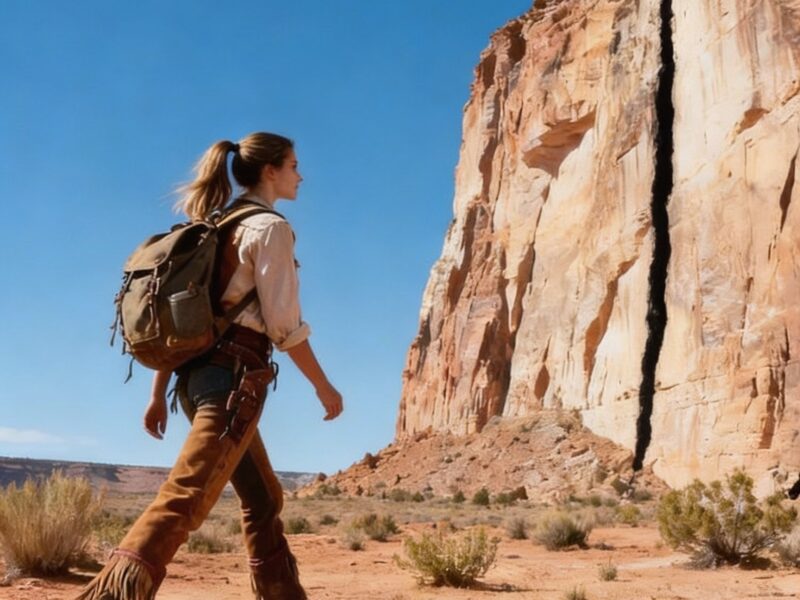
Widow Crawled Into a Crack No Wider Than Her Shoulders — 40 Feet In, She Built a Secret Shelter
Part 1
They threw Clara Voss out of Redemption Gulch at four o’clock in the afternoon, when the sun was still high enough to make the street shimmer and mean enough to turn every staring face into a blade.
Her mother-in-law stood on the shaded porch of the Voss Dry Goods Store in a black dress that had not gathered one speck of dust. Miriam Voss had dressed in mourning so perfectly people forgot she had never liked her son while he lived. Beside her, Jedediah Voss gripped the porch rail with both hands, his knuckles white, his mouth pressed into a line so hard it looked carved.
“You took him,” Miriam said.
The words crossed the street and struck Clara in front of everyone.
A mule brayed somewhere near the livery. A child stopped rolling a hoop. The men outside Finch’s saloon went still with their mugs halfway to their mouths.
Clara stood in the dust with Thomas’s canteen slung across her shoulder and a cloth bundle in her hand. She had packed in less than ten minutes because the Vosses had given her less than fifteen. One spare chemise. A tin cup. Flint and steel. A shawl. Thomas’s little field knife. A piece of hard bread Mrs. Gable had pressed into her hand through the back window without a word.
That was all that remained of her married life.
Miriam lifted one trembling finger, though Clara knew the tremble was fury, not grief. “You brought bad luck into this family from the first day. My son was strong before he married you.”
Thomas had been kind before he married her. That was what Miriam could never forgive.
Clara looked at Jedediah, waiting for one word from him. Not comfort. Not affection. She had given up on that long before the coffin. But maybe fairness. Maybe some plain acknowledgment that Thomas had died because the spring flood came fast through Harker Canyon and took his horse out from under him. Maybe one sentence admitting Clara had been on that same horse, that Thomas had pushed her up onto a ledge before the water tore him away.
Jedediah did not meet her eyes.
The silence finished what Miriam had begun.
“You have until sundown to be outside town limits,” Miriam said. “If you come back begging, you’ll be turned away. Thomas is dead. You are no longer ours.”
Clara almost laughed then.
No longer ours.
As if she had ever been.
Behind her, Finch leaned against a post outside the saloon, broad-bellied and red-faced, his smile wet with enjoyment. “Best listen, Clara. Widow with no family and no property ought not make enemies of respectable folks.”
The word respectable stirred a few chuckles.
Clara shifted her bundle to her other hand. Her wedding ring was gone already, taken by Miriam that morning in the name of family property. Her bed had been stripped. Her trunk emptied. Even Thomas’s letters had vanished from the little room above the store, though Clara had searched for them until Miriam slapped her hard enough to split her lip.
Now the cut pulsed with every heartbeat.
Clara turned without answering.
The street parted.
No one touched her. No one blessed her. No one said her name except Mrs. Gable, the quiet widow who kept census records and delivered babies when the midwife was drunk. She stood beside the well, one hand pressed against her own throat, eyes filled with a sorrow that was almost worse than contempt.
Clara kept walking.
The town ended without ceremony. One moment there were buildings, boardwalks, wagon ruts, and the sour smells of beer, horses, and sun-hot dust. The next, the trail began climbing toward the Crimson Mountains, and Redemption Gulch became a cluster of roofs behind her, small enough to fit inside a fist.
The heat was brutal.
It pressed against Clara’s bonnet and soaked through the back of her dress. The trail rose in switchbacks through red stone and thorn scrub. Lizards darted from rock to rock. Buzzards rode the sky above the canyon as if they knew exile when they saw it.
Clara walked until grief stopped being a feeling and became a labor.
Step.
Breathe.
Do not turn back.
Step.
Breathe.
Do not fall.
Her mouth dried. Her shoulders burned. The canteen was half full, and she forced herself to sip only when the world tilted. Thomas had taught her that. “Water ain’t comfort out here,” he had said once, smiling as he took the canteen from her eager hands. “It’s time. Every swallow buys you more of it.”
Thomas.
His name opened under her ribs.
She stopped on the trail and bent forward, one hand braced on her knee. For a moment, the mountains blurred. The last memory came back with savage clarity: brown water roaring through Harker Canyon, the horse screaming, Thomas’s arm around her waist, then his hands under her, lifting, shoving, saving.
“Climb,” he had shouted. “Clara, climb!”
“I won’t leave you!”
“You climb and you live!”
Then the water took him.
She had lived.
Everyone in Redemption Gulch seemed to think that was the sin.
Near sunset, when the rocks had turned the color of fresh blood, Clara saw the crack.
It was not a cave. Not an inviting hollow or a shady overhang. It was a vertical wound in the mountain face, black and narrow, partly hidden behind a spill of scree and thorn. Most people would have passed without noticing it. Clara nearly did.
Then a breath of cool air touched her cheek.
She stopped.
The trail curved downward toward an old prospector’s road, but the fissure opened above it, no wider than her shoulders. Darkness filled it completely. Not shadow. Not shade. Darkness with depth. It looked impossible that a person could fit inside, and more impossible that anything on the other side could exist.
Clara climbed toward it.
Loose stone shifted under her boots. Twice she slid and scraped her palms. At the opening, she stood panting, one hand flat against the sunbaked rock.
Cool air slipped from inside.
It smelled of stone, dust, and something deeper. Something untouched by the town, by Miriam Voss’s voice, by the eyes that had stripped Clara bare in the street.
A sensible woman would have kept walking.
But sensible women were not cast into the mountains at sundown with nowhere else to go.
Clara turned sideways and pushed herself into the crack.
The rock took her at once.
It scraped her back, pressed her chest, caught at her skirt. Panic rose fast. She could not lift her arms properly. Could not turn around. Behind her, the strip of sunset narrowed. Ahead, darkness pressed so thick it seemed solid.
Her breathing went ragged.
No.
She closed her eyes, though there was nothing to see anyway.
“Climb,” Thomas had said.
Not because the ledge looked safe. Not because she was unafraid. Because living had demanded it.
Clara shuffled forward.
One inch. Then another. The passage forced her sideways like a blade sliding into a sheath. The mountain gripped her so tightly her shoulder bones ached. Ten feet in, the outside light died. Twenty feet, the air cooled sharply. Thirty feet, the darkness became so complete she felt erased by it.
Her palm slid along the right wall.
Then suddenly found nothing.
Clara froze.
Her hand hung in empty space.
She took another cautious step. The left wall fell away too. She stumbled forward and nearly dropped to her knees as the stone released her into a larger hollow.
For a long moment, she stood in blindness.
Her heart hammered loud enough to fill the cavern.
Then she fumbled for Thomas’s flint and steel. Her fingers shook so badly the first strike failed. The second too. On the third, a spark caught the bit of dried cattail fluff she kept wrapped in cloth. Flame bloomed small and gold.
The cavern appeared around her.
Twenty feet across, maybe more. Ceiling high enough to stand. Floor uneven but mostly dry. Walls of red-brown stone curving inward like cupped hands. At the back, a thin sound reached her.
Drip.
Drip.
Drip.
Water.
Clara stared.
The flame trembled in her hand.
Not a grave, then.
A room.
A secret.
A beginning.
She sank to the stone floor and finally cried.
Not loudly. Not prettily. She cried like a woman trying not to spend water. Tears slipped down her face, salt stinging the cut on her lip, and she pressed Thomas’s canteen against her chest until the metal warmed under her hands.
Outside, Redemption Gulch had cast her out.
Inside the mountain, something had let her in.
She slept badly that first night, curled near the entrance with her shawl wrapped tight, the darkness around her so deep it felt alive. She woke to every faint sound: grit falling, water dripping, some distant shifting in the rock. Fear came in waves. What if a snake lived deeper in? What if the mountain closed its jaws? What if no one ever found her body?
Then she remembered that no one would be looking.
At dawn, she crawled out of the fissure and stood on the ledge, blinking in the hard light. Below, the wash leading toward Redemption Gulch lay pale and empty. The town sat in the distance, smoke rising from chimneys, ordinary as if cruelty were just another morning chore.
Clara looked down at her palms.
Raw. Scraped. Still hers.
She began to work.
The cavern became a task, and task became mercy.
She cleared loose stones from the floor by hand, carrying them out through the narrow passage in apronfuls and scattering them among the scree so no pile betrayed her entrance. She learned to move through the crack without panic: turn left shoulder forward, breathe out at the tight place, keep chin tucked, do not think of coffins.
By the third day, she found the water source at the back of the cavern: a steady drip from a seam in the ceiling, falling into a shallow natural basin. The water was cold and clear. She cleaned the basin with a scrap of cloth and filled Thomas’s canteen, whispering a thank-you she was not sure was meant for God, the mountain, or her dead husband.
By the end of the first week, hunger drove her back toward town.
She went at sunrise, dust in her hair, stone scratches on her cheeks, her dress hem torn and stiff with red dirt. Redemption Gulch watched her enter as if the mountains had spit up a ghost.
Miriam saw her first from the mercantile porch.
“You were told to stay gone.”
“I’m not here for you,” Clara said.
The words surprised them both.
Jedediah came to the doorway behind his wife, his beard untrimmed, his eyes sunk deep from grief and sleeplessness. Clara held out a bundle of split kindling she had gathered from deadfall above the wash.
“I’ll trade work for flour,” she said.
Miriam gave a sharp laugh. “You have nothing worth trading.”
Jedediah looked at the wood. Then at Clara’s hands.
Something moved in his face. Not tenderness. Nothing so generous. But shame, maybe, crawling slow.
“Leave it on the dock,” he said. “There’s a sack of beans by the back door.”
Miriam turned on him. “Jedediah.”
“She worked,” he said.
“She cursed this family.”
His voice rose for the first time Clara had ever heard. “She worked.”
The street went silent.
Clara did not thank him. Gratitude would have made it charity. She left the wood and took the beans.
From the saloon porch, Finch called, “Where you sleeping these days, Clara? Heard coyotes crying up in the rocks. They keeping you company?”
Laughter rolled.
Clara kept walking.
“Maybe she found herself a den,” someone said.
“A crack wife for the mountain,” another added.
Then Finch, delighted with himself, lifted his cup. “There goes the Fissure Witch.”
The name stuck by noon.
By nightfall, it had reached the mine road and the livery and the church steps. Clara heard it three times before she left town. Each time, she felt it strike. Each time, she kept walking.
But that evening, as she squeezed through the narrow entrance into the cavern and felt the mountain cool around her, the name changed shape in her mind.
Witch.
Let them think so.
Let them fear the dark they had forced her into.
Days became weeks.
The shelter grew.
Clara built a raised sleeping platform against the back wall, stacking flat stones with a patience that became almost prayer. She gathered desert grasses and yucca fibers, weaving them into a mattress that smelled of sun and dry earth. She carved niches into the softer rock with Thomas’s field knife, shallow shelves for beans, flour, herbs, jerky, and the tin cup.
Fire was harder.
Smoke would betray her. Smoke would invite men with questions, boys with dares, perhaps Miriam with a Bible and a curse on her tongue.
So Clara studied the ceiling.
For days, she watched how air moved when she lit tiny bits of dried grass near cracks in the stone. She followed the pull of smoke, the faint draft, the hidden upward breath of the mountain. At last she found a network of small fissures above the rear wall. With a branch hardened in coals stolen from town ash barrels, she scraped and widened the passage inch by inch. It took more than a month. Her arms ached every night. Grit fell into her hair and eyes. Twice the branch snapped. Once she nearly gave up.
Then one cold dawn, she built a tiny fire beneath the flue.
Smoke rose.
Not into the cavern.
Up.
She scrambled outside, climbed the ridge on bleeding hands, and found the vent half hidden in a patch of scrub oak twenty yards above the fissure. A pale wisp of smoke leaked upward, thin enough to vanish in morning haze.
Clara laughed.
The sound startled a raven off a nearby rock.
It was the first time she had laughed since Thomas died.
The next week, while hauling clay from a dry creek bed to line the fire pit, she met Caleb Rourke.
Or rather, Caleb found her with her skirt torn, her face streaked with mud, and a knife in her hand.
He appeared on the ridge above her without warning, a broad dark shape against the white sky. His horse stood behind him, reins loose, calm as stone. The man himself looked made from the rougher parts of the country: tall, hard-shouldered, sun-browned, with black hair tied at the nape and a scar cutting through one eyebrow. A rifle rested in his hand, pointed toward the ground but ready.
Clara tightened her grip on the knife.
He looked at the clay sack, the knife, her scratched arms, and the narrow trail behind her.
“You the widow from town?”
His voice was low, roughened by disuse.
Clara lifted her chin. “You the man who asks questions of women alone?”
Something flickered in his eyes. Not amusement exactly. Interest.
“Caleb Rourke,” he said. “I run the mule line over Black Mesa. Cabin’s east of here.”
She had heard the name.
Everyone had.
Former army scout. Freighter. Tracker. Half-wild, said Finch. Dangerous, said men who disliked being looked at too directly. A man who had killed three raiders during the bad winter and carried a wounded child twelve miles through snow. A man who came to town only when necessary and never stayed long enough to belong to anyone.
“What do you want?” Clara asked.
“Wondered who’s been moving stone up here.”
Her stomach dropped.
His gaze shifted past her toward the mountain face.
She stepped into his line of sight. “No one.”
Caleb looked at her standing there with a poor knife and a body too thin from hunger, trying to block a mountain.
For some reason, the quiet in his face hurt more than mockery.
“You got shelter?” he asked.
“Yes.”
“Food?”
“Some.”
“Anyone troubling you?”
“Everyone.”
His jaw tightened slightly.
Clara did not know why she said it. The truth came out before she could dress it properly. Maybe because he had asked without pity. Maybe because he looked like a man who understood trouble as a thing to be measured, not gossiped about.
Caleb’s eyes moved to the cut still healing near her lip.
“Who did that?”
“No one who matters.”
“That answer usually means someone who does.”
She raised the knife a little. “I don’t need rescue, Mr. Rourke.”
“No,” he said, looking at the clay in her sack. “I can see that.”
The words unsettled her.
He reached into his saddlebag and took out a small paper packet. He tossed it down. It landed near her boot.
Clara did not move.
“Salt,” he said. “You look like you’re living on beans and stubbornness. Both need salt.”
“I didn’t ask.”
“I know.”
“I don’t take charity.”
“Then trade me.”
“With what?”
He nodded toward the clay. “You know where the red clay bed is. Mine washed out last rains. I need some for a chimney patch. Show me, and the salt’s a trade.”
She studied him.
His face gave little away. He was not handsome in any polished sense. Too severe. Too weather-cut. But there was steadiness in him, the kind the desert did not give easily and men could not fake for long.
“If you follow me to my shelter,” she said, “I’ll cut you.”
“I believe you.”
That was the strangest part.
He said it like he respected the warning.
Clara picked up the salt. “The clay bed is west of the split mesquite. Half mile down. Dig beneath the cracked white crust.”
He nodded. “Fair trade.”
Then he mounted and rode away without looking back.
Clara stood watching until the ridge emptied.
Only then did she realize her hands were shaking.
After that, Caleb appeared every few days.
Never too close. Never at the fissure. Sometimes she saw him on distant ridges, horse still beneath him, rifle across his saddle as he watched the canyon like a man reading weather. Sometimes she found things near the clay bed after she went for supplies: a sack of coffee, a coil of cord, dried apples wrapped in cloth, a small iron hook. Each time, there was something missing in exchange—some clay taken, or a bundle of scrub oak gone, or a flat stone she had not needed.
Trade.
Always trade.
It infuriated her.
It kept her alive.
The first time she confronted him, he was repairing a washout near the upper trail. She climbed toward him with the coffee sack in hand and anger bright enough to warm her through.
“I know what you’re doing.”
Caleb drove a post into the dirt with a stone mallet. “Fixing a trail.”
“You’re leaving things.”
“You’re finding them.”
“You think I don’t see the difference between trade and pity?”
He set the mallet down. “I think you see too much.”
The words stopped her.
He looked at her then, really looked. The morning sun caught the scar through his brow. “I know what town did. I know Voss turned you out. I know Finch runs his mouth. I know folks turn cruel when grief needs somewhere to go.”
Clara’s throat tightened. “And what do you know of grief?”
His face closed.
For one breath, she regretted asking.
Then he said, “Enough to leave it unnamed most days.”
Wind moved between them.
Clara looked away first.
“I had a wife,” Caleb said.
She went still.
“Fever took her at Fort Laramie eight years back. Our girl followed two days later.”
Clara closed her eyes.
“I came west after that because mountains don’t ask a man to explain why he can’t stand a table set for three.”
The confession settled softly, heavily.
“I’m sorry,” Clara whispered.
“I know.”
She looked at him.
He picked up the mallet again, but did not strike. “I’m not trying to own your survival, Clara.”
It was the first time he had said her name.
It moved through her like water finding a hidden crack.
“I’m trying to stand far enough away that you keep it, and close enough that if someone comes to take it, he meets me first.”
That should have angered her.
Instead, it made her want to weep.
She did not.
She placed the coffee sack on the ground between them. “I need hinges.”
His mouth twitched.
“For what?”
“A door.”
“To a shelter you insist I not know about?”
“To a shelter you don’t need to know about.”
He nodded solemnly. “Naturally.”
“I can trade clay. And I found a patch of wild onions near the dry fork.”
“I hate onions.”
“Then suffer.”
This time, he did smile.
It changed his whole face and frightened her more than the rifle ever had.
Part 2
By winter, Clara’s shelter had become a hidden home, and Caleb Rourke had become the only person alive who knew how much of her heart still slept among stones.
He had never entered the fissure.
Not once.
The first time he came upon the entrance by accident—or claimed it was accident—he stopped ten paces away and turned his back immediately.
Clara, emerging with a bundle of dried grass in her arms, froze in the narrow mouth of the crack.
Caleb stood facing the valley, hands loose at his sides.
“I won’t look,” he said.
“You already found it.”
“I found where you come out. That ain’t the same as being invited in.”
She stared at his back.
The wind lifted the edge of his coat. His rifle hung from his saddle, too far for immediate use, which she understood as a deliberate courtesy. He had made himself vulnerable so she would not feel cornered.
Something in her chest hurt.
“Why?” she asked.
“Because every person needs a place nobody can enter without permission.”
He mounted and rode off before she could answer.
That night, Clara lay on her woven mattress above the stone floor, listening to the drip of water and the low sigh of wind passing through the hidden flue. She thought of Thomas, whose memory had become less a knife and more a lamp. She thought of Caleb’s broad back turned deliberately away from the entrance to her secret world.
She had loved Thomas gently.
That love had been morning light, warm bread, shared chores, a hand on her shoulder while she read aloud from last year’s almanac. He had been good in a world that punished goodness first.
What she felt near Caleb was not gentle.
It was not even welcome.
It was a raw, wary pull, born of silence and survival, sharpened by the knowledge that he saw too much and asked too little. She caught herself listening for his horse. She saved the better piece of flatbread when she cooked. She repaired a tear in his glove and pretended she had mended it only because poorly kept leather offended her.
The first time he touched her, blood was involved.
Finch’s younger brother, Silas, and two miners followed Clara from town after she traded firewood for flour. She noticed them by the old wash, their laughter too loud, boots scraping stone behind her. She quickened her pace. They did too.
“Witch walks fast,” Silas called. “Afraid we’ll ask where you keep your broom?”
Clara gripped her bundle and kept going.
Another voice said, “Finch says she’s got gold up there. Widow hiding a claim, maybe.”
Her blood chilled.
Gold.
Men killed for less than rumors of gold. They would tear the mountain apart if they believed she had something hidden.
She reached the first incline and turned. “Leave me alone.”
Silas grinned. He had Finch’s wet mouth but none of his bulk, all wiry malice and bad teeth. “We just want to see your hole.”
The miners laughed.
Clara took Thomas’s knife from her pocket. “Come closer and you’ll see your blood first.”
That gave them pause.
Not enough.
Silas lunged.
A rifle shot cracked overhead.
All three men dropped as if the sky had slapped them.
Caleb appeared on the ridge above, smoke curling from his rifle barrel. He sat his horse like judgment, dark coat moving in the wind, face unreadable.
“Next shot takes a knee,” he said.
Silas scrambled upright. “We was only joking.”
“No,” Caleb said. “You were hunting.”
The word stripped all laughter from the wash.
One miner backed away. “We don’t want trouble, Rourke.”
“You found it.”
The men ran.
Silas went last, hatred twisting his face. “She worth dying for?”
Caleb’s rifle lowered an inch.
Silas ran harder.
Clara stood shaking so badly the knife nearly fell from her hand.
Caleb rode down slowly, dismounted, and stopped several feet away. He did not reach for her.
“Are you hurt?”
“No.”
His eyes dropped to her wrist.
She looked down and saw blood where Silas’s nails had torn skin.
“It’s nothing.”
“It’s blood.”
“Those can be the same thing.”
“They usually aren’t.”
He took a clean cloth from his pocket and held it out.
She stared at it, then at him. “If you say I should let you look at it, I’ll throw a rock at your head.”
“I was going to say you should press hard.”
“Oh.”
The faintest softness crossed his eyes.
Clara took the cloth and wrapped her wrist. Her hands shook. She hated that he saw.
Caleb noticed and looked away toward the valley. “I’ll ride behind you until the upper trail.”
“I said I don’t need rescue.”
“I know.”
“Then stop rescuing me.”
His jaw tightened. “When men corner a woman in a wash, the language changes.”
She had no answer to that.
He rode behind her, far enough to give dignity, close enough to be a warning.
After that, town gossip shifted.
No longer just witch.
Now she was Rourke’s witch.
Clara heard it outside the mercantile when she came for lamp oil. Miriam Voss stood near the counter, dressed in stiff black as always, while Finch and two women from church spoke loudly enough to be overheard.
“Mountain man’s got strange tastes,” Finch said.
One woman giggled. “Maybe she cast a spell.”
Miriam turned. Her eyes moved over Clara with poisonous satisfaction. “Some women bury one husband and go looking for another before the grave settles.”
Clara’s face went cold.
Jedediah, standing behind the counter, flinched.
“Thomas’s grave settled months ago,” Clara said quietly. “Unlike your conscience.”
The store froze.
Miriam’s mouth opened.
Clara placed coins on the counter. “Lamp oil.”
Jedediah reached for the bottle, but Miriam slapped his hand away. “No.”
He looked at his wife.
“No more trade,” Miriam said. “Not with her. Let her mountain savage feed her if he’s so eager.”
Clara felt every eye on her.
Humiliation rose hot, familiar. But beneath it came something else. Anger. Deep, clean anger, untouched by shame.
She leaned across the counter. “Your son died saving my life.”
Miriam went white.
“You have turned that into a curse because it is easier than admitting he was brave in ways you never understood.”
Jedediah bowed his head.
Miriam whispered, “Get out.”
Clara picked up her coins. “Gladly.”
Outside, she nearly walked into Caleb.
He stood beside the porch post, hat low, face harder than she had ever seen it.
“You heard,” she said.
“Yes.”
She waited for him to offer comfort. He did not. Instead he looked through the store window at Finch, who suddenly discovered the far wall.
“You want me to say nothing,” Caleb said.
“I want you not to murder anyone.”
“That’s more specific.”
Despite everything, a laugh broke out of her.
It came too close to tears. She turned away sharply.
Caleb stepped down from the porch and walked beside her toward the edge of town.
At the well, one of the church women muttered, “Shameful.”
Caleb stopped.
Clara closed her eyes. “Caleb.”
He turned toward the woman. “You know what’s shameful, Mrs. Pryce?”
The woman shrank.
“Turning out a widow. Mocking hunger. Calling cruelty righteousness because you say it in a dress fit for church.” His voice did not rise. It did not need to. The whole street heard. “Anyone in this town speaks filthy about Clara Voss again, they say it where I can hear.”
Finch, unable to leave well enough alone, called from the saloon, “You threatening women now, Rourke?”
Caleb turned.
“No,” he said. “I’m informing men.”
The street emptied quickly after that.
Clara stood rigid, furious and shaken. “You shouldn’t have done that.”
“No?”
“I had it in hand.”
“You did.”
“Then why?”
He looked at her, and the force in his gaze made her breath catch. “Because having it in hand doesn’t mean you should always have to hold it alone.”
She walked away before her face betrayed her.
He followed at a distance.
That evening, snow fell in the high peaks, though the valley remained dry and rust-red. Clara climbed to her shelter with sacks of mesquite beans, clay, and a grief she could not name. Caleb waited below the ridge beside his horse.
“You can leave,” she called down.
“I can.”
“You aren’t.”
“No.”
The absurd stubbornness of it finally broke something.
“Do you intend to stand guard all night?”
“If needed.”
“Against what? Finch’s mouth?”
“Mouths send hands eventually.”
She wanted to argue.
She could not, because he was right.
Clara descended halfway to the ledge. “I have coffee.”
His head lifted.
“I am not inviting you in,” she said quickly.
“I didn’t assume.”
“I can make it outside.”
“Cold night.”
“I know that.”
He said nothing.
She exhaled hard. “You are very difficult to be generous toward.”
“Been told worse.”
She built a small fire on the ledge below the fissure where smoke would mingle with dusk. Caleb sat across from her, leaving space. They drank coffee from one tin cup, passing it back and forth. The intimacy of that seemed to grow with every exchange.
Clara watched his hands.
They were scarred. Capable. Beautiful in the way tools could be beautiful when shaped by use.
“What was her name?” she asked.
He did not pretend not to understand.
“Annie.”
“And your daughter?”
“Rose.”
Clara looked into the fire. “I’m sorry.”
“I know.” He turned the cup between his hands. “Annie hated the mountains. Said they looked like sleeping beasts. She wanted trees that made shade and water that didn’t try to kill you.”
“Why did you come back here?”
“Because after they died, I hated everything she loved.”
Clara absorbed that.
It was the most honest thing anyone had said to her in months.
“I hated Thomas for saving me,” she whispered.
Caleb went still.
The confession came like blood from a reopened wound.
“I know it’s wicked. I know he did what love does. But some mornings I wake up and hate him because he put me on that ledge and left me to face all the days after.”
Caleb’s voice was low. “That ain’t wicked.”
“It feels wicked.”
“It’s grief.”
“I loved him.”
“I know.”
She looked at him then, scared of what came next.
His face held no jealousy. No impatience. Only recognition.
“You can love the dead,” he said, “and still be alive.”
Tears slipped down her cheeks before she could stop them.
Caleb did not move to wipe them away. He let her have even that.
“I don’t know how,” she said.
“No.”
The fire cracked.
He looked toward the darkening valley. “But you’re learning.”
Spring crept in harshly, with windstorms and sudden heat.
The town remained below, ugly and necessary. Clara still traded occasionally, though never again at the Voss store. Mrs. Gable met her in quiet places with flour, sewing needles, and news. In exchange, Clara brought herbs, cured rabbit skins, and once, a carved stone bowl that made Mrs. Gable weep because beauty had become rare after so much meanness.
Caleb came and went.
He never pressed. Never declared. Never asked to see the shelter. That restraint did more damage to Clara’s defenses than any pursuit could have.
One night, she found him wounded.
She had gone to collect yucca fibers near the mesa when she saw his horse standing riderless, reins trailing. Fear hit so fast she could not breathe. She followed the tracks into a narrow draw and found Caleb sitting against a rock, blood darkening his shirt.
“Don’t look so grim,” he said. “It’s mostly dramatic.”
Clara dropped to her knees. “What happened?”
“Two men thought my mule freight looked easier to take than pay for.”
“Where are they?”
“One ran. One’s rethinking his occupation.”
Her hands moved over his shirt, searching the wound. Knife slash across his ribs. Deep but not fatal if cleaned. Her fear turned to anger because anger was easier.
“You idiot.”
“Wasn’t my knife.”
“You let someone get that close?”
“I was distracted by his friend’s pistol.”
“Stop talking.”
“Yes, ma’am.”
She pressed cloth against the wound. He hissed between his teeth. Blood warmed her fingers.
“You need stitching.”
“I can do it.”
“Not unless your arms bend backward.”
His mouth twitched despite the pain.
She looked toward the ridge, then back at him. Dusk was coming. The town was too far. His cabin farther. The shelter was closest.
Her shelter.
Her secret.
Caleb saw the decision before she spoke.
“No,” he said.
“You’re bleeding.”
“I won’t have you give up your safe place because I failed to duck.”
“It’s mine to give.”
His eyes locked on hers.
The words hung between them, larger than shelter.
Clara swallowed. “Can you walk?”
“Yes.”
“Don’t be proud. I’ll leave you for coyotes.”
“Cruel woman.”
“Move.”
She got him to the fissure just as the last light drained from the sky.
He looked at the narrow opening, then at her.
“You sure?”
“No.”
He nodded, accepting the truth.
“I trust you,” she said.
His face changed.
Then he turned sideways and entered the mountain.
It was harder for him. His shoulders scraped both walls. Once he stopped breathing too fast, and Clara pressed a hand to his back in the dark.
“Slow,” she whispered. “Breathe out at the tight place.”
He obeyed.
When they emerged into the cavern, Clara lit the lamp.
Caleb stood in the center of her hidden world and said nothing.
His gaze moved over everything: the raised bed, the fire pit, the flue, the carved shelves, the water basin, the clay-lined hearth, the woven mats, the bundles of herbs hanging from stone hooks. Not a cave. Not a den. A home made by hand, will, grief, and intelligence.
His silence stretched so long Clara’s nerves frayed.
“Well?” she demanded.
He turned to her.
There was reverence in his face.
“You built a fortress out of being unwanted.”
The words entered too deeply.
She looked away. “Sit down before you fall.”
He sat.
She stitched him by firelight.
His skin was hot under her hands, his body tense but obedient. She cleaned the wound with boiled water and whiskey, then sewed the flesh closed while he gripped a stone so hard his knuckles whitened. He did not curse once. That annoyed her.
“You may swear,” she said.
“I am.”
“In your head?”
“Violently.”
She laughed, and the needle trembled.
His eyes found her face.
In the small firelit cavern, with the mountain holding them in secret, their laughter faded into something else.
Awareness.
Longing.
Danger.
Clara tied the last stitch. “There.”
“Thank you.”
“You’ll need to stay the night.”
He looked at the single bed.
“So will you,” he said.
“Yes.”
The fire popped.
“I can sleep on the floor,” he said.
“You’re wounded.”
“I’ve slept wounded before.”
“That doesn’t make it noble.”
“No,” he said quietly. “But neither of us trusts easy, and I won’t take advantage of pain opening a door.”
Her throat tightened.
“You never do,” she whispered.
His eyes lifted.
“You never take what isn’t offered.”
“No.”
“Why?”
He looked at her for a long moment, firelight catching the hard lines of his face.
“Because I know what it is to have life take everything without asking.”
Clara sat back on her heels.
Something in her broke open—not with grief this time, but with want. Want so fierce it frightened her. She wanted his hand on her hair. His breath against her mouth. His weight beside hers in the dark. She wanted to stop being only the woman Thomas saved and become the woman who chose something after.
She leaned forward and kissed Caleb Rourke.
He went utterly still.
For one heartbeat, she thought she had made a terrible mistake.
Then his hand came up, not grabbing, not claiming, but cupping the side of her face as if she were flame. His mouth moved against hers, restrained at first, then rougher when she made a small sound and gripped his shirt. He tasted of whiskey, smoke, and blood. She felt the tremor of him holding back.
That restraint undid her more than hunger would have.
She pulled away, breathing hard.
His hand remained near her face but did not touch.
“Clara,” he said, voice low and wrecked.
“I’m not dead,” she whispered.
Pain crossed his face, tender and severe. “No.”
“I don’t want to live like I am.”
He closed his eyes.
“But I’m scared,” she said.
His eyes opened.
“So am I.”
The honesty steadied her.
She rested her forehead against his. They did not go further that night. Not because they did not want to. Because both understood desire could become another flood if they let it sweep away what needed building.
Caleb slept on the floor beside the fire despite her protests.
Clara slept badly on the stone bed, not from fear this time, but because the cavern had changed.
It no longer held only her survival.
It held a man who knew the way in.
And had chosen to honor the way out.
Part 3
The summer storm announced itself without rain.
Clara felt it first as pressure.
By noon, the air above the Crimson Mountains had turned thick and breathless. Heat lay over the rocks in a shining sheet. Insects stopped singing. Lizards vanished. Even the buzzards abandoned their circles and rode higher into the sky, away from the canyons.
She stood on a ledge above the dry wash and looked north.
Clouds gathered there, not soft white thunderheads but purple-black towers boiling behind the peaks. The kind of sky Thomas had once pointed to with a face gone serious.
“That’s a bad sky, Clara. Means there’s a world of water up in those mountains waiting to come down.”
Her scarred palms tingled.
Below, Redemption Gulch sat in the basin of the dry wash, ordinary and doomed. Smoke from cookfires rose straight into the still air. Children chased one another outside the church. Finch’s saloon doors stood open. The rebuilt sign over the Voss store creaked faintly though no wind touched it.
Built in the wash because wagons came easier there.
Built in danger because convenience made men arrogant.
Clara turned and started down.
Caleb had ridden two days earlier to deliver freight to a mining camp east of Black Mesa. He would be watching the same sky if he was near high ground, but he was not here. The knowledge left her feeling exposed in a way that angered her. She had survived before Caleb. She would survive now.
But love, she had discovered, did not weaken a person by making survival impossible alone.
It weakened by making alone hurt worse.
She reached the edge of town before three.
People noticed her at once.
They always did.
Fissure Witch had faded some after Caleb’s public warnings and Mrs. Gable’s quiet loyalty, but it had not vanished. Names like that sank roots. Women stopped talking as Clara passed. Men watched with the wary suspicion of people who had been cruel and did not like reminders walking around unbroken.
She went first to Mrs. Gable’s house.
The widow opened the door and immediately read Clara’s face.
“What is it?”
“Bad flood sky north of the ridge. You need to get high.”
Mrs. Gable went pale. She looked past Clara toward the street. “How long?”
“I don’t know. Maybe hours. Maybe less.”
“You’ll tell the others?”
Clara looked toward the saloon.
Her stomach tightened.
“Yes.”
Mrs. Gable touched her arm. “They may not listen.”
“They still deserve warning.”
The words tasted bitter and true.
Clara crossed to the church bell and pulled the rope.
The bell cracked through the hot silence.
Once.
Twice.
By the fourth ring, doors opened. People spilled into the street, irritated, curious, alarmed. Finch came out of the saloon wiping his mouth. Miriam Voss stepped from the mercantile in black that had gone dusty at the hem. Jedediah came behind her, older now, bent by grief and the labor his pride had not prepared him for.
Clara stood beneath the bell rope.
“There’s a flood coming,” she said.
For a breath, no one spoke.
Then Finch laughed.
Not loudly at first. Almost with relief.
“Well, saints preserve us. The witch has brought prophecy.”
A few men chuckled.
Clara forced herself not to look away. “The sky north of the mountains is black. The air is wrong. Birds have left the canyon. If rain falls above Harker or Mercy Draw, the water will come through this wash.”
Finch lifted his hands theatrically. “Hear that? Birds offended her, so now we climb rocks.”
Mrs. Gable stepped beside Clara. “She may be right.”
“Of course you’d say so,” Miriam said coldly. “Widows gather around madness like flies.”
Jedediah flinched. “Miriam.”
Clara looked at him. “Thomas knew these canyons. He warned me about skies like this.”
Miriam’s eyes sharpened with hate. “Do not use my son’s name to make yourself important.”
Something in Clara went very still.
The whole town seemed to lean toward the wound.
She walked toward Miriam until only two steps separated them. “Your son died because he understood water better than the men who built this town in its path. I am speaking because he taught me. Hate me later if you live.”
Miriam recoiled as if slapped.
The church bell rope swung in the silence.
Then Jedediah stepped forward.
“I’m going to the north rise,” he said.
Miriam turned on him. “You will not shame us by listening to her.”
He looked at his wife with a weariness so deep it had become quiet. “I’ve already shamed us enough.”
The first wind came then.
Cold.
It moved down the street, lifting dust into spirals.
People looked north.
The purple sky had grown visible beyond the roofs.
Finch’s smile faltered.
Clara raised her voice. “Take children, blankets, water. Leave wagons. Leave furniture. Climb to the west slope or the church ridge. Now.”
Some moved.
Not many.
Habit is a terrible anchor.
Then Caleb rode into town at a gallop.
His horse came lathered, nostrils red, eyes rolling. Caleb swung down before the animal stopped fully, his coat streaked with mud, one sleeve torn, rifle at his back.
“Out of the wash!” he shouted.
This time, people listened.
Not because his warning was better. Because his voice was a man’s and came with a gun.
Clara felt the familiar bitterness rise.
Caleb saw it in her face even through chaos.
“I saw the upper canyon,” he said, stopping before her. “Water’s already moving.”
“How long?”
“Not long.”
His eyes searched her face, checking for fear, injury, resolve. “You warned them?”
“Tried.”
His jaw tightened. “Then we make them move.”
They did.
Caleb kicked open the saloon doors and dragged drunken miners into daylight. Clara ran house to house with Mrs. Gable, hauling children, shaking women from panic, forcing water skins into hands. Jedediah opened the Voss store and threw flour sacks onto the street.
“Leave it!” Clara shouted.
“Food for after!”
“There may be no after if you stand here sorting beans!”
He stared, then abandoned the sacks and took a little boy by the hand instead.
Miriam refused to leave.
Clara found her in the store, standing behind the counter with Thomas’s old ledger clutched to her chest.
“You have to go.”
“This is my son’s store.”
“This is wood in a wash.”
Miriam’s face twisted. “You would like that, wouldn’t you? To see everything of his swept away so only you remain.”
Clara stepped closer. Outside, people screamed orders. Thunder cracked over the mountains.
“I am tired,” Clara said, voice shaking, “of being accused of surviving on purpose.”
Miriam stared.
“I loved him. I loved your son. I did not steal his life by keeping mine. He gave it to me, and you have made me pay for accepting it every day since.”
For the first time, Miriam’s expression broke. Beneath the cruelty was grief so spoiled by bitterness it had become poison.
The building shuddered.
Not from water.
From sound.
A distant roar.
Miriam’s eyes widened.
Clara grabbed her arm. “Move.”
This time, Miriam moved.
They reached the street as the roar deepened. People were climbing the west slope now, some crying, some dragging trunks until Caleb slashed the ropes with his knife and shoved them onward. Finch stood outside his saloon shouting for his wife and children. His arrogance had vanished.
“Annie!” he bellowed. “Children!”
“They went toward the back,” someone shouted.
The first wall of water appeared at the mouth of the canyon.
It was not blue.
It was black-brown, thick with trees, boulders, brush, and pieces of mountain. Ten feet high, maybe more, moving faster than a horse could run.
For one frozen second, Redemption Gulch saw its own death.
Then chaos split open.
Clara shoved Miriam toward Jedediah. “Climb!”
Caleb grabbed Clara’s wrist. “Come on.”
But Finch’s wife screamed from the far side of the saloon.
The back steps had collapsed. She stood on the rear landing with two children, trapped between the building and the first rush of water cutting across the alley.
Clara saw the old side ladder leaning against the livery.
So did Caleb.
“No,” he said.
“She has children.”
“Clara—”
“I know the cut behind the saloon. Thomas showed me.”
His eyes blazed. “The water’s too close.”
“Then be fast.”
She ran.
Caleb cursed and followed.
They reached the livery as the flood hit the first outer sheds. Wood exploded. A wagon lifted like a toy and slammed into the blacksmith wall. Horses screamed from the stable. Clara seized the ladder, but it was too heavy.
Caleb took it from her with a grunt, swung it onto his shoulder, and drove forward through flying dust and spray. Clara ran ahead, skirts gathered, heart pounding.
Finch’s wife clutched the children, sobbing.
“Jump!” Clara shouted.
“I can’t!”
Caleb threw the ladder across the gap between the landing and a stack of crates against the slope. It hit, slid, caught on a broken rail.
The first water slammed against the saloon foundation.
“Go!” Caleb roared.
The older child crawled first, shrieking. Clara climbed onto the crate stack and caught her. The younger froze halfway.
The saloon shifted.
Finch appeared on the porch roof above them, pale with terror. “My boy!”
Caleb stepped onto the ladder.
It bowed under his weight.
“Caleb!” Clara screamed.
He moved anyway, low and steady, grabbed the boy by the back of his shirt, and shoved him toward Clara. The boy slid into her arms. She stumbled, nearly fell, and Finch caught his son from the roof edge.
Then the ladder cracked.
Caleb dropped.
For one horrifying instant, Clara saw him fall toward the churning water.
He caught the landing rail with one hand.
The saloon groaned.
“Caleb!”
His eyes found hers.
No fear. Only command.
“Climb!”
“I won’t leave you.”
The echo of her own past struck them both.
His face changed.
“Don’t make me ask twice,” he said.
The rail tore loose.
Clara lunged.
She caught his wrist as he dropped, her shoulder nearly wrenching from its socket. Pain shot through her arm. Finch grabbed her waist. Caleb’s weight pulled both of them forward.
Water roared below, full of broken glass and splintered beams.
Clara screamed—not in fear, but fury.
“No!”
Caleb slammed his other hand into the crate edge. Finch hauled. Clara pulled until something in her arm burned white-hot.
They dragged him up as the saloon tore free from its foundation.
The building lurched, twisted, and collapsed into the flood.
They climbed.
There was no dignity in it. No heroism shaped for stories. They clawed up mud and shale on hands and knees, dragging children, shoving bodies, coughing on spray. The flood swallowed the street below. The mercantile ripped open. The church bell rang once as the tower broke, a wild, mournful note, then vanished into the roar.
High on the slope, survivors huddled under screaming sky.
But the west slope was not high enough.
Clara knew it as soon as she saw the second surge coming through Mercy Draw.
The water would spread wide. It would take the lower ledges. It would trap them against slick rock with no shelter from rain, wind, or falling debris.
Her fissure was higher.
Safe.
But hidden.
Her sanctuary. Her secret. The one place the town had not contaminated with its judgment.
Caleb reached her side, breathing hard, blood running from a cut above his eye. “What now?”
She looked at him.
He understood before she spoke.
“You don’t have to,” he said.
She almost laughed. Even now, he guarded her choice.
“Yes,” she said. “I do.”
She stood on a rock and shouted, “Follow me!”
Finch, soaked and shaking, looked up at her. “Where?”
“To the mountain.”
Mrs. Pryce cried, “There’s nothing there.”
Clara’s voice cut through the rain. “There is if you trust me.”
Trust.
The word hung over people who had given her none.
For a second, no one moved.
Then Caleb stepped beside her, rifle in hand, face brutal with urgency. “You heard her. Move.”
They moved.
Clara led them along the narrow trail toward the fissure. Rain began in huge, hard drops, striking stone like thrown pebbles. Behind them, Redemption Gulch disappeared under churning brown water. Ahead, the mountain face waited.
When the first survivors saw the crack, panic broke out.
“In there?” Mrs. Pryce sobbed. “We’ll be buried.”
“It widens after forty feet,” Clara said. “Turn sideways. Keep one hand on the person ahead. Breathe out where it narrows.”
Finch stared at the opening, then at Clara. Shame moved over his face like sickness.
“You first,” Caleb told him.
Finch swallowed. He looked at his children, then nodded. “I’ll take the boy.”
One by one, they entered.
Children cried in the tight dark. Women prayed. Men cursed softly when stone scraped shoulders and fear pressed their chests. Clara stood at the entrance directing them, placing hands, calming voices, counting heads. Mrs. Gable went in with three children. Jedediah followed, dragging Miriam, whose face had gone blank with shock.
When only Caleb and Clara remained outside, he looked at her.
“The water’s climbing.”
“I know.”
“You next.”
She scanned the slope. “Finch’s wife.”
“She went in.”
“No. Mrs. Alder? The old woman from the laundry?”
Caleb turned.
A figure lay near the lower trail, half hidden by rain and brush.
Clara was already running.
The woman had fallen and struck her head. Blood streaked her gray hair. Clara tried to lift her, but the old woman was dead weight.
Caleb scooped her up.
Water surged across the lower trail below them.
“Hurry!” Clara shouted.
They stumbled upward. Rocks slid underfoot. The old woman moaned. At the fissure, Caleb shoved her gently into Clara’s arms.
“You guide her.”
“You’re coming behind.”
“Yes.”
But a crack like thunder split the slope.
A rush of mud and debris slid between Caleb and the entrance, knocking him sideways. He slammed against rock, lost his footing, and dropped to one knee. The ledge beneath him began to crumble.
Clara pushed the old woman into the fissure and lunged back out.
Caleb’s boot slid.
She grabbed his coat.
“Don’t,” he snarled. “Get inside.”
“Shut up.”
The mud pulled at him. Rain blinded her. Clara dug her heels into stone, both hands locked in his coat, screaming with effort. He tried to help, but the slope kept giving.
Then Finch emerged from the fissure, pale and shaking. Without a word, he grabbed Clara’s waist.
Jedediah came behind him.
Then Micah Boone, who must have followed Caleb from the freight road.
Together they hauled Caleb up inch by brutal inch until he collapsed at the entrance, half covered in mud.
Clara fell beside him.
For one second, their foreheads touched in rain.
“You never listen,” she gasped.
He coughed a laugh. “You noticed.”
Then the second surge hit the slope below, and the world became water.
They squeezed into the fissure just before the lower ledge vanished.
Inside, the passage magnified every sound: sobbing, scraping, prayers, the distant monstrous roar of the flood. Clara moved last, one hand on Caleb’s back, one shoulder grinding against stone. When they emerged into the cavern, the fire was already lit. Someone had found the kindling. Warm light flickered over stunned faces.
The townspeople stood inside Clara’s secret world and saw what she had built.
The raised bed. The shelves of food. The clean water basin. The smoke flue. The fire pit. The woven mats. The careful order. The proof of months of labor they had called madness.
No one spoke.
Mrs. Finch sank to her knees, clutching her children. Mrs. Pryce covered her mouth. Finch stared at the flue as if looking at scripture. Jedediah looked at the stone shelves, then at Clara’s torn hands, and something in him collapsed.
Miriam stood near the wall, eyes fixed on the fire.
Clara took inventory because action was easier than feeling.
“Children closest to the fire. Wet clothes off if you have blankets. Mrs. Gable, check Mrs. Alder’s head. Jedediah, block the passage draft with that hide. Finch, water carefully. One cup each first.”
Finch obeyed without hesitation.
That more than anything told the room the world had changed.
Caleb stood near the entrance, one hand pressed to his ribs. His eyes were on Clara, but he said nothing. This was her place. Her command. He would not take it from her, not even now.
Hours passed.
Rain hammered the mountain. The flood roared below, sometimes fading, sometimes rising again like an animal returning to feed. Inside, the cavern held. Smoke climbed the hidden flue. Children slept. The old laundry woman woke and whispered thanks. Someone cried quietly in the dark. Someone else prayed, but softer now, less certain that God preferred loud people.
Near midnight, Finch approached Clara.
He looked smaller without his saloon, without his porch, without an audience. Mud crusted his shirt. His hands shook around the tin cup.
“I called you names,” he said.
Clara sat near the fire, wrapping Caleb’s cut with a strip torn from her petticoat. She did not look up. “Yes.”
“I made others laugh.”
“Yes.”
“I thought…” He swallowed. “I thought you were hiding because you were broken.”
Clara tied the bandage.
Caleb’s eyes stayed on Finch, cold enough to freeze blood.
Finch looked around the cavern. “You were building.”
Clara finally looked at him.
His face crumpled.
“My children are alive because of you.”
The cavern quieted.
Finch lowered himself awkwardly to his knees.
“I am sorry, Clara Voss.”
The apology did not repair what he had done. It did not erase every laugh, every public humiliation, every time she had walked through town feeling their contempt stick to her skin. But it entered the room honestly, and that mattered.
Before Clara could answer, Miriam spoke.
“She should have warned us sooner.”
The cavern went still.
Jedediah closed his eyes.
Clara felt Caleb move beside her, but she touched his wrist.
No.
She stood and faced Miriam across the fire.
“I did warn you.”
“You came too late.”
“I came when I saw the signs.”
“You always have an answer.”
“No,” Clara said, voice breaking for the first time. “I have a dead husband. I have the last thing he taught me. I have hands that learned stone because your house had no room for my grief. That is all I have.”
Miriam’s mouth trembled. Hatred tried to gather there, but exhaustion weakened it.
“Thomas was mine,” she whispered.
Clara softened despite herself. “Yes.”
“You lived.”
“Yes.”
“My boy did not.”
“No.”
The truth was too plain to fight.
Miriam’s face twisted, and for one terrible moment she looked not cruel but old. Broken. Lost in the same flood, only she had turned hers on anyone close enough to drown.
“I hated you,” she said.
“I know.”
“Because he chose you at the end.”
Clara’s eyes filled.
“No,” she whispered. “He chose life. Mine was the one he could reach.”
Miriam made a sound like pain leaving bone.
Jedediah crossed to his wife and put a hand on her shoulder. She did not shrug it off. That was the only apology she could offer that night.
Later, when most slept, Clara stepped into the narrow passage for air.
The flood had begun to recede, though the roar continued below. The fissure smelled of wet stone and mud. Caleb followed her only as far as the entrance widened enough for both to stand.
Outside, rain had softened to mist. The world below was dark and moving.
Clara leaned against the rock.
“They know now,” he said.
“Yes.”
“You sorry?”
She understood what he meant. Her secret was no longer secret. Her fortress had become refuge for the very people who had made her need one.
Clara looked back into the cavern, where firelight flickered over sleeping children and humbled faces.
“No,” she said. “But I am grieving it.”
Caleb nodded.
Of course he understood.
“I wanted one place untouched by them,” she whispered.
His hand rose, then stopped. Waiting.
She leaned into it.
His palm cupped her cheek, warm and rough.
“They can know the doorway,” he said. “Doesn’t mean they own the room.”
Her eyes closed.
She turned her face into his hand and kissed his palm.
Caleb’s breath caught.
For a long moment, there was only the soft rain, the dying flood, and the mountain around them.
“I love you,” Clara said.
His hand stilled.
She opened her eyes. “I don’t say it because I’m saved. I don’t say it because I’m afraid. I say it because I know what it is to have one life end and another begin against my will. This one…” Her voice trembled. “This one I choose.”
Caleb looked as if the words hurt him.
In the darkness, the hard lines of him seemed to break and reform around something unguarded.
“I love you,” he said. “I have for longer than I had any right to. I love your sharp tongue and your stone house and the way you look at fear like it’s another chore. I love the woman Thomas saved. I love the woman who saved herself after. I love the woman who just saved a town that didn’t deserve her.”
She touched his scarred cheek. “Some did.”
“Some.”
He bent his head and kissed her.
Not like the first time in the cavern, wounded and careful and full of restraint. This kiss carried the flood outside, the terror of almost losing each other, the release of words finally spoken. Clara rose into him with a small sound, hands gripping his coat. Caleb held her firmly, one arm around her waist, the other braced against the stone above her shoulder as if protecting even this stolen dark.
When they parted, she was crying.
He wiped the tears with his thumb.
“I don’t want to hide anymore,” she said.
His eyes searched hers. “You don’t have to.”
“I don’t know how to live down there.”
“Then don’t live down there.”
At dawn, they emerged.
Redemption Gulch was gone.
The flood had scoured the basin clean. Buildings lay broken and scattered across mud flats. The saloon had vanished entirely. The Voss store had collapsed into a jagged pile half a mile downstream. The church bell sat in the mud like a drowned moon. Only a few stone chimneys remained, standing useless above the wreckage.
Survivors gathered on the ledge in silence.
Some wept. Some stared. Some sank to their knees.
Clara stood above them, Caleb beside her, and felt no triumph. She had imagined, in her angriest hours, the town humbled. She had never understood humility would look so much like children shivering and old men searching mud for what could not be recovered.
Finch came to stand below her.
His voice was hoarse. “What do we do?”
Everyone looked at Clara.
The attention should have felt like justice.
It felt like weight.
She looked at the high slopes west of the wash, where stone shelves rose safely above the flood line. Thomas’s voice moved through memory. The driest wash holds the memory of the greatest floods.
“We rebuild high,” she said.
Jedediah nodded slowly. “On the rock.”
“No homes in the basin. Storehouses raised. Drainage cuts here and here.” She pointed, seeing the land not as wilderness now but as warning and possibility. “A bell on the north ridge. Watchers during storm season. No one laughs at bad sky again.”
“No,” Finch said quietly. “No one will.”
Miriam stood apart, staring at the ruins of the store. At last she turned to Clara.
“I cannot ask forgiveness,” she said.
Clara looked at her.
“I wouldn’t know what to do with it if you gave it.” Miriam’s voice shook. “But Thomas did teach you well.”
It was not enough.
It was something.
Clara nodded once.
In the weeks that followed, Redemption Gulch became something else.
They called the new settlement High Mercy, though no one could agree who suggested it first. Some said Mrs. Gable. Some said Finch, trying to redeem himself with poetry. Caleb said towns named by committee deserved whatever confusion followed.
They built on rock.
Caleb led the heavy work, hauling timber and stone with his mule teams, his voice quiet and absolute. Men who once mocked Clara now waited for her measurements before setting posts. Women who had whispered crossed the slope with baskets of bread and lowered eyes, unsure how to speak to her. Clara did not make it easy. She did not become sweet because respect arrived late. But she became fair, and in hard country, fair was a kind of mercy stronger than softness.
The fissure shelter remained.
Not as curiosity. Not as shrine. Clara allowed no one inside without permission. Caleb built a hidden outer gate that looked like natural brush and stone, hinged with the iron she had once asked for and he had traded her for onions he hated.
“You did hate those onions,” she said while he fitted the latch.
“I survived.”
“You complained for two days.”
“I suffered with dignity.”
“You did not.”
He smiled, and the sight still had the power to undo her.
They married in autumn on the high slope above the new town.
No church stood yet, so Mrs. Gable read the vows from Thomas’s old Bible, the one Jedediah had found wedged in mud beneath a broken counter and brought to Clara with both hands. Miriam did not attend, but she sent a square of lace that had belonged to Thomas’s grandmother. Clara sewed it inside her sleeve where no one could see.
She wore no white.
She wore a plain blue dress, sturdy boots, and Thomas’s canteen strap across her shoulder because the dead were not erased by the living. Caleb stood beside her in a black coat that made him look uncomfortable and severe. When he took her hands, the whole gathering saw the scars across her palms.
No one looked away.
Mrs. Gable asked if Caleb would cherish her.
“I will,” he said.
The words were simple, but his voice made them iron.
She asked if Clara would cherish him.
Clara looked at the man who had stood far enough away to honor her survival and close enough to guard it when danger came.
“I will,” she said.
Then, quieter, for him alone, “And I’ll argue with you often.”
His mouth twitched. “I counted on that.”
When he kissed her, High Mercy cheered.
Even Finch, who had rebuilt not a saloon but a boardinghouse on the upper road and no longer tolerated cruelty in his doorway, wiped his eyes and pretended dust had done it.
That evening, after the feast, Clara and Caleb climbed alone to the fissure.
The sun dropped behind the Crimson Mountains, turning the rock face red as memory. Below, the new town glowed with cooking fires on high ground. Children ran along safe stone paths. The north ridge bell hung ready. The wash lay empty and quiet, but no one mistook quiet for innocence anymore.
Clara stood at the entrance to the crack that had once been her only refuge.
Caleb waited beside her.
“Do you want to go in?” he asked.
“Yes.”
He turned sideways to enter first, then stopped. “Still tight.”
“You fit before.”
“I was bleeding and motivated.”
She laughed.
Inside, the cavern waited cool and familiar. The fire pit. The shelves. The water basin. The raised bed. The marks of her hands everywhere.
Clara lit the lamp.
Golden light filled the stone room.
Caleb stood behind her and wrapped his arms around her waist. She leaned back against him without fear.
“I crawled in here because I had nowhere else,” she said.
“I know.”
“I thought the mountain was hiding me.”
His mouth brushed her hair. “Maybe it was keeping you.”
She looked around at the shelter: the proof of loneliness, grief, rage, wisdom, and will. Then she turned in his arms.
“No,” she said softly. “I was keeping myself.”
Caleb’s eyes warmed. “That too.”
She touched his face.
Outside, the rebuilt town settled under the stars. Inside, water dripped steadily into the basin, patient as time. Clara listened to it and felt Thomas’s memory near, not as a wound tearing open, but as a hand once loved and finally released.
She had been cast out.
She had crawled through stone.
She had built a secret shelter forty feet inside the mountain and made a home where the world said none could exist.
Then, when the flood came, she had opened it.
Not because the town deserved her.
Because she deserved not to become like them.
Caleb kissed her forehead, then her mouth, and Clara rose into the kiss with the sure knowledge that survival had not been the end of her story. It had only been the narrow passage.
Beyond it was room enough to stand.
Room enough for fire.
Room enough for love.